Developers want more info on tool that will ID risk
CONCERNED that there may be a repeat of the damage done by last October’s Hurricane Melissa — which wrecked history-rich buildings such as his company’s Fairfield Road office and his family’s Bellefield Great House — businessman Mark Kerr-Jarrett is among developers eager to hear more about the Government’s plan to share with them a tool that can help identify at-risk areas and suggest steps that can safeguard assets.
“All the people saying, ‘Oh, this [Hurricane Melissa] is a once-in-a-lifetime event’, I don’t think so. I think the way that the climate is going now, we’re going to see this fairly regularly, and we have to engineer and do the infrastructure improvements in order to minimise their catastrophic effect on the built environment,” Kerr-Jarrett told Jamaica Observer’s Real Estate on the Rock last week.
The ruins of the building his family firm — Barnett Limited — has used as an office since about 1998 is a constant reminder to everyone using that heavily trafficked section of Fairfield Road of how helpless we can be when faced with nature’s wrath.
“That whole Fairfield cottage has to be condemned and demolished because it’s structurally unsound,” Kerr-Jarrett explained. “It’s Spanish wall and the water has got down into all the walls and has completely degraded their load-bearing capacity. They have no functional use anymore.”
He estimates that the building dates back to the 1700s or 1800s. According to the businessman, there had been talk of having it declared a national heritage site, but that was never finalised.
Barnett Limited now operates out of North Bank — a development the company built last year to meet brisk demand in the commercial real estate segment of the market. But Kerr-Jarrett has all but given up on any thought of repairing Bellefield Great House. It has been in their family for generations and, before Melissa, was a tourist attraction.
According to Kerr-Jarrett, efforts are under way to get the popular restaurant that operates from one section of the property “back up and running again, because the damage to the sugar mill was really not that bad”. However, the Great House took a hit and the roof is still sporting the now-familiar tarpaulin.
“To be honest, Bellefield Great House is not a priority right now. I don’t think the insurance is going to pay for everything, and there are no incentives that we get for the building being an old building,” Kerr-Jarrett said.
“As a country, we don’t do anything to protect our history and our historical buildings. All of them that are being maintained are a labour of love by the owners, but sentiment doesn’t pay the bills,” he added.
It is unclear if there will be a plan, under the Government’s Jamaica Systemic Risk Assessment Tool (J-SRAT), that specifically speaks to the protection of historically significant buildings if they are deemed to be at risk. But as developer of the ultra-modern Barnett Tech Park, which was inundated with mud and debris when the Category 5 Melissa hammered sections of Montego Bay, Kerr-Jarrett is curious about J-SRAT.
“I’ve never heard of this tool before, and I need a lot more information before I’m willing to make an assessment of it,” he said.
Speaking during the Realtors Association of Jamaica’s recent Leaders in Real Estate Breakfast, Minister of Water, Environment, and Climate Change Matthew Samuda said the Government plans to give developers access to J-SRAT once the processes associated with the technology are finalised.
Samuda told those gathered for the event that Jamaica is the world’s only developing country that has this tool.
“It amalgamates thousands of data points related to infrastructure, related to energy, related to your water distribution systems, related to your critical social services, and ascribes climate risk to these areas and to these points of infrastructure. Now it drops into a supercomputer and AI does some calculations. It tells you: What is your risk from flooding, what is your risk from storm surge; what it is you need to do, from an adaptation standpoint, to protect your assets,” the minister said in explaining J-SRAT.
Samuda said the World Bank-funded J-SRAT was developed by the University of Oxford to assist Jamaica in its planning process.
Like Kerr-Jarrett, head of Jamaican Institute of Planners (JIP), Martin Addington is eager to hear more about J-SRAT, especially as it appears work being done by JIP, United Nations Development Programme (UNDP), and the Construction Industry Council (CIC) may be duplicating aspects of the tool being touted by the minister.
“We didn’t know about J-SRAT either but after the hurricane we had reached out to the Government, suggesting that we could assist with developing something like that. We got contact with the UNDP [in November], and they were offering assistance to the Government to do a response project to the hurricane, and it had included something similar. So what we found is that they may have some overlapping efforts and that there are other groups that are doing similar sort of assessment,” he told the Sunday Observer.
“We refined our framework and submitted to the Government in, I think, early December. We had one meeting in January, discussing it. Last week I wasn’t able to attend the [most recent] meeting. I need to find out what happened there,” Addington added.
The work he described as being proposed by the JIP/CIC/UNDP collaboration sounds very similar to what is being done under J-SRAT.
According to the Ministry of Economic Growth and Infrastructure Development’s website, J-SRAT was launched in Jamaica on May 3, 2022. Development and testing began in early 2021.
“In developing the J-SRAT there was collaboration with public and private sector stakeholders to obtain national key input data and to work towards developing models to identify points of network climate vulnerability,” said the website.
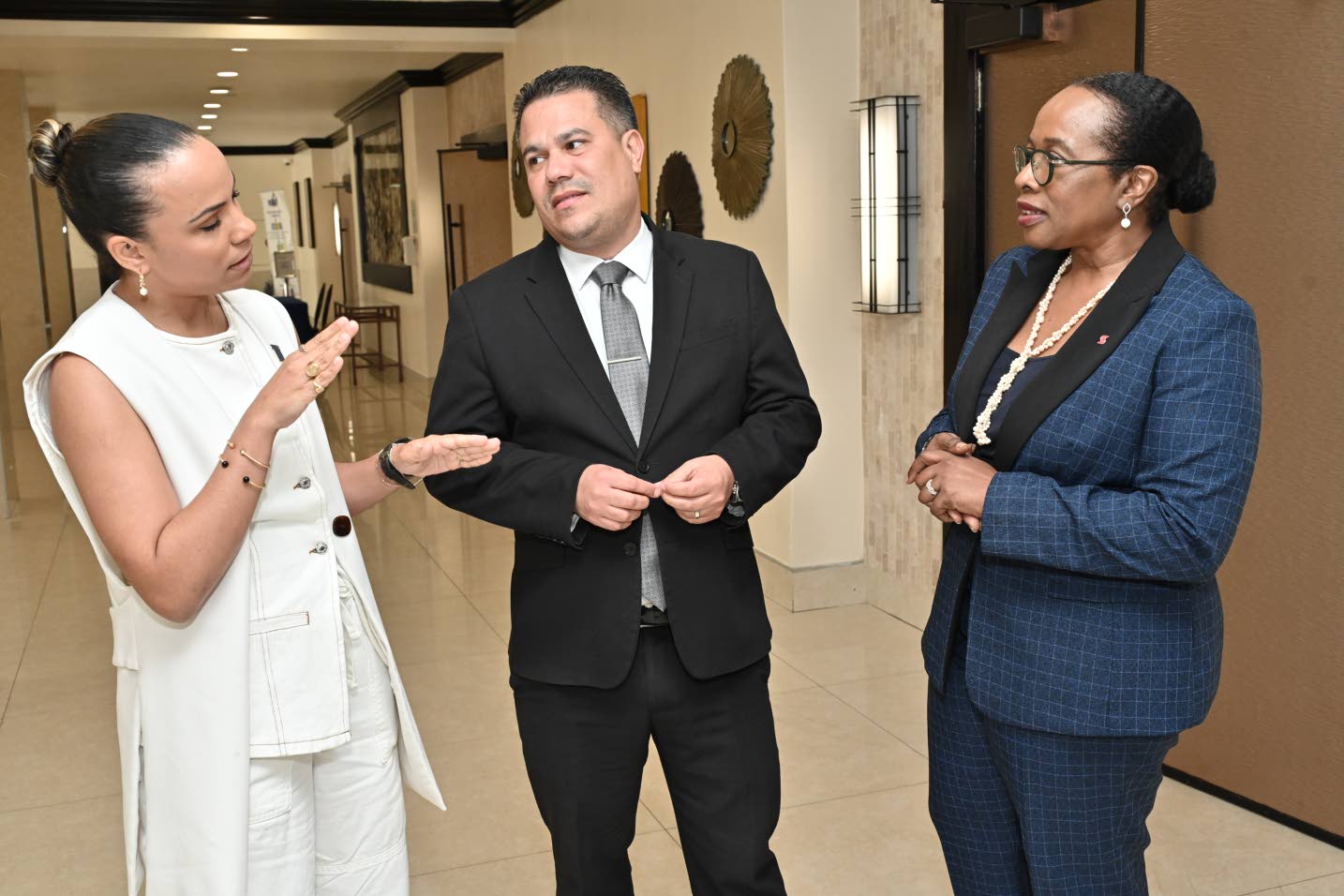
President of the Realtors Association of Jamaica (RAJ), Gabrielle Gilpin-Hudson (left) makes a point to Minister of Water, Environment, and Climate Change Matthew Samuda and Head of Retail Banking, Caribbean North and Central, Scotiabank, Yvett Anderson. The occasion was RAJ’s Leaders in Real Estate Breakfast, held at the Jamaica Pegasus hotel in New Kingston on February 26.
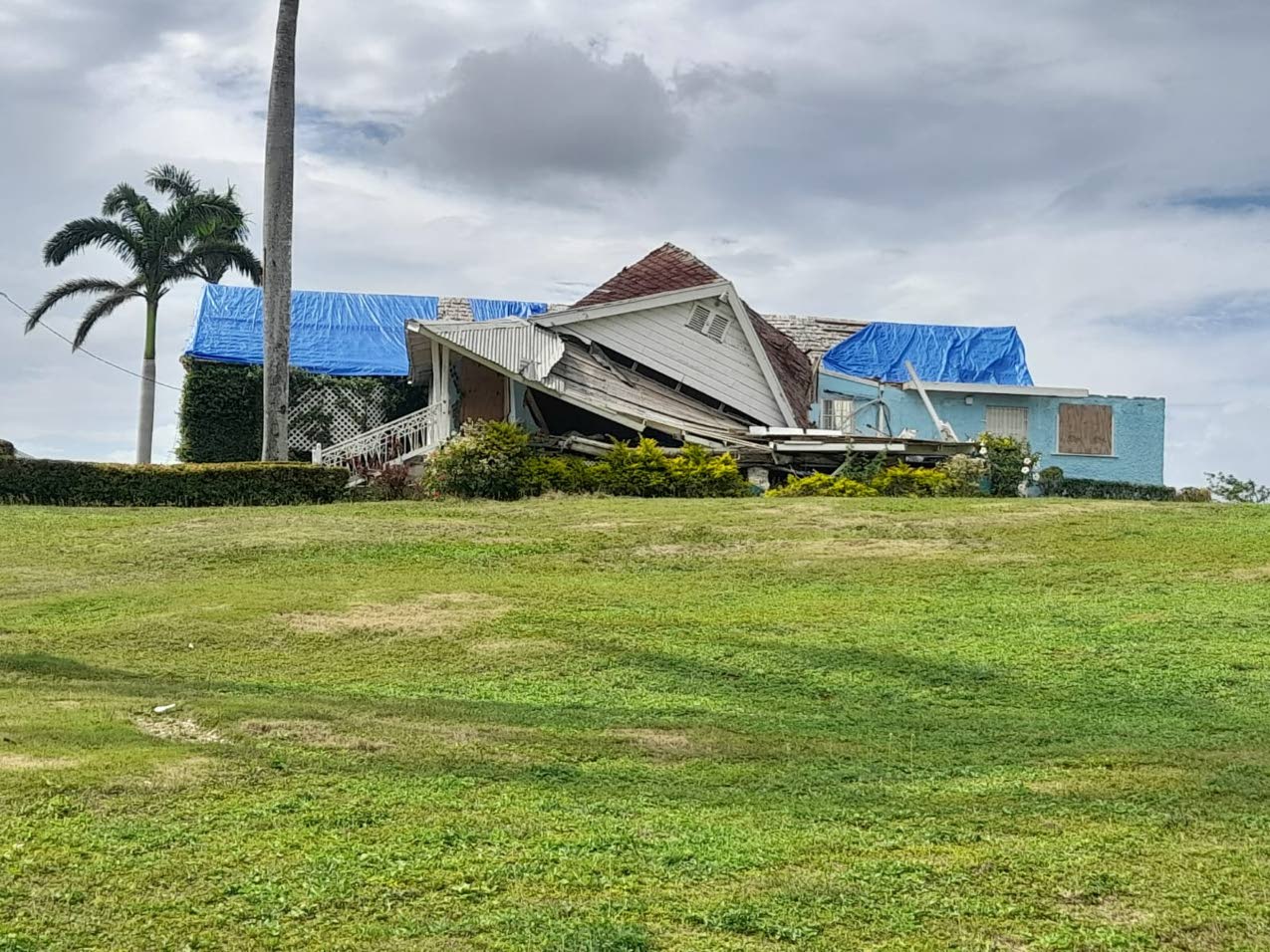
Barnett Limited’s Fairfield Road office lies in a state of disrepair post-Hurricane Melissa’s wrath. (Photo: Charmaine N Clarke)
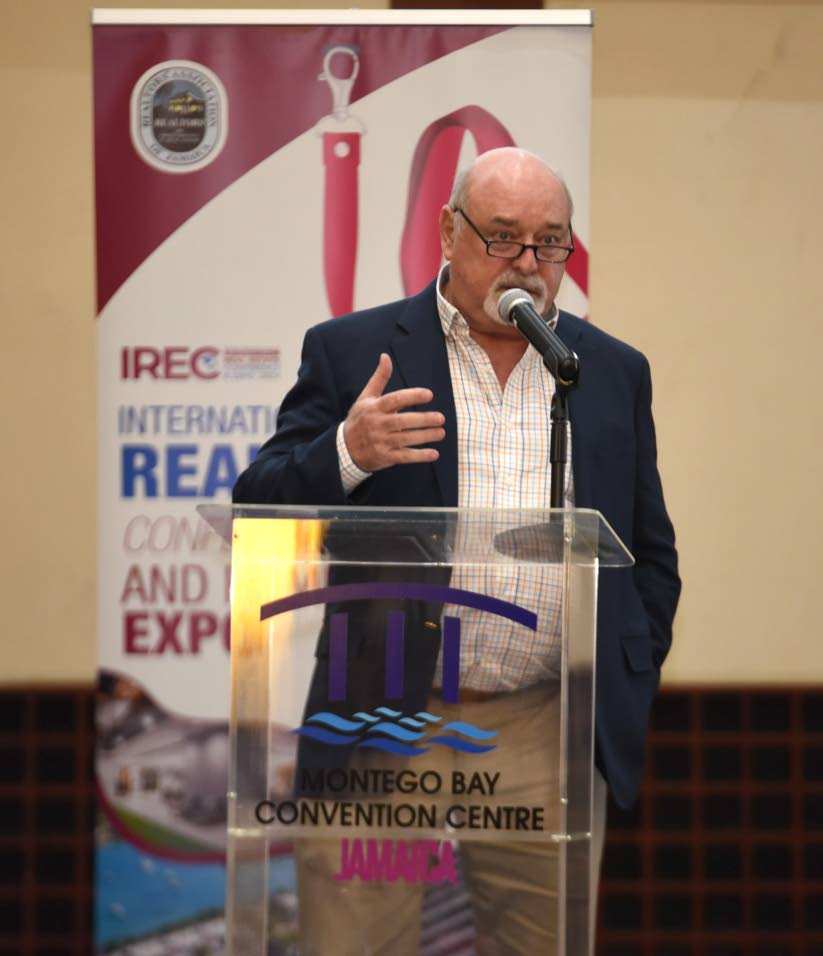
KERR-JARRETT…to be honest, Bellefield Great House is not a priority right now