



From hardship to hope
Natalie Irving-Mattocks turns personal struggle into purpose, empowering women after Hurricane Melissa
WITH International Women’s Day being observed this year under the theme ‘Give to Gain’, few stories capture its meaning more powerfully than that of Dr Natalie Irving-Mattocks.
The executive director of Caribbean Technical Assistance and Education Centre for Health (C-TECH) — a regional organisation dedicated to strengthening health systems, building workforce capacity, and improving access to quality health services across the Caribbean — has worked hard to uplift women and girls, especially during crises such as the aftermath of Hurricane Melissa.
But her passion for humanitarian work did not begin in a boardroom. It began with her own struggles.
Irving-Mattocks told the Jamaica Observer that while growing up in Jamaica’s inner city she moved 20 times before the age of 18, living with different relatives as she navigated a complicated relationship with her parents. She became pregnant at 15 and is also a survivor of sexual assault — experiences that shaped the empathy and determination that would later define her career.
Despite those challenges, she said the kindness of others helped transform her life, and she always stands ready to do the same for others.
“People were just always willing to help me, and part of it is because of my attitude and also my propensity to want better in life. I would have benefited tremendously from others and so I have this passion to give back, especially to women and girls who are in a similar situation to what I would have experienced as a child,” said the executive director.
With a bachelor’s degree in international relations and human resource development and a Master of Business Administration in Project Management, her experiences eventually led her to establish C-TECH in 2020 while completing her doctorate in public health. The regional organisation was created in partnership with the International Training and Education Center for Health (I-TECH) at the University of Washington.
When Hurricane Melissa devastated sections of Jamaica in October 2025, Irving-Mattocks shared that she was overseas, but as reports of the destruction began pouring in she made a decision to immediately return home. What she encountered on the ground left her overwhelmed.
“I remember I was at church sharing because everybody was asking, ‘What have you seen?’ I literally broke down. I was not able to verbalise what I saw because I just couldn’t stop the tears and the emotion from flowing. When you heard — especially at some of the shelters, they were so overcrowded — you have one room with 24 individuals, and these are a lot of strangers mixed up with women and girls and men, and I just started envisioning that disaster.
“That alone, in and of itself, for me was a disaster. Let alone the fact that many never had the food, the clothing — they lost everything. Some of the women, we were talking to them and they were just explaining that they’ve lost everything — no home, they have no livelihood, they’re not working,” she told the Sunday Observer.
One particular encounter with a mother and her four children, who had taken shelter in Westmoreland, continues to haunt her.
“She said to me she’s with people she doesn’t know, men she doesn’t know, everybody in one room at the shelter. For me, I just couldn’t hold back the tears. I was so emotional…and I had to find [resources] to see how we can help,” she shared.
Determined to act, Irving-Mattocks and her team moved quickly. She shared that C-TECH is on record as one of the first partners in the field after the hurricane — something even recognised by the Ministry of Health and Wellness.
In the weeks that followed, the organisation’s staff worked daily in affected communities, delivering tarpaulins; bringing ice to residents; purchasing Starlink systems for police stations, hospitals, and health centres; and providing food assistance and vouchers to struggling families.
Through partnerships with the United Nations Population Fund and the US Health Resources and Services Administration and I-TECH, the organisation mobilised wide-scale support for women and girls in disaster-affected communities.
The initiative helped maintain critical maternal and reproductive health services, supporting 703 antenatal visits for pregnant women, 278 post-natal visits, 231 neonatal check-ups, and 249 safe deliveries during the response period.
Additional support included cash vouchers for 869 pregnant and lactating women, dignity kits for 600 women, and food assistance valued at approximately US$46,000, benefiting more than 10,000 women and families. The programme also delivered mental health and psychosocial support to more than 1,500 women and girls.
For Irving-Mattocks, the work is deeply personal.
“Humanitarian work comes naturally for me. I have a passion to see women and girls succeed — I mean everybody, but also women and girls — because when we do well people do not take advantage of us, and that’s something I believe in because when I didn’t have it I wasn’t able to speak up in situations because you are so vulnerable. I put myself in a position where I can provide for myself, where I can enter certain rooms, where I can break barriers, where I can support other women and girls,” she shared.
Irving-Mattocks stated that disasters often expose the hidden vulnerabilities women and girls face, particularly in overcrowded shelters and disrupted communities, and with this knowledge, she had to act.
“There was one young girl I spoke to, and she said at the shelter the person responsible for the food was telling her that she had to give up something to get food. We captured a few cases with a little girl, too, so I don’t think we understand the devastation. And sometimes we try to say, ‘But how come we pay attention so much to women?’ It’s not because men are not affected but you see those reproductive health needs, you see the abuse — sexual, emotional, physical abuse — that we don’t want to address,” she said.
As she reflected on the theme ‘Give to Gain’, she highlighted the resilience of women in crises and emphasised the importance of women supporting women.
“Create a step for another woman. If the playing field is not equal, create some form of equity so that women can grow and continue to thrive. When we support each other as women we can only go further together. We have to get rid of that crab-in-a-barrel mentality and that competitive spirit against each other in a malicious way…we have to change that mindset that as women we cannot get along and we cannot work together for the same good. It should be about sisterhood and women supporting each other,” Irving-Mattocks stressed.
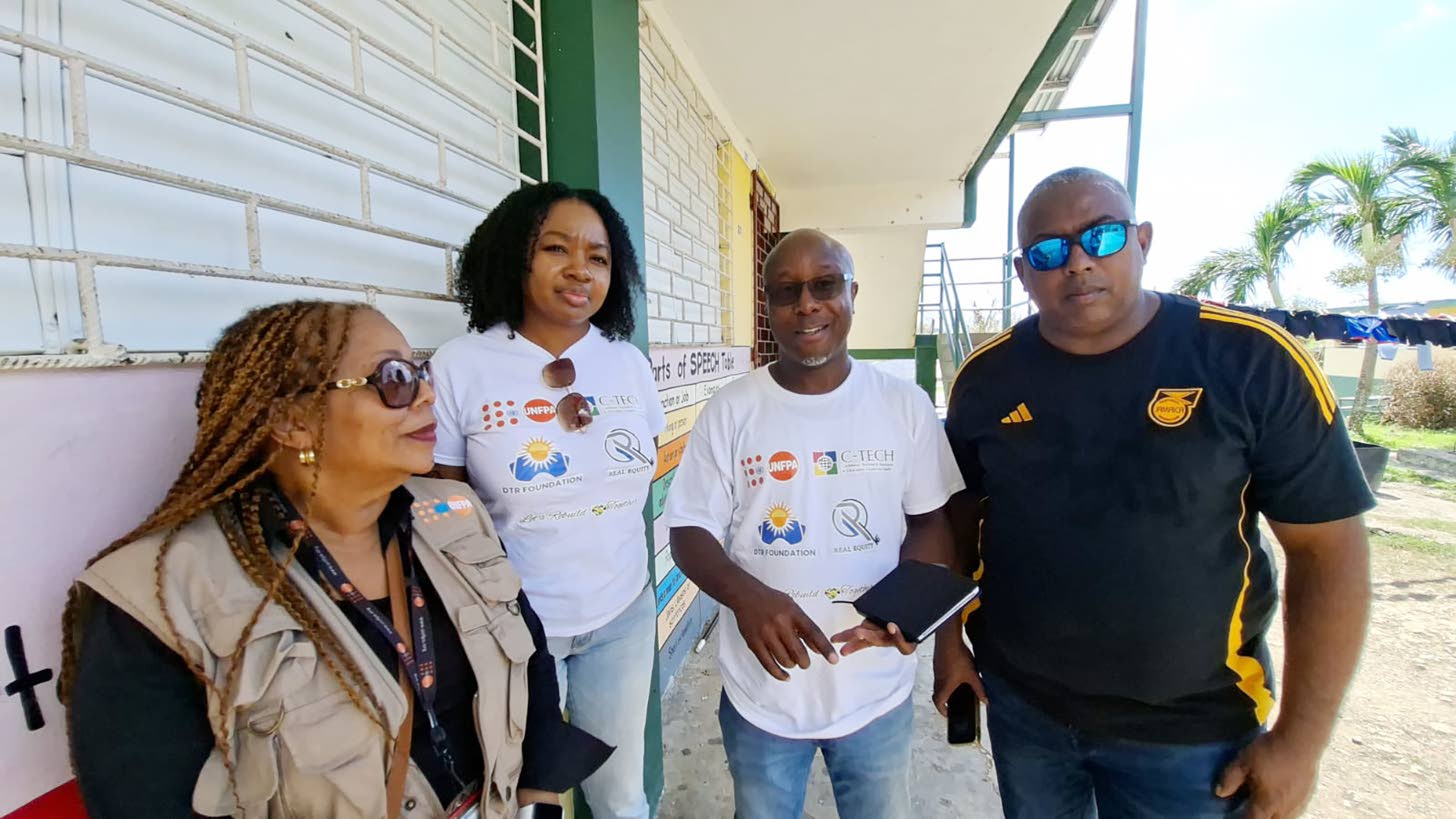
Natalie Irving-Mattocks (second left), executive director of Caribbean Technical Assistance and Education Centre for Health, shares a moment with (from left) Dr Denise Chevannes, HIV/AIDS and sexual reproductive health specialist, UNFPA; Dr Al Pilliner, DTR Foundation; and Robert Beharie of DTR Foundation, during a relief mission at Petersfield High School in Westmoreland in the aftermath of Hurricane Melissa. (Photo: Rosalee Wood Condell)


