



Exploring other options
Cuban medical personnel being offered stay option, says Tufton
HEALTH Minister Dr Christopher Tufton on Monday sought to ease public concern over the future of Cuban medical personnel in Jamaica, saying that some of them currently serving here will be offered the option of individual contracts if they wish to stay.
He also outlined long-term plans to recruit additional staff locally and internationally to prevent gaps in the public health system as the long-standing state-to-state programme comes to an end.
Speaking at a virtual press conference following the fallout over the end of the Cuban medical arrangement, Tufton said the Government’s immediate priority is to preserve continuity in critical services, particularly in areas where Cuban personnel have been central to delivery. That includes the Jamaica-Cuba Eye Care Programme at St Joseph’s Hospital which, he said, will continue for now under the current Cuban team until March 20, with surgeries already booked and post-operative care still to be carried out.
“There’s an agreement on that, and for the remainder of the programme’s operations, services will be limited to surgery and post-operative care,” Tufton said.
That, he explained, means the provision of surgical procedures for patients who are already scheduled, and follow-up care for patients who have already undergone eye surgery and retina-related post-operative treatment and monitoring.
It also includes those who are prepped for surgery, Tufton said, adding, “I think the number I got was about 130 something, 140; those procedures will continue to take place.”
Tufton said the Government does not intend to abandon the eye care service once the current arrangement expires. Rather, he said, the Administration is preparing for several possible outcomes, including the option for some Cuban workers to stay on under direct contracts or, failing that, the use of Jamaica’s own staff and outsourced support to keep the programme alive.
“It was very explicit, when we announced the discontinuation of negotiations, that those Cubans who are here would be offered individual contracts, if they so desire. It’s entirely up to them, and so it depends on what they say and what they’re willing to do. We are offering the opportunity for them to remain, we have said that many times, and depending on the interest expressed, then we will proceed,” Tufton said.
That direct-contract option formed a key part of Tufton’s reassurance but he was careful not to suggest the outcome was settled. He said discussions are still under way and declined to give figures on how many workers might be interested, noting that the offer is recent and conversations are continuing.
Beyond the immediate contingency plan, Tufton used the press conference to sketch out a wider staffing strategy aimed at reducing Jamaica’s dependence on any single overseas arrangement.
He said the ministry has already begun screening applicants from the Diaspora and other countries — after advertising specialist posts — and that nearly 140 applications had been received, with 70 specialist nurses shortlisted for interviews.
According to him, these candidates include people working in the United Kingdom, Canada, and the United States, as well as applicants from countries such as Ghana.
He said the Government expects some of those recruits to help fill gaps within the next three months, while other measures are also due to feed into the workforce this year. Among them are 48 nurses and 33 doctors tied to the Barry Wint Scholarship programme, along with 100 nurses currently enrolled in the ministry’s in-house specialist nursing programme. Those initiatives, he argued, are meant to strengthen Jamaica’s long-term capacity to train and retain its own professionals in areas where the system is thin.
Tufton also pointed to negotiations with Ghana and Nigeria, saying memoranda of understanding are being pursued to recruit specialists from those countries, while talks are continuing with The Philippines and India on training and recruitment support.
Additionally, Tufton announced that Cabinet has approved direct international recruitment through private recruiters, and the creation of an international recruitment unit within the ministry’s corporate services division to coordinate hiring from overseas.
Chief Medical Officer Dr Jacquiline Bisasor-McKenzie said the ministry is already carrying out a gap analysis across the public system to determine how existing facilities can absorb some of the pressure if Cuban workers leave.
She named Kingston Public Hospital, Mandeville Regional Hospital, Cornwall Regional Hospital, and University Hospital of the West Indies as institutions that already offer ophthalmology services and which could help shoulder some of the load. She also said outsourcing remains an option, if necessary, to avoid a break in treatment.
Tufton also insisted that the end of the Cuban arrangement should not derail major hospital projects or expansion plans. Asked whether the change would affect the reopening of Cornwall Regional Hospital or the Western Children and Adolescents Hospital in Montego Bay, he said the ministry had already been planning for growth in those facilities and would simply have to move more aggressively to fill specialist shortages.
“It won’t have an impact. The Cuban health-care workers who are here have served an important role. Their role was specific to certain services, based on where the critical shortages were or are… So the intention is to focus on those areas with the plan as outlined, whether it is the surge plan in the short term, or the recruitment plan in the medium to longer term,” said Tufton
However, he acknowledged that the transition may not be seamless and warned that some delays could still arise, particularly in the short term, but he argued that the ministry has prepared enough fallback options to avoid a collapse in care.
“I’m not saying it will be easy because there are overtime requirements and, you know, wear and tear and local stuff will be a challenge in some areas. Sometimes you may experience some delays but we have a plan. We’re working the plan, and we believe that any disruption that may be caused will be overcome in a relatively short period of time,” he said.
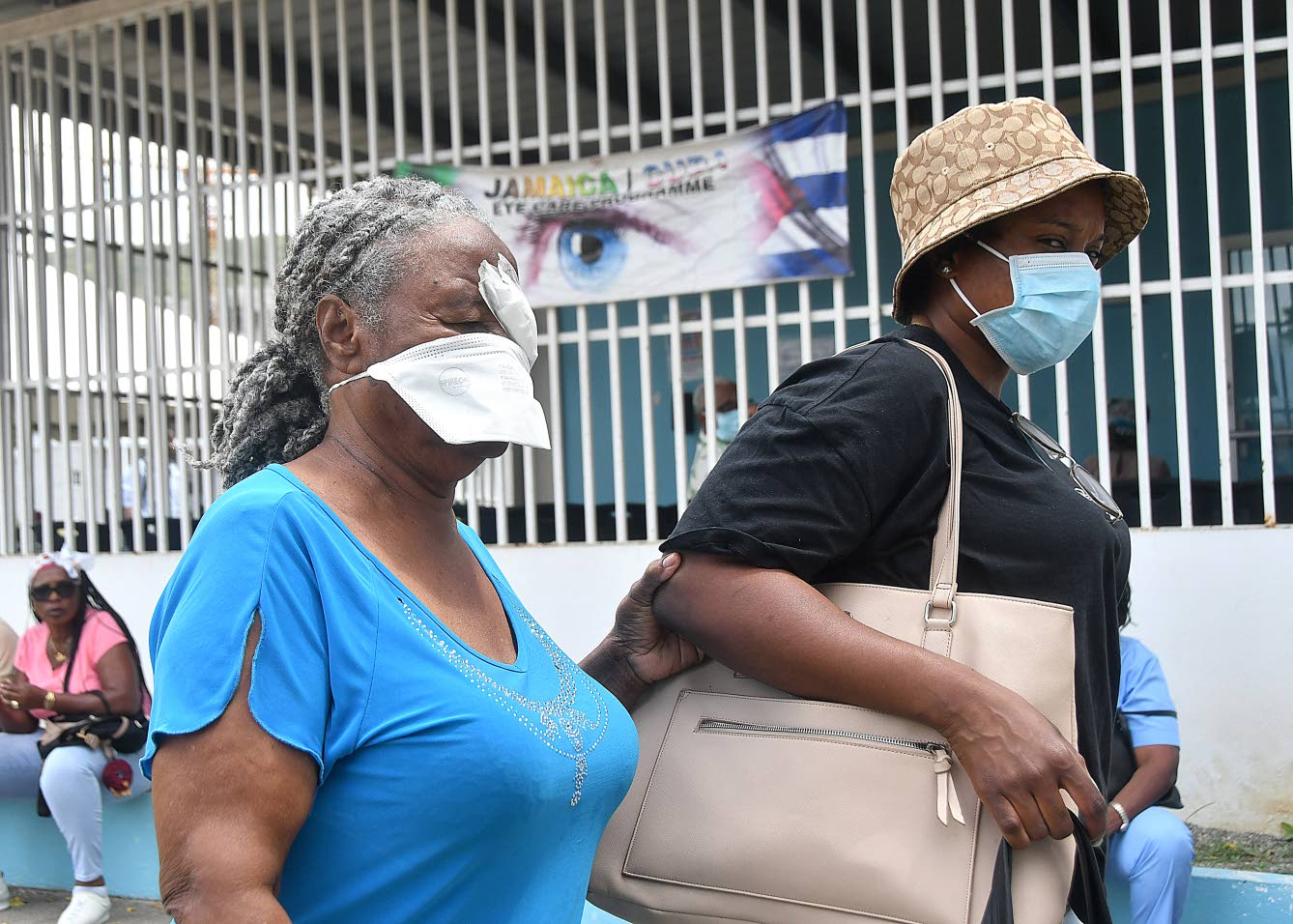
Eighty-year-old Raverlyn Bailey (left) is guided by her niece Latoya Wallace, after receiving treatment on Monday at the eye clinic run by Cuban doctors at St Joseph’s hospital in Kingston. (Photo: Garfield Robinson)


