



Wealth creation, according to billionaire Lee-Chin
IF you want to learn how wealth is built, many say the best place to start is with someone who has already achieved it. Recently, students at Portmore Community College got that rare opportunity, hearing directly from 75-year-old billionaire businessman Michael Lee-Chin.
Beginning his presentation with a question to the audience: What is the highest value you can give? Using himself as an example, Lee-Chin explained that his presence before the students was meant to deliver the highest value he could give them.
“What is that one thing — if I am successful at imparting it — that will change your life forever? That’s a high bar, but I’m going to try,” he began.
From there, Lee-Chin began outlining the principles that have guided his own approach to wealth creation. He briefly reflected on his upbringing, sharing aspects of his early life as motivation for the students, emphasising that it is possible to rise from humble beginnings. He also expressed gratitude for the opportunities with which he was provided through education. Lee-Chin also shared the story of Roxroy Kerr, whom he described as his protégé. Kerr, who was once featured in the Jamaica Observer for his rags-to-riches journey from plumber to owner of a multimillion-dollar business, Principal Cesspool Services, was used as a benchmark example as Lee-Chin began outlining his lessons on wealth creation. The foundation of wealth, Lee-Chin explained, lies in mathematics, specifically the time value of money and the formula for future value.
He wrote the formula: FV = PV (1 + r)t
Explaining it to the students, Lee-Chin said wealth is created through the future value of money, which equals the present value multiplied by one plus the rate of interest, raised to the power of time. To think about wealth, he said, one must think about the total rate of return, which is the “r” in the formula, as well as time and taxes and how each affects the eventual outcome. Describing compounding as the “eighth wonder of the world”, Lee-Chin said the total rate of return is the first and most important variable.
“If you take $1,000,000 and compound it at 11.4 per cent for 40 years, you get $75 million,” he told the students. “But let’s say you got one per cent less. In 40 years you would have $52 million, not $75 million. It’s only one per cent less, but on the back end, 40 years from now, it’s a huge difference.”
He noted that small differences in interest rates can result in major differences in wealth over time, pointing out that a one per cent reduction in returns could create a difference of about 33 per cent, similar to taking a cut in income. That, he said, is why the total rate of return is so important, and optimising it is how wealth is created. The next variable is time, because the longer money is allowed to compound, the more wealth it generates. He emphasised the importance of starting to invest early in order to maximise the benefits of compounding, noting that the later someone begins investing, the less wealth they ultimately accumulate. The third factor he discussed was taxes and the impact taxes can have on returns. Using the same example of an investment compounding at 11.4 per cent over 40 years to produce $75 million, if a 15 per cent tax were applied annually to the rate of return, the investor would not end up with that same amount.
“I’m not saying you should tax evade,” he told the audience. “I’m saying invest in such a way that you don’t pay taxes. That’s not tax evasion.”
Lee-Chin then returned to the story of Roxroy Kerr, explaining that Kerr had learned what he described as a three-step formula for success in any profession. The first step, he said, is to find a role model who has already successfully accomplished the goal you are pursuing.
“Who before me has done this endeavour that I am seeking to be good in?” he asked. “Identify a role model.”
The second step is to get the recipe from that role model by asking them how they achieved their success. The third step, he said, is not to change the recipe. Leaning into a quote from Warren Buffett, whom Lee-Chin identifies as his own role model and someone he once had the opportunity to meet, Lee-Chin recounted asking Buffett how he became successful.
“To invest successfully over a lifetime does not require a stratospheric IQ, unusual business insights, or inside information. What’s needed is a sound intellectual framework for making decisions, and the ability to keep emotions from corroding that framework.” – Warren Buffett
To be successful, Lee-Chin explained, decisions must be made using a clear framework while keeping emotions in check.
“When times are good, don’t float off, and when times are bad, don’t get paralysed and do nothing,” he said.
But beyond discipline and decision-making, he stressed that access is also critical to success, noting that access often comes through strong relationships.
“Don’t be transactional. Don’t be quick with a quid pro quo — I do this for you because I want you to do something for me. No. Build relationships,” he said.
In diverting to the importance of getting things done, Lee-Chin cited advice he once received from another wealthy individual.
“He said, ‘To be successful, it’s two per cent strategy and 98 per cent execution.’ So I thought, how many more times is execution more important than strategy? Forty-nine times”, he said.
Moving to the next step in wealth building, Lee-Chin referenced the techniques used by scientists in developing theories. The first step in the scientific process is observation. Scientists begin with a question and observe patterns or behaviour to gather information. The second step is to create a hypothesis based on those observations. The third step is to stress-test the hypothesis under different conditions.
“If all the stress tests hold and the hypothesis stands, you codify it, and then you hard-wire it so it becomes theory,” he explained.
To illustrate the concept, Newton’s laws of motion was referenced, ie the three foundational principles formulated by Sir Isaac Newton in 1687 that define the relationship between an object’s motion and the forces acting upon it. The laws describe inertia — the resistance to change; the relationship between force, mass and acceleration, expressed as F = ma; and the principle of action and reaction. Lee-Chin told the students that these principles are not only scientific laws but can also be viewed as life laws, and that these were among the lessons Roxroy Kerr absorbed. Having applied these principles himself, Lee-Chin said individuals who create wealth, rather than inherit it or marry into it, tend to follow a similar framework.
According to him, wealth creators typically follow several key principles.
1. Own a few high-quality businesses.
2. Thoroughly understand those businesses.
3. Ensure those businesses operate within strong, long-term growth industries.
4. Use other people’s money prudently.
5. Hold those businesses for the long run.
In addition to those principles, successful wealth creators also possess what he described as the three P’s — they predict, plan, and persevere with their plans.
“What I say is simple, not easy,” he told the students. “Simple to understand, not easy to execute, because execution is 49 times.”
But for those still searching for a guiding principle, Lee-Chin shared the philosophy that has defined his own journey, and that is “One does well by doing good.”
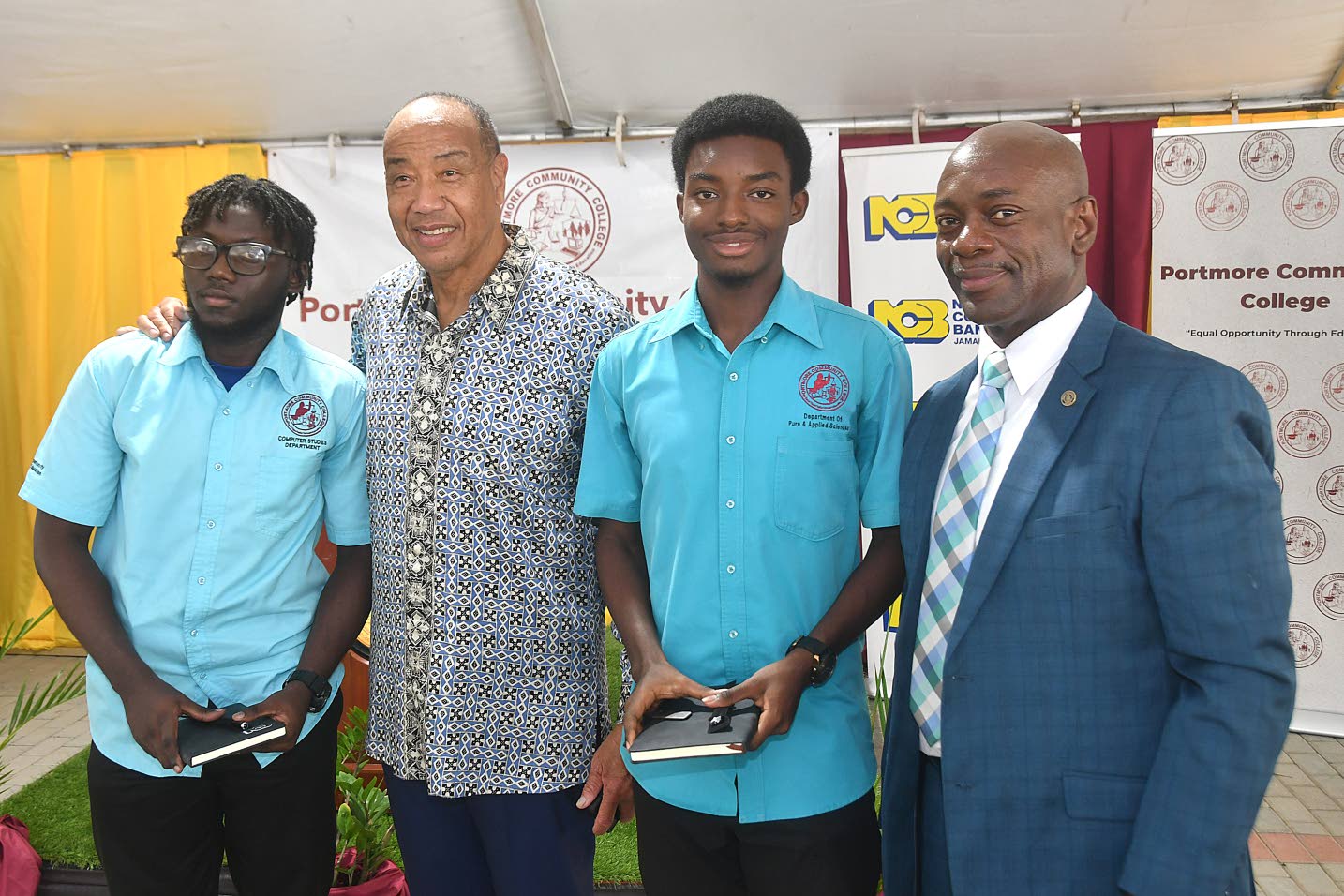
Otherneil Robinson, Lamaughn Whyte (student), businessman Michael Lee-Chin and Prinicpal Dr Austin Wright at the Portmore Community College in St Catherine (Photo: Garfield Robinson)
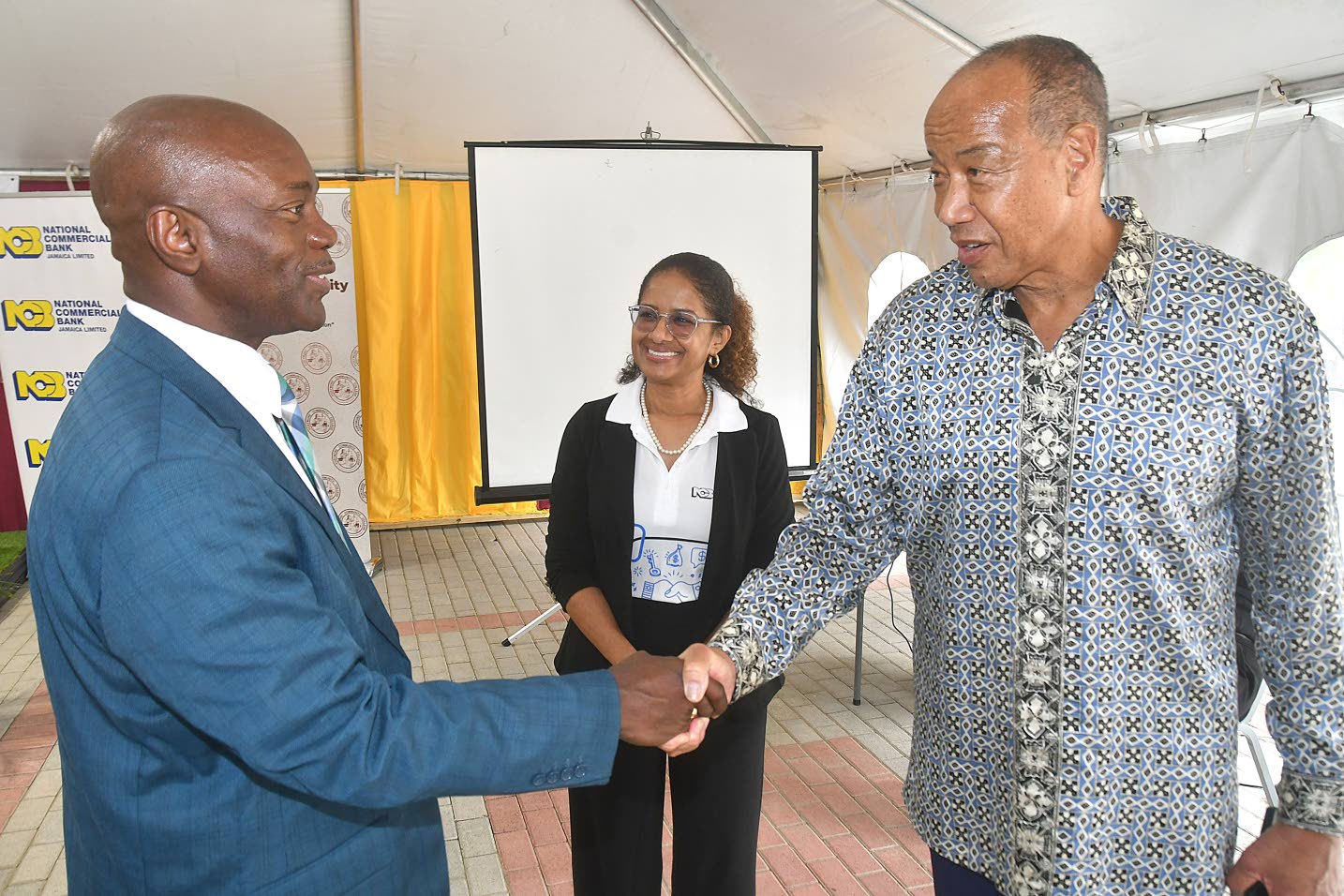
Prinicpal Dr Austin Wright thanked billionaire businessman Michael Lee-Chin for sharing the laws of weath creation to students. (Photo: Garfield Robinson)


