



Know the money rules? Quatta says act on them
MANY people already know the basics of personal finance: budget carefully, save consistently and invest for the long term. Yet, despite that knowledge, many still struggle to build wealth or achieve financial stability. For fintech founder and money coach Anna Palomino, that disconnect between knowing what to do and actually doing it became the starting point for building Quatta, a financial planning platform designed to make managing money feel less intimidating and more engaging.
“Knowledge has never been the real problem. If knowing were enough, gyms wouldn’t need personal trainers. The gap between knowing and doing is almost always emotional or environmental,” Palomino explained to the Jamaica Observer in an interview.
The idea emerged after years of working directly with clients and observing recurring patterns in how people interact with their finances. Some individuals simply did not know where to begin with personal finance, while others understood what they should be doing but felt overwhelmed by the volume of financial information coming from social media, banks and financial institutions. Others, she noted, were carrying deeper emotional experiences tied to money, such as childhood experiences, financial trauma or deeply ingrained beliefs about what they deserved financially — issues that traditional financial planning tools often fail to address. From that observation came the idea of reframing financial planning as something people would want to engage with rather than avoid.
“I knew that if we could make the journey feel more like a mission than a chore, people would actually show up for it,” she said.
Within the platform financial goals are organised as missions, a structure intended to break long-term financial objectives into smaller and more achievable steps.
“In Quatta, you are an agent. Your financial journey and portfolio are your dossier, and every action you take in the real world (saving, insuring, investing) earns you points and advances your mission. When you complete a directive you’re debriefed, your dossier is updated, and your next mission is issued.”
The concept draws on principles from behavioural science — an area of research that examines how psychological factors influence financial decision-making and habit formation. Behavioural researchers have found that the use of game-like systems often relies on mechanisms such as positive reinforcement whereby users receive immediate rewards for completing a desired action, and feedback loops wherein visible progress encourages people to repeat behaviours. Other research has also shown that turning long-term financial goals into game-like challenges can improve financial outcomes. One study by Bayes Business School found that consumers were around 20 per cent more likely to reach their savings goals when psychological rewards and gamified features were used. These same principles are what helped shape the design of the Quatta platform.
“Behavioural science has shown us for decades that reward systems, progress tracking, and identity-based habit formation are among the most powerful drivers of sustained behaviour change. The financial industry has just been slow to apply it,” she told the Business Observer.
Palomino said those principles help users focus on incremental wins rather than distant financial goals that may feel overwhelming. When financial planning begins to feel manageable and rewarding rather than punitive, people are more likely to return consistently to the process. The behavioural approach also addresses what Palomino believes is one of the most persistent challenges in personal finance — the gap between knowing what to do and actually doing it. And because there is no shortage of financial content in the world, what has been missing is a tool that takes someone from financial chaos to financial freedom across every single area of their portfolio, all in one place. When asked whether Jamaican consumers are ready for a platform that approaches financial planning in this way…
“Not only are they ready… they’ve been waiting.” She responded confidently.
She explained that Jamaica has a population that is digitally engaged, entrepreneurially minded, and deeply motivated to build wealth. What has been missing is a tool that meets them where they are and respects the specific financial reality of their life. Most financial apps were built for North American or European markets. They assume financial infrastructure, income levels, and investment access that simply don’t reflect Jamaica’s reality. And while the idea of financial freedom is often discussed in broad terms, Palomino said its meaning ultimately varies from person to person. For some, it may simply mean never having to panic about an unexpected expense. For others, it could mean leaving a job they dislike because their investments can support their lifestyle. And becoming the first person in their family to own property or retire with dignity could be the meaning of financial freedom for yet another set of persons.
“What Quatta does is help each person define their version of freedom, and then build the exact path to get there — one mission at a time,” said Palomino.
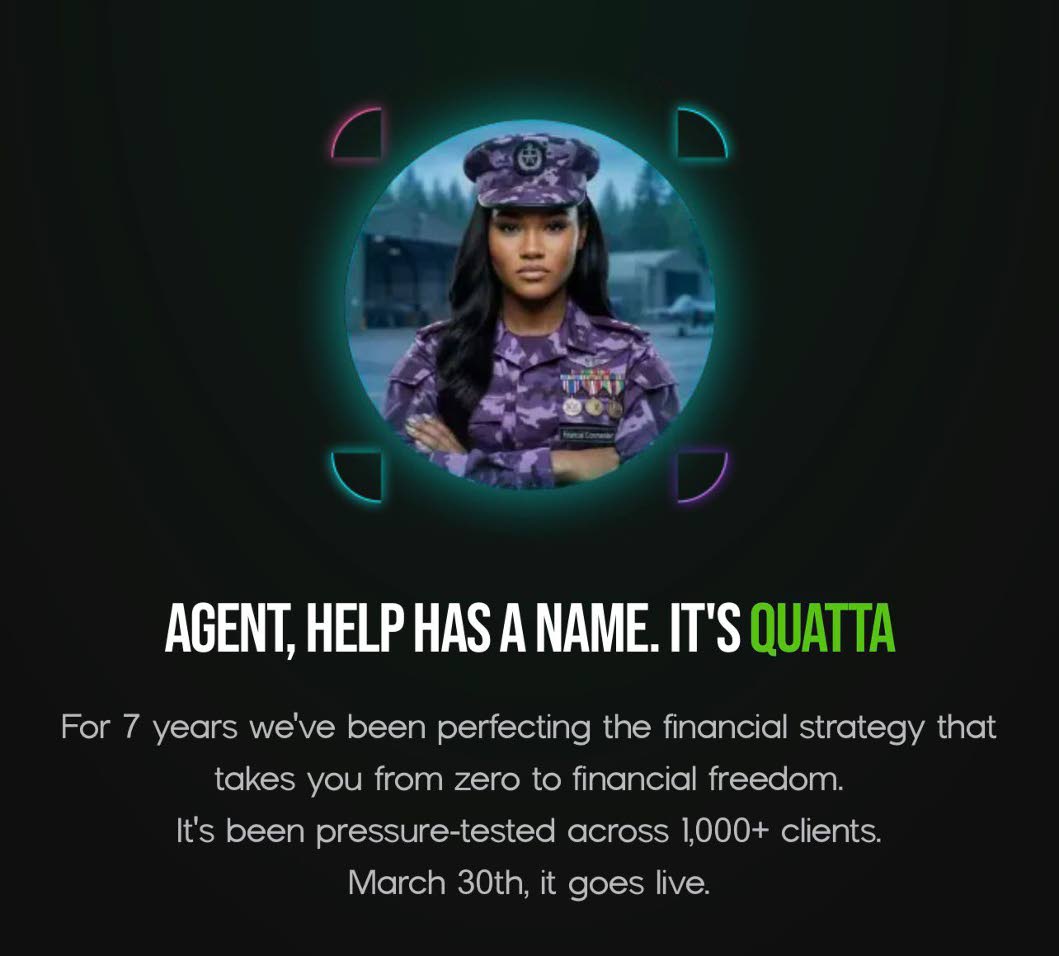
Promotional graphic for the Quatta financial planning platform, which uses a mission-style, gamified approach to guide users through personal finance decisions and building wealth. The app, developed by fintech founder Anna Palomino, is scheduled to go live on March 30.

PALOMINO…what Quatta does is help each person define their version of freedom, and then build the exact path to get there — one mission at a time


