BOJ moving to strengthen payment services regulation
THE Bank of Jamaica is moving to significantly deepen its control over the country’s financial system, advancing a series of legislative changes that will tighten regulation of payments, remittances and credit unions as it prepares for a major shift in its role.
While the central bank already supervises key parts of the financial system, the changes outlined in its 2025 annual report point to something more far-reaching — a move to formalise, expand and enforce its authority across a broader set of financial activities, closing gaps that have long existed in Jamaica’s regulatory framework.
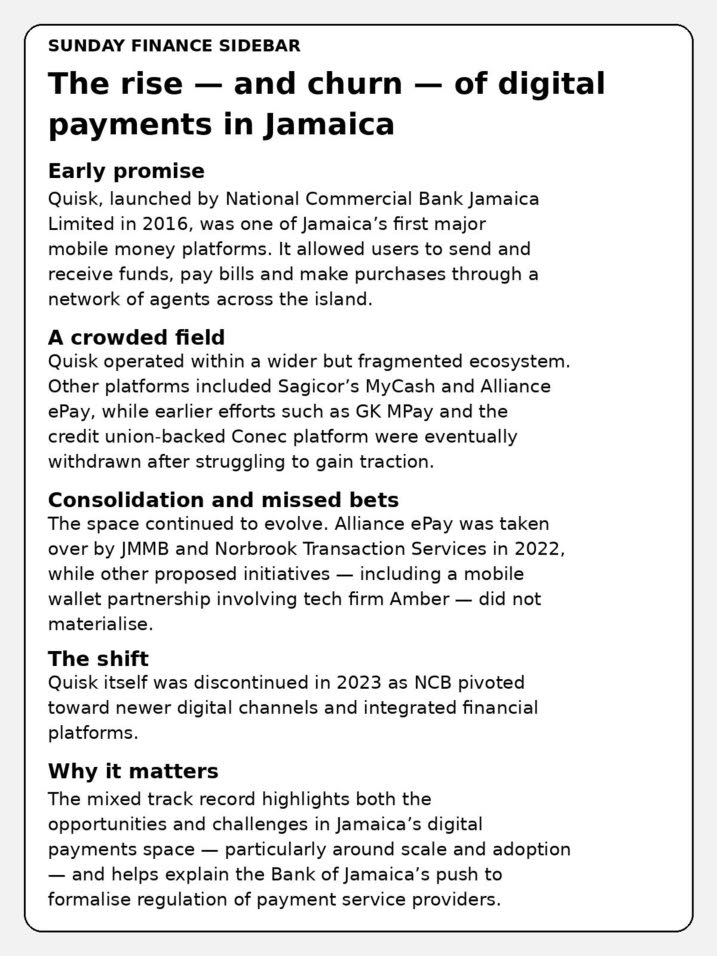
That push is anchored in proposed amendments to the Payment Clearing and Settlement Act (PCSA) which would establish a formal licensing regime for payment service providers (PSPs) — the companies behind mobile payments, merchant transactions and digital transfers.
“During November 2025 the bank submitted comments on the fifth draft of the proposed legislation,” the central bank said in its annual report, noting that the amendments would also introduce offences and enforcement provisions applicable to operators and participants in financial market infrastructure.
The shift would move the payments space away from a framework largely guided by policy and oversight into one defined by statute, with clearer rules on who can operate and how those entities are supervised.
The move also comes as the central bank continues to upgrade the country’s payment infrastructure, including the migration of its real-time settlement system to international ISO 20022 standards and the expansion of its Jam-Dex digital currency platform.
At the same time, the central bank is seeking to strengthen its authority over the money services business (MSB) sector, which includes remittance providers, through amendments to the BOJ Act.
Under the proposed changes the bank would gain enhanced powers to act against unlicensed operators — including the ability to pursue offences wherein entities misrepresent themselves as authorised providers, and obtaining search warrants where it suspects illegal activity.
“Once implemented, the amended Act will strengthen the legal framework governing MSBs and enhance the statutory oversight of the sector, thereby facilitating full compliance with Financial Action Task Force (FATF) Recommendation 14,” the BOJ said.
Further changes are also being contemplated for the credit union sector. Draft legislation — including amendments to the Co-operative Societies Act and a proposed Credit Unions (Special Provisions) Bill — would see the BOJ assume supervisory responsibility for these institutions.
If enacted the move would bring a large segment of Jamaica’s financial system under the central bank’s prudential oversight for the first time.
The legislative push extends beyond those areas. The BOJ is also advancing the Financial Institutions Resolution Bill, which is intended to provide a more structured framework for dealing with failed financial institutions.
Taken together, the proposals point to a broader effort to tighten and align the country’s financial regulatory framework, particularly as Jamaica prepares to transition to a Twin Peaks model of supervision.
Under that framework the BOJ would assume responsibility for prudential oversight across the financial system while the Financial Services Commission (FSC) would focus on market conduct and consumer protection. The draft submission is currently under review by government stakeholders ahead of being sent to Cabinet.
The transition is already underway and both regulators have continued preparatory work. During 2025 BOJ and the Financial Services Commission conducted joint supervisory examinations and held industry consultations to outline the proposed changes and gather feedback from financial institutions as both prepare for the new framework.
“In 2026 the preparation for the Twin Peaks regulatory model will continue. The bank will maintain close collaboration with the Financial Services Commission to conduct structured supervisory examinations in preparation for full implementation of the framework,” the BOJ said.