



So close, yet so far from opportunity to study in the US
Portland teen secures 3 scholarships but faces funding gap; appeals for help
WITH three scholarship offers to study in the United States in hand, Noni Kai Freebourne was over the moon when she got them but was quickly brought down to Earth when reality hit: The generosity of the three educational institutions is not enough to help her fulfil her dream.
A student at Titchfield High School and an alumni of Ardenne High School, the 19-year-old successfully secured admission to Alabama State University, Columbia College Chicago, and the University of Arkansas at Pine Bluff, with half scholarships from each institution for up to US$16,500 a year to study computer science.
However, plagued by financial challenges that have long affected her educational journey, she has no way of coming up with the remainder of the US$30,000 needed to prove she can financially support herself while overseas. So Freebourne is appealing for help, determined not to fail after coming this far.
A resident of Port Antonio in Portland, she told the Jamaica Observer that access to education has always come at a cost her family could barely afford. She recounted spending her early high school years travelling two to three hours to Kingston, awaking as early as 3:00 am for a commute her parents struggled to finance, alongside other school expenses. The strain eventually forced her to transfer to Titchfield High to complete sixth form as the family’s financial challenges deepened following the COVID-19 pandemic.
Despite being self-taught as she prepared for the Scholastic Aptitude Test (SAT) — an entrance exam used by most colleges and universities in the US to make admission decisions — the 19-year-old successfully scored 1390 out of 1600 and secured the scholarships, all while making the Caribbean Advanced Proficiency Examination Merit List, and participating in competitive chess and the Jamaican Mathematics Olympiad.
But Freebourne still faces a financial hurdle that is threatening to derail her plans.
“I’ve always wanted to study abroad and explore different cultures — especially in the United States because I have family there. I’ve always wanted to experience what they’re experiencing, and visit them and be closer to them, and so I decided that I’d want to study abroad. However, with the financial shortcomings, I kind of put that idea aside and said that maybe I should study locally because there are good universities here, but I’d always had that thought at the back of my mind that this is something I want to pursue,” she told the
Sunday Observer.
After starting sixth form at Titchfield High, a friend told her about Passport to College (PTC) — a non-profit organisation that assists students with their dream of studying overseas by helping them with the application process and opportunities to obtain scholarships.
“Passport to College had sent some resources that I could use. I was also using Khan Academy online because they have an SAT course, and I had also gotten a digital SAT book. It had some guidelines and practise questions that I could use…I’d gotten that book from the same friend who told me about PTC,” she shared.
Her study plan ran like a well-oiled machine until October 28, 2025, when Category 5 Hurricane Melissa battered sections of Jamaica a week and a half before she was supposed to sit the SAT on November 8. She recalled that she had no light or water, bringing an abrupt end to her ability to any online platform to study for the SAT.
“Even though I had the physical book, that was mostly for the full test that I was practising for, and less for the section-by-section and the different topics. I had to just work the practise questions from the book, based on the knowledge that I’d had from preparing before. I had to go out in the mornings on my verandah and finish the practise test and score myself — because they had a score section on how you would score yourself — and I just had to do those practise tests for the final preparation,” the teenager said.
While it was difficult, Freebourne said the hours spent planting seeds of knowledge were worth it when she saw the fruits of her labour.
The University of Arkansas at Pine Bluff offered her its top scholarship for freshmen students: The Chancellor Award. It provides the recipient with US$16,500 per year for four years, along with money for books. Freebourne also received a US$14,000-a-year scholarship from Columbia College Chicago, and a US$8,000-a-year scholarship from Alabama State University.
“I was a bit awestruck because I couldn’t believe it. I know that I’ve done well in my academics; however, I didn’t believe that people would see that and would actually think that, ‘Yes, we’d want you here at our university and we will support you financially to achieve that.’ It was a humbling and shocking experience for me,” she told the Sunday Observer.
She said she chose the University of Arkansas at Pine Bluff because it offered her the largest financial award, but she still faces a shortfall that’s needed to cover housing, transportation, and other expenses, as well as to demonstrate she can afford to sustain herself in the US.
“That is still a daunting figure for me, because even though it’s a very generous scholarship I would have to still cover around half to three-quarters of the remaining amount…I’ve given up on my hopes once so I promised myself that this time I would try to persevere and push forward, because I’ve gotten so far. I’ve gotten the scholarships so it’s just a small push to make it towards the finish line,” said Freebourne.
She appealed for assistance, noting that she would not abandon Jamaica after completing her studies but instead use her degree to help small businesses in and around her parish transition into the digital world.
“I’m really looking forward to studying abroad and using those skills to contribute and give back to my community. I’m really grateful for all that I’ve achieved so far, and I know that with the right guidance and the right support I’d be able to achieve various things abroad and represent the country, and come back and contribute to technological developments and uplift my community.
“There’s much potential to improve the businesses that are in this area by providing them with websites and more digital knowledge so they can promote their businesses on a larger scale in Jamaica, so I’d want to use the skills that I’ve learned in university to come back and support my community,” Freebourne said.
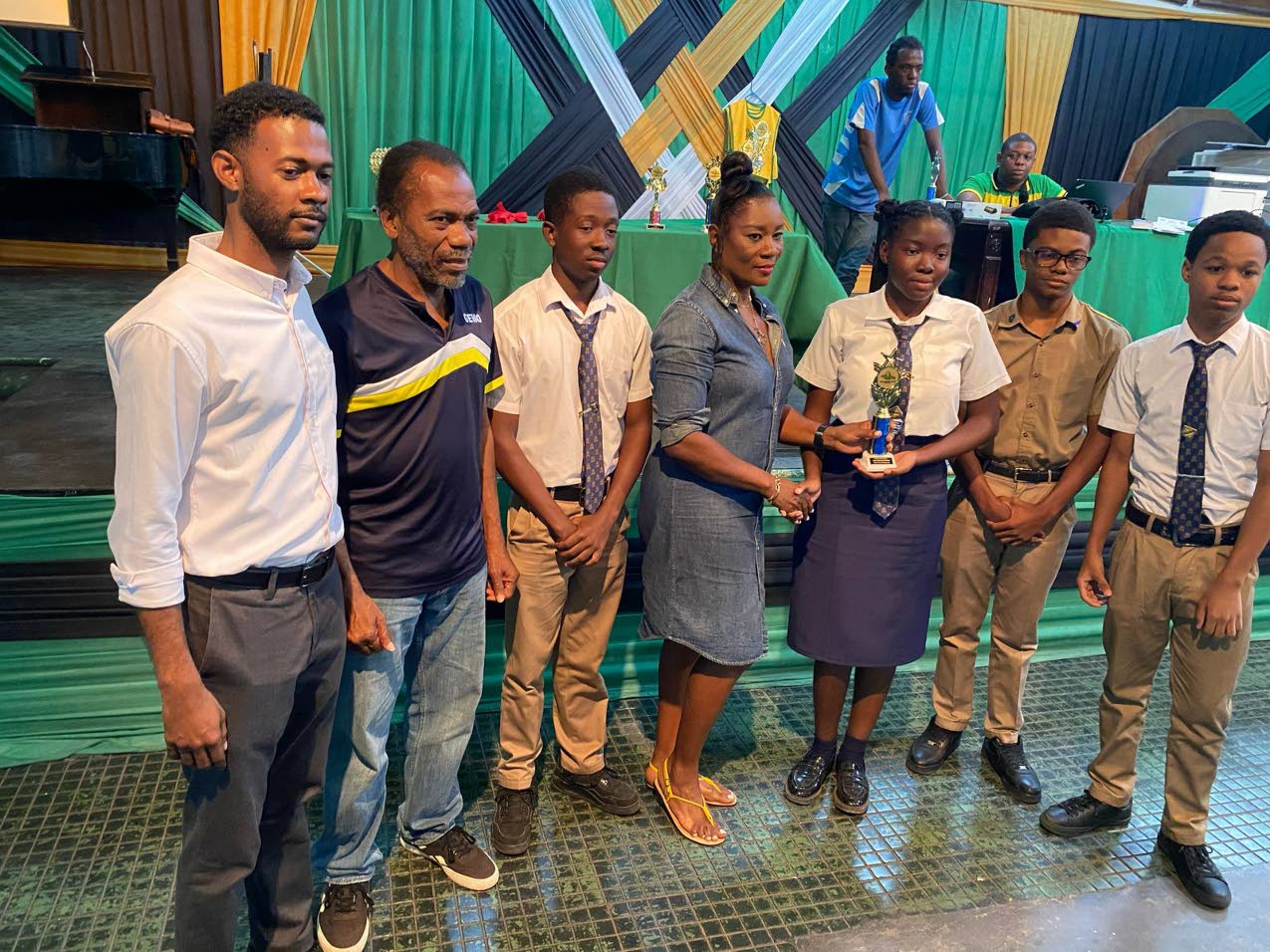
Noni Kai Freebourne (third right) and other members of the chess team at Titchfield High School are presented with the Region 2 award for chess at the 2025 National High Schools Chess Championships.


