



Big surgeries with tiny cuts
Visionary young surgeon committed to advancing colon procedure across Jamaica
IN operating rooms around the world, surgeries are undergoing a quiet revolution. Procedures that once required large incisions, lengthy hospital stays, and weeks of recovery are being replaced by technological and surgical advancements that allow patients to heal faster and return to normal life sooner.
In Jamaica, Dr O’Rane Thomas, whose work in minimally invasive surgery is reshaping how complex procedures are performed locally, is one of the surgeons said to be helping to lead that transformation.
Recently, Thomas led the surgical team at Medical Associates Hospital in successfully completing the hospital’s first laparoscopic colectomy — a highly technical colon surgery performed using a “keyhole” approach. Instead of a large incision, surgeons operate through small openings using a camera and specialised instruments inserted into the abdomen. While the milestone represents an important achievement for the hospital, Thomas believes it also signals a broader shift in the way surgery is practised locally.
“This achievement aligns with the broader modernisation of the hospital and reflects that the transformation we envision at Medical Associates is not only aesthetic, but fundamentally clinical,” David Walcott, managing director of Medical Associates Hospital, is quoted in a release. “It underscores our commitment to delivering world-class patient care and positions the hospital as a leader in minimally invasive surgery locally.”
For decades, colon surgery typically required a large abdominal incision. While effective, traditional open surgery often meant longer hospital stays, more pain, and a higher risk of wound complications. Minimally invasive surgery dramatically changes that experience.
The release said, central to the procedure’s success was the hospital’s recently installed laparoscopic tower — a modern imaging system that enhances visibility and precision during surgery. Advanced surgical instruments —including ultrasonic energy devices and specialised stapling tools — allowed the team to carefully dissect tissue and securely reconnect the bowel.
“This is a highly technical procedure that involves the use of high-definition cameras and specialised instruments inserted through small incisions in the abdomen,” Thomas explained. “Compared with traditional open surgery, the keyhole approach offers several benefits including less pain, shorter hospital stays, lower risk of wound infection, and a quicker return to normal activities.”
For patients, those differences can be significant. Recovery times are often faster, and the physical impact of surgery is greatly reduced.
The operation involved a patient suffering from complicated diverticulitis — a condition caused by inflammation of small pouches in the wall of the colon. Diverticulitis is relatively common, particularly among older adults, but severe cases can lead to infection and abscess formation.
“In this patient the inflammation was severe, leading to the formation of large abscesses and causing the colon to adhere to the bladder,” Thomas explained. “That made the surgery particularly challenging.”
Traditionally, cases of this nature often require multiple procedures, sometimes including a temporary colostomy bag while the bowel heals. However, using laparoscopic techniques and advanced surgical tools, the team was able to remove the diseased section of the colon and reconnect the bowel in a single operation.
“As a result, the patient avoided the need for a stoma bag and the burden of a second surgery to reconnect the bowel,” Thomas said.
The patient was discharged four days after the procedure.
“One of the major benefits of laparoscopic surgery is the shorter hospital stay,” Thomas noted. “Because patients experience better pain control and can resume their diet earlier, recovery is typically faster.”
According to the surgeon, investments in modern medical technology are essential for the continued advancement of health care in the Caribbean.
“It is critically important for hospitals in the region to invest in surgical innovation and modern equipment,” he said. “Such investments also help ensure that patients do not have to travel overseas for complex procedures.”
As minimally invasive surgery continues to expand, the patient experience of major operations is changing, the release said. Procedures that once meant weeks of recovery can now mean days. Patients can return to their families and daily lives sooner, with fewer complications and less discomfort. According to the release, with surgeons like Thomas leading the charge, the face of surgery in Jamaica is changing for the better.
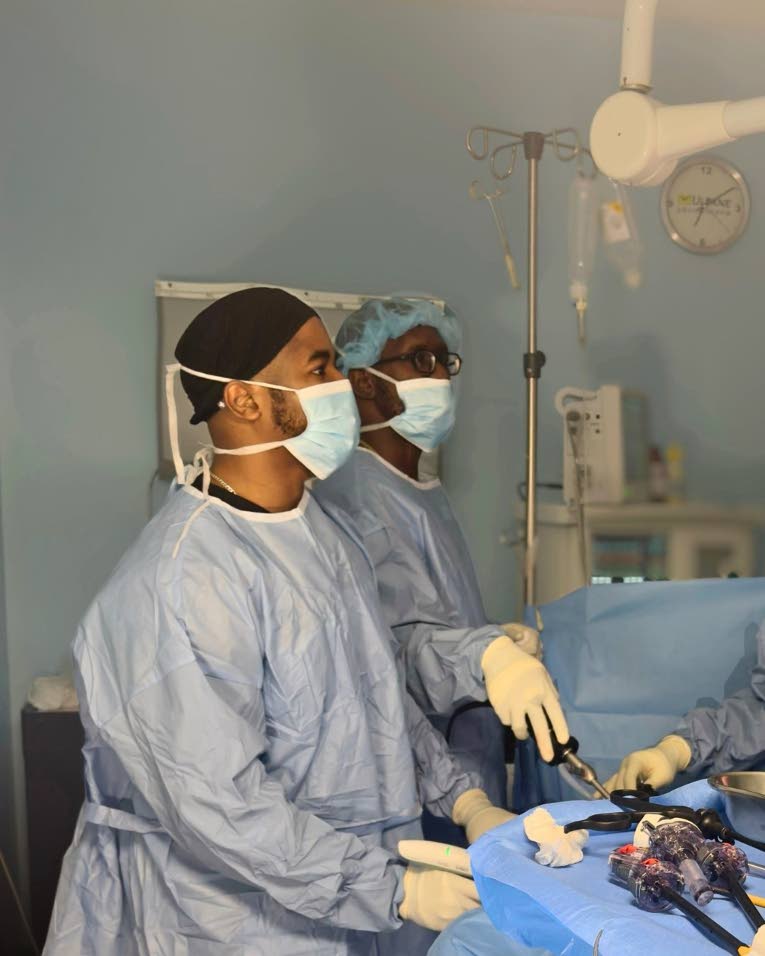
Dr O’Rane Thomas (left), lead consultant general surgeon, and Dr Matthew Wanliss, consultant general surgeon, are captured during the first laparoscopic colectomy at Medical Associates Hospital recently.


