



Government and Opposition senators spar over fiscal policies
• Small-Ferguson: Challenges should not be blamed on Melissa• Duncan: Administration’s strategy getting things done
OPPOSITION Senator Ramon Small-Ferguson has charged that Hurricane Melissa did not cause the fiscal pressures now being experienced by Jamaica, it merely exposed them.
Small-Ferguson made the assertion in the Senate on Friday as the Upper House debated the 2026/27 Appropriations Bill.
“We all know that Hurricane Melissa was a significant event but it would be incomplete and ultimately misleading to suggest that the fiscal pressures we now face began with the hurricane.
“The truth is that in the years leading up to Melissa, Jamaica was already showing signs of underlying fiscal weakness. These were not always evident in the headline numbers but they were clear in the structure of the fiscal accounts and in the policy choices underpinning them,” charged Small-Ferguson.
He claimed that three areas underscore the challenges the economy faced before the Category 5 storm devastated sections of the island last October.
According to Small-Ferguson, the first sign of trouble was an increasing reliance on revenue measures introduced as temporary responses to specific circumstances but which have since been retained and normalised as permanent features of the fiscal framework by the Government.
“Second, and most significantly, recent fiscal outcomes have been supported by one-off, non-recurring transactions. While these generated substantial inflows, they do not represent sustainable sources of revenue.
“Third, targeted measures with defined policy objectives have, over time, been redirected from their original purpose. The revenues remain, but the policy rationale has been diluted or abandoned,” added Small-Ferguson.
He charged that taken together, these factors point to a fiscal position increasingly dependent on temporary measures, policy drift, and non-recurring inflows, to maintain balance.
“In other words, the apparent strength of the fiscal accounts masked emerging structural pressures. This is the context in which Hurricane Melissa arrived. The hurricane did not create these conditions — it exposed and intensified them. And if we are to craft a credible response, we must begin from an honest assessment of that reality,” charged Small-Ferguson.
Like his Opposition colleagues in the House of Representatives, Small-Ferguson rapped the Government over its continued annual withdrawal of $11.4 billion from the National Housing Trust (NHT).
He argued that, “The NHT was established for a defined purpose. Redirecting its resources, regardless of surplus levels, represents a departure from that purpose and from the position previously articulated by the Government itself.
“A housing fund should not become a fiscal buffer for central government into perpetuity — yet that is what has occurred. A temporary measure has been embedded as a permanent support to the fiscal position.”
Small-Ferguson also raised the issue of the asset tax, which should have been a temporary measure but which has remained in place long after it was intended.
He pointed to what he described as measures taken by the Government that supported the fiscal position in the years leading up to Melissa, including one-off and non-recurring transactions.
“Among the most significant were the securitisation of future revenues from the concession arrangements for our two major airports — the Norman Manley International Airport and the Sangster International Airport. These transactions generated substantial inflows — approximately $75 billion in fiscal year 2024/2025 and $61 billion in fiscal year 2025/2026 — and were recorded as non-tax revenue.
“Let me be clear: There is nothing inherently wrong with securitisation; when properly structured, it can be a legitimate financing tool. The issue here is not the instrument but the structure and the economic substance of its use,” said Small-Ferguson.
He noted that these transactions were presented as off-balance sheet financing, and argued that this was a way to access liquidity without increasing sovereign debt.
“But when we examine the substance, a different picture emerges. The revenues that previously supported the Airports Authority of Jamaica have now been redirected to service the securitisation, weakening the Authority’s ability to sustain its own operations. The result is now evident. The central government has had to step in with over $13 billion budgeted this year to support the Authority, including approximately J$2 billion for the construction of a new headquarters,” said Small-Ferguson.
Responding to many of the claims of Small-Ferguson, Government Senator Keith Duncan was adamant that the Andrew Holness-led Administration has been fiscally responsible and working for the best of Jamaicans over the long term.
Duncan pointed out that the Administration has responded to movements in commodity prices over the years by moving to protect the most vulnerable.
He reminded the Senate that in response to rising energy prices in 2022, the Administration launched the ‘We Care Energy Co-Pay Programme’ whereby it implemented a direct pass through to the Jamaica Public Service Company in an arrangement where it paid 20 per cent of energy bills for households consuming 200 kilowatt hours or less of electricity per month for four months, from which more than 450,000 people benefited.
Regarding fiscal responsibility Duncan pointed out that debt-to-GDP is projected to rise to 68 per cent this year but will trend down to 60 per cent in 2029/30.
“We remain committed to fiscal responsibility and managing our debt,” declared Duncan.
He also noted that NHT is expected to spend more than $53.7 billion in capital expenditure in fiscal year 2026/27, representing nearly 50 per cent of total public bodies’ spending, with construction projected to start on over 10,000 housing solutions.
Regarding the asset tax, Duncan said he had taken note that neither the Opposition Leader Mark Golding nor Opposition spokesman on finance Julian Robinson, recommended its removal in their contributions to the 2026/27 Budget Debate.
He also told the Upper House that the sale of receivables was designed as a one-off securitisation measure to fund one-off capital expenditures, not to fund recurrent revenue.
“That is a strategy to move and get things done,” insisted Duncan.
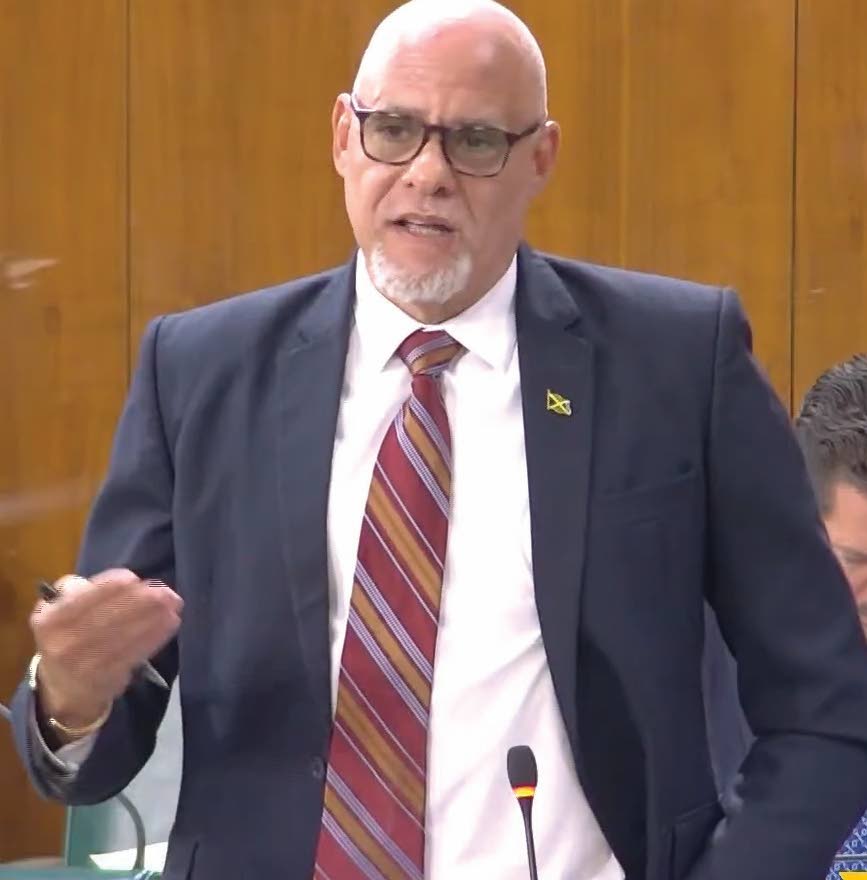
DUNCAN…the sale of receivables was designed as a one-off securitisation measure to fund one-off capital expenditures, not to fund recurrent revenuea


