



Hotels see softer Champs demand but brace for Carnival surge
Kingston’s hotel sector is emerging from the Boys’ and Girls’ Championships with slightly tempered activity, even as operators brace for what could be one of the strongest Carnival seasons on record.
President of the Jamaica Hotel and Tourist Association (JHTA) Christopher Jarrett on Monday told the Jamaica Observer that while properties were largely filled during Champs, the usual intensity of last-minute demand and overbooking pressures appeared more subdued this year.
“Champs, we had a little less activity… although we were full, we had a little less activity than we’ve seen in former years,” Jarrett said, noting that hotels typically operate beyond capacity during the event.
“We’re usually so overbooked that you have to be turning away reservations… so that didn’t happen this time, although for the most part, we were full,” he explained.
The moderation marks a shift from last year, when Kingston’s accommodation market was pushed to its limits for the back-to-back staging of major events including the Inter-secondary Schools Sports Association (ISSA)/GraceKennedy Boys’ and Girls’ Athletics Championships, Grand Slam Track, and Carnival. Hotels were not only fully booked but frequently over capacity, with demand spilling into Portmore and Spanish Town in St Catherine and even Ocho Rios, St Ann; while short-term rentals across the Corporate Area were effectively exhausted weeks in advance.
This year, that pressure appears less pronounced — at least for now.
While Jarrett could not immediately identify the reason for the softer out-turn, it comes against the backdrop of Hurricane Melissa, which disrupted economic activity late last year and weighed on several sectors, including tourism and entertainment. Part of that moderation may also be linked to the absence of Grand Slam Track, which boosted activity last year but has since been placed on hold following financial challenges and unpaid prize money. While the impact has not derailed demand entirely, it appears to have altered booking patterns, with consumers taking a more cautious or delayed approach.
Attention is now shifting to Carnival which is widely regarded as one of Kingston’s most important economic events. Festivities are expected to ramp up on April 8 and peak with the road march on April 12 before culminating with beach j’ouvert and parties on April 13 and 14.
The season typically spans several weeks of parties, fetes and concerts, drawing both diaspora and international visitors and driving a surge in demand across hotels, transportation, food services and the wider informal economy.
That economic significance is substantial. Carnival in Jamaica generated an estimated $165.7 billion in economic impact in 2025, with organisers indicating a return of roughly $2.25 for every $1 invested — reinforcing its role as a major revenue driver within the tourism and entertainment ecosystem.
For 2026, that contribution could take on even greater importance. With parts of the economy still recovering from the effects of Hurricane Melissa, a strong Carnival season is expected to provide a timely boost in visitor spending and business activity, particularly within Kingston’s hospitality sector.
Early indicators suggest that rebound may already be taking shape.
Based on forward bookings and airlift data from the Jamaica Tourist Board (JTB), Jarrett told the Business Observer that expectations are building for a significantly stronger showing, potentially surpassing previous years.
“It appears that it’s going to be one of the biggest carnivals that I’ve ever seen,” he said.
Hotels are already preparing for their usual surge in demand, where occupancy not only reaches capacity but often exceeds it through overbookings.
“Typically, we’re booked full… and we expect that to happen this year as well,” Jarrett added.
Still, booking patterns suggest that demand may be arriving later than usual.
Unlike last year — when accommodation options were largely exhausted well ahead of the festivities — availability remains visible across some booking platforms, even within Kingston, pointing to a possible shift in consumer behaviour.
Jarrett said that trend may simply reflect the timing of bookings rather than a decline in demand.
“We usually get a lot of late bookings… if you check a few days before the event, you might get a better read,” he noted.
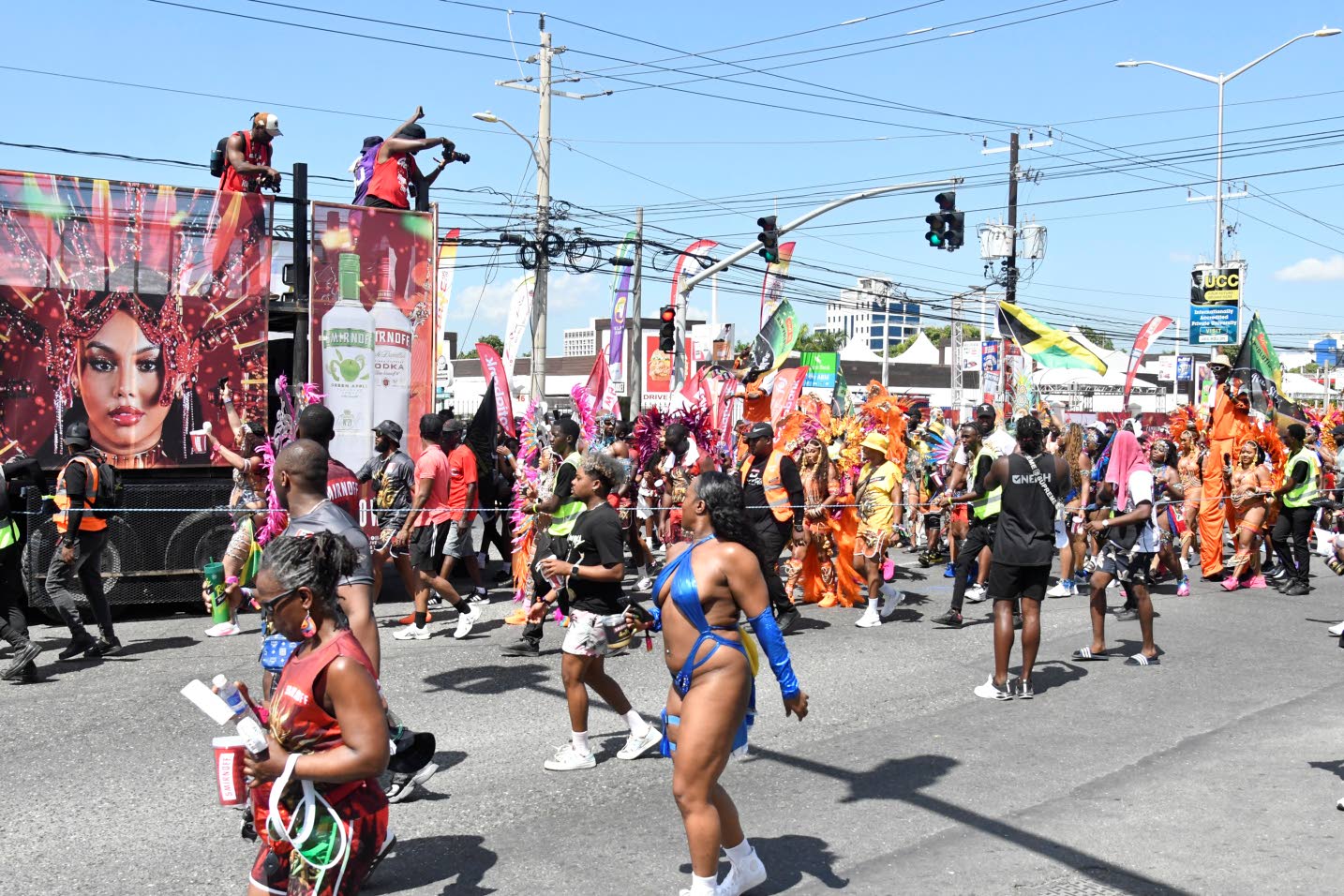
Revellers take to the streets during 2025 Carnival Road March in Kingston. Hoteliers are anticipating a surge in demand for the 2026 season, which is expected to deliver a significant boost to the economy.


