Market rises but participation weakens
Main index rises for the quarter but more stocks fall as gains narrow
STOCKS ended the first quarter higher but the gains masked a weakening market, with more stocks falling and investors putting less money to work.
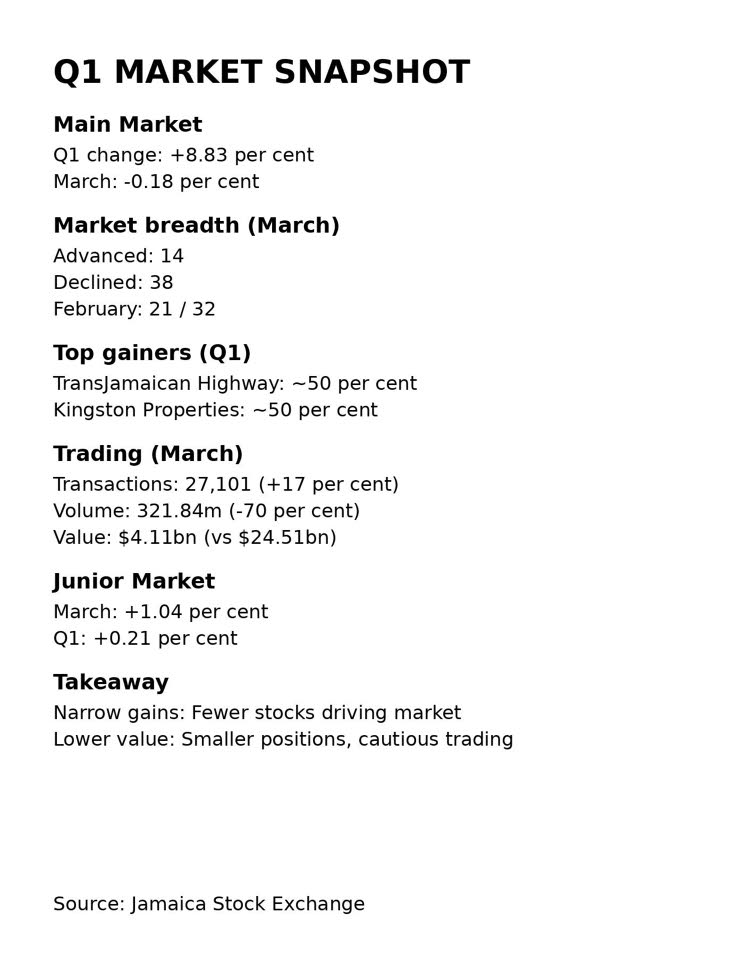
The Main Market index rose 8.83 per cent for the three months to March 31, reflecting gains built up earlier in the period. However, it slipped 0.18 per cent in March, trimming some of those gains and suggesting the rally lost steam toward the end of the quarter.
More stocks fell than rose in March, showing that the market’s gains were not widely shared. Fourteen stocks advanced while 38 declined, compared with 21 advances and 32 declines in February, pointing to a steady weakening in participation as the quarter progressed.
In simple terms, the market moved higher but fewer companies were responsible for those gains.
That pattern was reflected in the performance of a small number of stocks. Kingston Properties and Sagicor Real Estate X Fund posted strong gains and helped lift the index while several others lagged behind.
At the same time, a number of widely held stocks moved lower, including Caribbean Producers, Mayberry Jamaican Equities and JMMB Group, suggesting that investor confidence was uneven across the market.
For the quarter, some of the biggest gains came from TransJamaican Highway and Kingston Properties, which rose by about 50 per cent. On the other side, several stocks recorded double-digit losses, widening the gap between winners and losers.
This growing divide between a few strong performers and a larger group of declining stocks points to a market that is becoming more selective, with investors concentrating on specific opportunities rather than spreading their investments broadly.
Trading activity also pointed to a shift in behaviour, with the number of transactions rising 17 per cent to 27,101 in March even as volume fell 70 per cent to 321.84 million units. The value of those trades fell sharply to $4.11 billion from $24.51 billion a year earlier.
This means that while more trades were taking place, investors were committing less money to each trade, a sign of caution and shorter-term positioning.
It also suggests that some investors may be testing the market with smaller positions rather than making large, long-term commitments.
The junior market showed a more muted performance. The index rose 1.04 per cent in March and was up just 0.21 per cent for the quarter, pointing to limited overall movement.
Within that segment, gains and losses were also mixed. Stocks such as Jetcon Corporation and Future Energy Source Company rose while others, including Kintyre Holdings and IronRock Insurance, declined.
This mirrors the pattern in the main market where gains were uneven and not spread across the wider market.
The picture that emerges is of a market that is still rising but with weaker support underneath. That matters, because rallies driven by a narrow group of stocks and smaller trades are often harder to sustain, especially if investor confidence does not improve.
If that trend continues the market could struggle to build on its early gains, even if headline indices remain positive.