



Injury sparks therapy venture
AN early experience with injury as a young athlete, and the inability to access the level of care needed, would go on to shape one man’s path into physical therapy and eventually into entrepreneurship.
Founder of Elevation Therapy and Fitness Jordaine Nembhard was a former athlete who had a lot of injuries and found it difficult to get the physical therapy needed; that led him to learn all things physiotherapy.
“Learning how I could have helped myself and helped people in the future — that’s the reason I went into physical therapy to begin with,” said Nembhard.
Prior to starting his own practice, his focus was simply on helping people recover. However, while employed at another physical therapy practice, he felt he could be doing more and that his skills were not being fully valued, which pushed him to consider working independently. After four years in the field, he made the decision to establish Elevation Therapy and Fitness, driven by a desire for greater independence and fair compensation. The business initially started by serving athletes, and while it has since expanded to offer general physical therapy, it remains heavily rooted in sports due to its core client base. Much of its clientèle consists of collegiate athletes, and the practice continues to attract individuals focused on improving their physical performance. Nembhard broadly defines an athlete as anyone seeking to improve their body through physical activity, noting that the service is open to anyone with that goal.
“If you just want to be able to walk faster, better and stronger and run faster and better,” he told the Jamaica Observer.
While physical therapy is often associated with injury recovery, prevention is just as important. He noted that adjusting training techniques and exercises can help reduce the risk of injury and limit the need for long-term treatment. Injuries treated vary widely, with no single condition dominating. However, muscle-related injuries, such as strains, are among the most common, affecting everyone from everyday individuals to high-performing athletes.
“You come in with pain and you leave with less pain until the pain goes away completely,” he defined his service simply.
Elevation Therapy and Fitness formalised its presence in the collegiate space through a partnership with Mico University College in December 2025, building on what had previously been an informal, referral-based client base largely made up of track and field athletes. As the business grew, so too did the need for a stable location. One of the biggest early challenges was securing capital, particularly to acquire the necessary equipment and find a suitable space within budget. In its initial years, the business operated out of multiple short-term locations before eventually settling at 8 Lady Musgrave Road, where both he and his clients found a more stable and comfortable environment.
“As grandma said, ‘I have to catch a people place until I get to one,’ and then eventually I get my own space, and now I’ve been here for two years,” he shared.
In the years leading up to launching the business, Nembhard said he made deliberate sacrifices to invest in his development.
“Any money I used to get from my workplace, I like to put a little down so I can do continuous education. I couldn’t go to any parties or anything, so all of my money goes back to the physical therapy,” he told the Sunday Finance.
Those investments have begun to pay off. The business has recorded profits over the past two years, which he attributes to a growing client base and improved financial management, including better budgeting and resource allocation. However, growth is already creating new demands. The current location is expected to be relocated as the business begins to outgrow its space, prompting a renewed search in the real estate market. Sessions start at $6,500, with costs increasing depending on the treatment offered, including services such as dry needling, taping, cupping and shockwave therapy.
The nature of physical therapy is inherently close and personal, requiring a high level of trust between practitioner and patient. Knowing this, Nembhard’s approach involves using humour to make clients feel comfortable, as it helps to build that rapport that is coupled with his personality. Asked what sets Elevation Therapy and Fitness apart, he said that while physical therapy is largely standardised globally, his approach is shaped by how he connects with clients.
“Physical therapy is governed by a world organisation, so most therapists know similar things, but I think my approach is different and my personality is easier for people to resonate with, and that leads to better outcomes,” he said.
Looking ahead, Nembhard envisions expanding into a larger space equipped with more advanced facilities, allowing the business to go beyond injury recovery and prevention into areas focused on overall physical development and aesthetics.

Founder of Elevation Therapy and Fitness, Jordaine Nembhard (Joseph wellington)
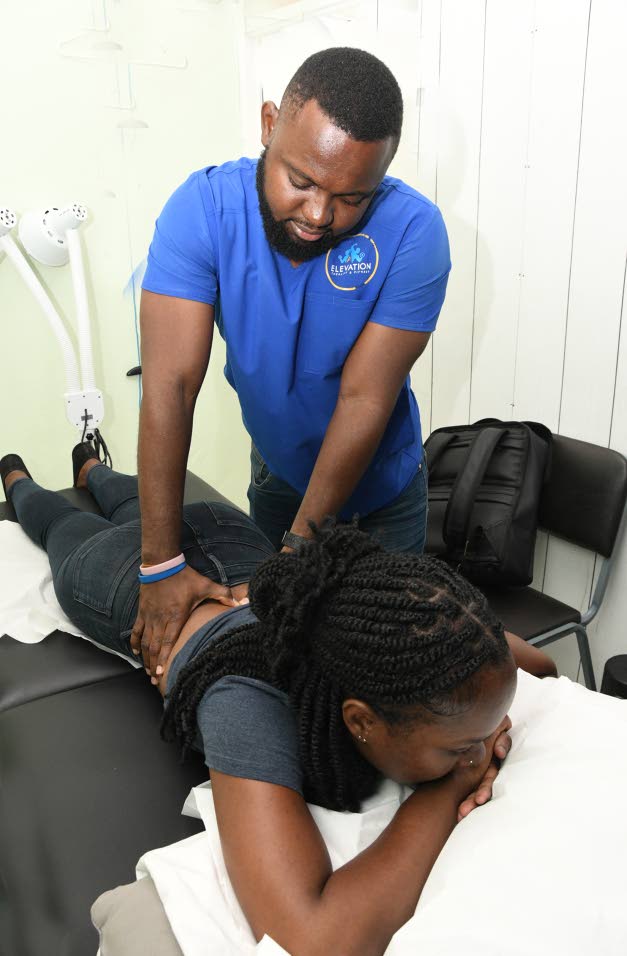
Jordaine Nembhard works one-on-one with a client during a physical therapy session at Elevation Therapy and Fitness. (Joseph wellington)

NEMBHARD…you come in with pain and you leave with less pain until the pain goes away completely (Joseph wellington)

.


