



When the storm stopped money
Power and telecom outages disrupted cash and digital payments, exposing a growing financial risk
WHEN Hurricane Melissa tore through Jamaica on October 28, 2025 the damage was immediate but the deeper shock came after, when outages disrupted the flow of money across the island, exposing how climate shocks are now spilling into the financial system — a shift the Bank of Jamaica (BOJ) flagged in its 2025 Financial Stability Report.
For many Jamaicans, it showed up in simple ways — an automated banking machine that wasn’t working, a card transaction that failed, a payment that had to wait. In those moments, money existed — but could not move.
Data from the BOJ show that in the immediate aftermath of the storm, just 454 of the island’s 907 automated banking machines (ABMs) were operational — leaving only 50.1 per cent of the network functioning at a time when demand for cash was rising. In October, before the full impact of the hurricane, 95.9 per cent of ABMs were operational.
The breakdown also pushed the system below the central bank’s own performance benchmarks. BOJ standards require at least 90 per cent of machines to be operational and uptime above 95 per cent. By November, only 88.3 per cent of ABMs were functioning, with uptime averaging 77.1 per cent — pointing to instability weeks after the storm had passed.
Conditions improved gradually, but recovery remained incomplete. By 31 March, 798 of the pre-storm 907 ABMs were back in service, equivalent to 88 per cent of the network and still below the central bank’s 90 per cent benchmark.
The impact was not evenly distributed. In St Elizabeth, just 13.2 per cent of machines were operational immediately after the storm. Trelawny and Westmoreland recorded 19 per cent and 21.6 per cent, respectively — highlighting how access to cash collapsed most sharply outside major urban centres.
The impact extended beyond access points. In a November 3 release, the BOJ said financial institutions were facing “significant challenges” restoring branch and automated teller machine networks, citing physical damage, lack of power and connectivity, limited access to roadways and security concerns in affected areas.
The central bank said it was working with the Jamaica Bankers’ Association to restore services and ensure access to cash, while also waiving fees on its Real Time Gross Settlement system to support the transfer and settlement of funds and exploring temporary relief measures for customers in hurricane-hit areas. Core settlement systems remained operational, but access to cash and banking services was constrained.
“Hurricane Melissa highlighted vulnerabilities related to operational continuity, particularly regarding access to cash through physical infrastructures such as automated banking machines as well as digital payment channels,” the BOJ said in its 2025 Financial Stability Report.
The disruption came as Jamaica’s payment system was becoming more reliant on digital and real-time platforms. The BOJ reported that point-of-sale transaction values rose to $101.2 billion in December 2025 from $89.8 billion a year earlier. The number of POS terminals also increased to 34,151 from 31,836.
That shift has improved efficiency — but also increased the system’s exposure to outages. As more transactions move onto digital platforms, disruptions now affect not just convenience, but the ability of households and businesses to transact. When networks go down, commerce slows — even when cash and credit remain available.
Both sides of the payment system — cash and digital — were disrupted at the same time.
“The experience of Hurricane Melissa demonstrated how climate events can transmit simultaneously through credit, liquidity and operational channels,” the BOJ said, noting the effects on borrower repayment capacity, collateral values and payment system functionality.
The hurricane triggered stress across multiple layers at once — restricting access to cash, disrupting digital payments, and affecting business activity, with knock-on effects on liquidity and borrower capacity.
Banks remained well capitalised and liquid despite the disruption. Deposit-taking institutions maintained a capital adequacy ratio of 14.8 per cent, above the 10 per cent regulatory minimum, while liquidity coverage ratios stood near 194 per cent. Securities dealers reported capital adequacy of 20.7 per cent, and the insurance sector remained well above prudential requirements, with total assets of about $614.4 billion at end-September 2025, before the hurricane made landfall.
The system held — but because of strong buffers, not because the shock was small.
Electricity and telecommunications, in effect, became part of the financial system. When they failed, the channels through which money moves were disrupted — regardless of the strength of financial institutions. That dependency is no longer theoretical — it has now been tested, reshaping how financial risk is understood.
“The Bank is advancing its climate risk programme, including the refinement of climate stress testing methodologies, improvements in data and disclosure frameworks, as well as integration of climate considerations into supervisory practices,” the BOJ said.
While these measures strengthen financial institutions, they do not directly address the infrastructure vulnerabilities through which recent shocks have been transmitted.
While financial institutions are becoming more resilient, the infrastructure they depend on remains vulnerable. Disruptions to power and telecommunications — systems largely outside the direct control of financial regulators — can still interrupt the flow of money and transmit shocks across the system.
As Jamaica’s financial system becomes more digital, its stability is increasingly tied to infrastructure resilience — leaving a gap that financial policy alone may not be able to close, and that future shocks are likely to test again.

A point-of-sale terminal sits idle during post-hurricane outages, as disruptions to electricity and telecommunications prevented digital payments from being processed.
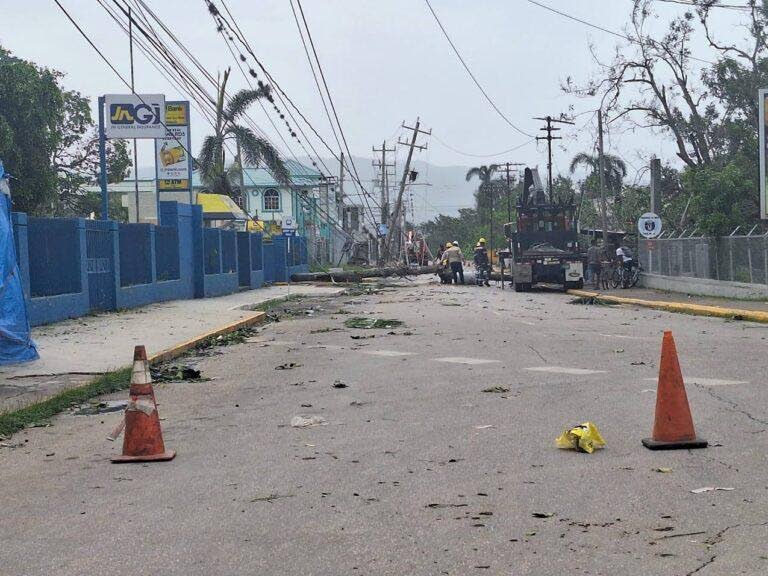
Downed power lines following Hurricane Melissa, during which widespread outages disrupted electricity and telecommunications, cutting off access to cash and digital payments.


