



Not an empty promise
Samuda says JLP committed to completing six major rural water projects
MATTHEW Samuda is insisting that major water projects he announced on Sunday at the Jamaica Labour Party (JLP) mass meeting in Half-Way Tree, St Andrew, are not a general election ploy.
Samuda, whose ministerial portfolio gives him responsibility for water, the environment, climate change, and the blue and green economies, told thousands of JLP supporters gathered in the St Andrew parish capital, where Prime Minister Dr Andrew Holness announced that Jamaicans will go to the polls on September 3, that the JLP Administration has invested $22 billion in the country’s water infrastructure since 2016, the result being that 350,000 Jamaicans were getting piped water for the first time.
He said if given a third term in office, the JLP will undertake a major project that will impact 38,000 Jamaicans in six rural townships which are currently poorly served by the National Water Commission (NWC).
The towns are Agualta Vale and Mason Hall in St Mary, Albert Town in south Trelawny, Union/Balaclava in St Elizabeth, Port Morant in St Thomas, and Green Park to Bamboo in St Ann.
On Tuesday Samuda provided details on the project, including costing, during an interview with the Jamaica Observer.
“It’s approximately $5 billion, give or take. The pipe price and pump price are fluctuating a little more wildly than normal because of global instability but generally it [the project cost] should be coming in at around $5 billion,” he said.
The minister shared that close to $3.5 billion of the amount is to be funded by the Caribbean Development Bank, under a project that sees Jamaica benefiting from significant technical assistance and even some grant funding in the design phase of the programme. He said the six locations will be packaged together as a suite of projects.
“This suite of projects has already been designed, the engineering has been done. It is on the books of the Government of Jamaica through the budget… there is allocation of funds,” Samuda outlined.
“We’re now at the stage of procurement; it’s procurement-ready but not shovel-ready,” he said, but pointed out that there are other projects that were previously announced that are now shovel-ready.
During his rally speech he mentioned several other systems that have been completed or are in varying stages of construction.
“I did that in a way to ensure that people understood that this is not an empty commitment; this [the six rural projects] is a follow-through of our commitment to significantly improve water supply for Jamaicans — especially in rural Jamaica — who have suffered for way too long,” said Samuda,
He noted that the $22 billion that is being invested includes projects like the Ferry to Rock Pond pipeline — a $1.4-billion project that will take water from Ferry in St Catherine to the top of Red Hills, St Andrew, then gravity-feed it to water-starved communities like Coopers Hill.
“The projects we have completed have already impacted the lives of 350,000 Jamaicans — both urban and rural. Those are projects completed, commissioned and people [are] getting bills.
“It is why NWC, which served 75 per cent of the population, is now serving 79 per cent of the population. Up to about 90 per cent, it’s the small municipal and private systems. The final 10 per cent is in deep rural areas where residents rely on rainwater harvesting, extraction from their own springs, etc,” he said.
Samuda also said that phase one of the Western Water Resilience Project is estimated to cost $28 billion. The total project cost is in excess of $60 billion over five to seven years of construction.
The first phase includes the replacement of transmission lines from Martha Brae to a terminal reservoir in Montego Bay. It will benefit communities like Rose Heights, St James; Green Island, Hanover; and Negril. Up to 68 kilometres of pipes will be replaced with 24-inch and 36-inch ductile iron pipes.
Currently, up to 70 per cent of the water distributed along the existing transmission main is lost to leakage, which is termed non-revenue water (NRW).
Samuda said the major upgrade will significantly improve the efficiency of the system. He also explained that a lack of financial resources has prevented the NWC from scheduling the replacement of pipes.
“That is frightening,” he said while pointing out that nationally, on average, about 65 per cent of the water produced by the NWC is not billed. “That’s what happens when you have not invested in the water infrastructure for 50 years,” he pointed out.
Samuda previously told Parliament that US$300 million is to be invested in the National Non-Revenue Water project in 2026 to tackle the problem. This now hinges on whether the JLP returns to office after the election.
While the problem of NRW is spread right across the country, Samuda said that in the Corporate Area, communities like Tivoli Gardens and Arnett Gardens are particularly affected because of their age. He also said it’s pervasive in parts of Vineyard Town, where an earlier phase of NRW work was conducted but which did not cover the entire community.
The NRW project will be spread over eight to 10 years, and Samuda explained that it is not just about replacing a pipe.
“It’s putting in flow meters, and digitising the network, and changing household meters to get accurate readings, and being able to monitor areas so [that] when you have a change in pressure, you know that you have a leak in that area so you’re able to repair leaks long before they’re visible to the public,” he said.
He also shared that the first phase of the procurement process has been completed; it’s an international tender.
“We’ve completed phase one with the pre-qualification so we’re expecting final submissions from two international contractors who’re bidding,” he said.
In the meantime Samuda said a water sector analysis — conducted with the help of the World Bank when Dr Nigel Clarke was Jamaica’s minister of finance — has a price tag of US$5 billion to overhaul the entire system.
“We are midway in a huge programme of investment, and the six projects announced on stage are very advanced; they are at the stage of procurement [and] they will be able to be procured in the next term. It’s not an empty promise, and the work that we’ve done thus far in the water sector should show citizens of those areas that it is not an empty promise — it’s a commitment,” Samuda said.
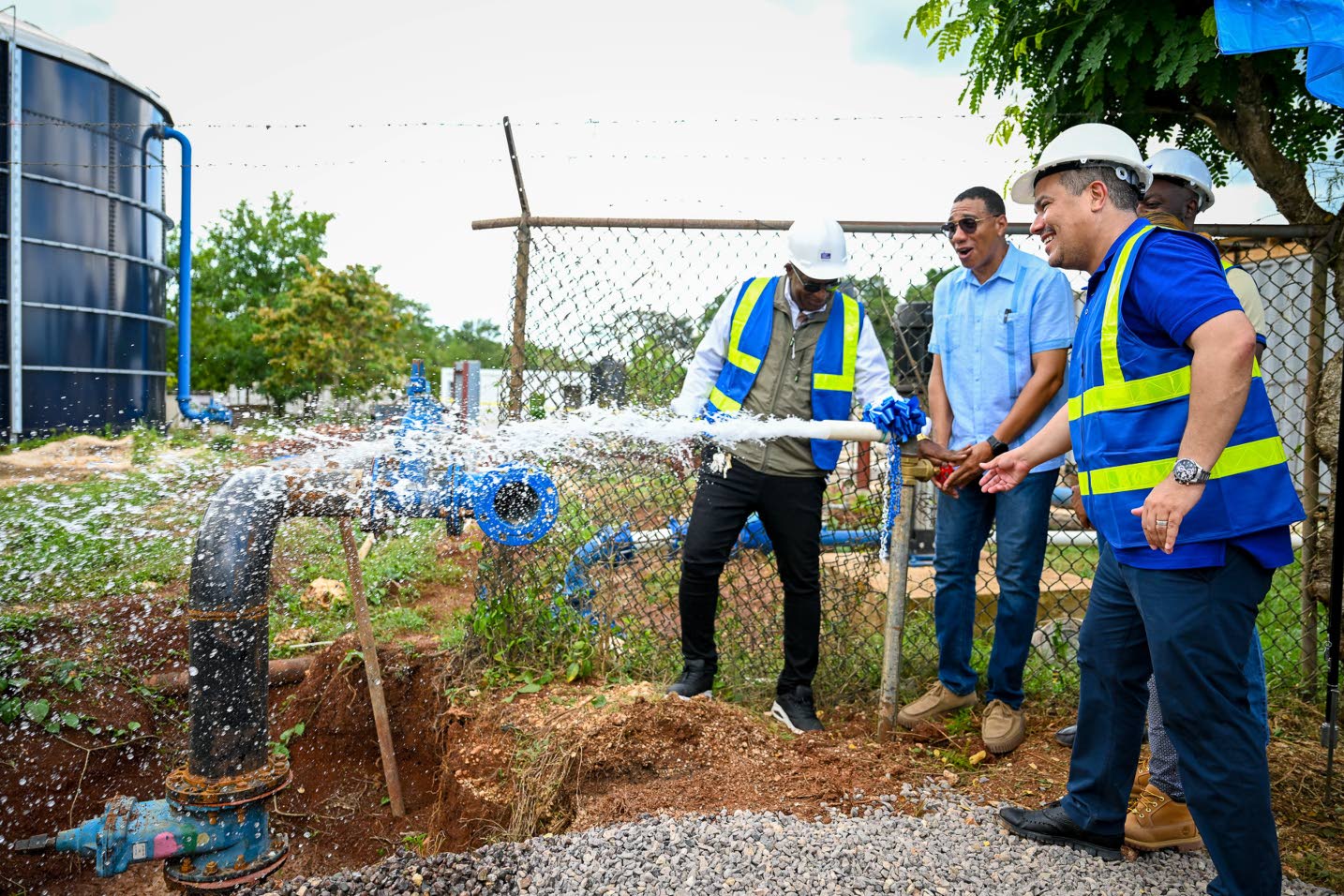
Prime Minister Andrew Holness (centre) turns on the valve at the commissioning ceremony for the Runnit Pipeline Project in St Elizabeth, one of the water supply schemes which minister with responsibility for water Matthew Samuda (right) says the Administration has delivered in the past year. Looking on is Member of Parliament for St Elizabeth North Eastern Delroy Slowley.


