



Head and Heart
The mental battle of Jamaican athletes in the hunt for glory
TOKYO, Japan — For Jamaica’s top athletes, the battle at a major championship is not just about times, distances, or the perfect execution of technique. It is also a fight against doubt, personal ambitions, and the immense weight of carrying a nation’s hopes.
Behind the medals and headlines are human beings navigating the mental strain of living up to an unforgiving standard wherein anything less than the podium can feel like failure.
Pressure from within.
Each individual experiences and reacts differently to the stress but for Jamaica’s 800m flag-bearer Natoya Goule-Toppin, the psychological toll has been a silent battle that, at the Olympic Games in Paris, came to a boil.
“It is super difficult because everyone is expecting you to go out there and win,” she said, reflecting on her own mental journey. “You know Jamaica — if you don’t have a medal it’s like you’re nobody. And that could put a lot of stress on you.
“Coming into this championships I didn’t put any stress on myself, I didn’t try to please anyone because, yes, I am here and I am representing my country [but] I am also representing myself and my mental health. I would normally put pressure on myself, asking, ‘What would this person think?’, ‘What would that person think?’, but coming into a championship, if you are not strong mentally, and if you don’t make it to the final or perform how you want to perform, it can take a toll on you.
“Last year at the Olympics, after not making it to the final, I was literally walking in the village like a madwoman. It was like I was going crazy because I knew what I could have done.”
Goule’s experience is not unique. Across the Jamaican team in Tokyo, athletes have been vocal about the importance of mental resilience, and how the smallest mental lapses can derail years of physical preparation.
High jumper Romaine Beckford admits that learning to manage his mindset was the biggest lesson of his 2025 season.
“I think right now everything builds on the mentality, and I think each championship that I go to, I have learnt to accept stuff and move forward in the situation and not keep it in with me,” Beckford explained.
“One of the biggest mistakes I made this year was, coming off the great ending of the season that I had in 2024, I expected too much of myself and then the first couple meets that I went and it didn’t go well, it kind of had a mental block on me.
“As the season went on I learnt to accept things, and that made things better for me. Going forward next year it’s for me to know that this is track and field; you can feel good today and then tomorrow you go out there and still feel good but nothing goes your way. So, it’s just whenever there is a fire, you blaze it,” Beckford added.
For Samantha Hall, who made her first global final this year in the discus, the lesson was about endurance — not just physical, but mental.
“Big lesson is, it’s a long season; it’s my first time competing this long. I am trying to see where I am at, how I can perform, work on my technical cues,” she said. “So coming next year and the years after, I just have to work on those and especially being mentally prepared for a final. It was my first final so I really didn’t know what to expect. So for the coming years that will be what I need to work on — how to be mentally strong whether the energy is there or not.”
Mental strain is not an issue that only affects athletes at the lower end of the performance scale. Seasoned campaigner and medal magnet Shericka Jackson shared that she too has wrestled with the psychological stress of expectation.
She demonstrated her Teflon resolve in the 200m final, bouncing back from months of physical problems and bitter disappointment in the 100m final to win bronze and add to her collection.
Jackson shared how speaking with her therapist helped her reset after a difficult stretch.
“It was really rough. I think the two days’ break — even though I didn’t like the break — I think the two days helped me to recover. I spoke to my therapist and we worked through getting better, and I think I recovered well so I am now OK,” said Jackson after her 200m success.
Meanwhile, triple jumper Jordan Scott was blunt about the burden athletes shoulder.
“It’s a lot,” he said. “You have the weight of a nation on you and family, friends. You’re trying to go out there to be the best version of yourself at all times [so as] to represent all of this, and I think if you’re not all the way there mentally it can take a toll on you and it will affect some performance,” Scott told the Jamaica Observer.
“I think at the end of the day you should just stick to the process that you have going for the entire season that allowed you to be successful, and just go out there on the day and zone in.”
These candid admissions highlight what administrators are also beginning to acknowledge — success at this level is as much mental as it is physical.
Jamaica Athletics Administrative Association Vice-President Ian Forbes, who also leads the Jamaican delegation in Tokyo as team leader, confirmed that greater emphasis will be placed on mental preparation as part of the federation’s wider support system going forward.
“Most definitely,” Forbes told the Observer. “As you know, it can be very stressful for some and for others it can be traumatic, and of course to keep them calm, calm their nerves, help them to focus mentally — it’s certainly not just about the physical side. The mental side is extremely important so most definitely, yes, it’s something that we are looking at working on
“I am positive that in short order you will see it being employed on a regular basis.”
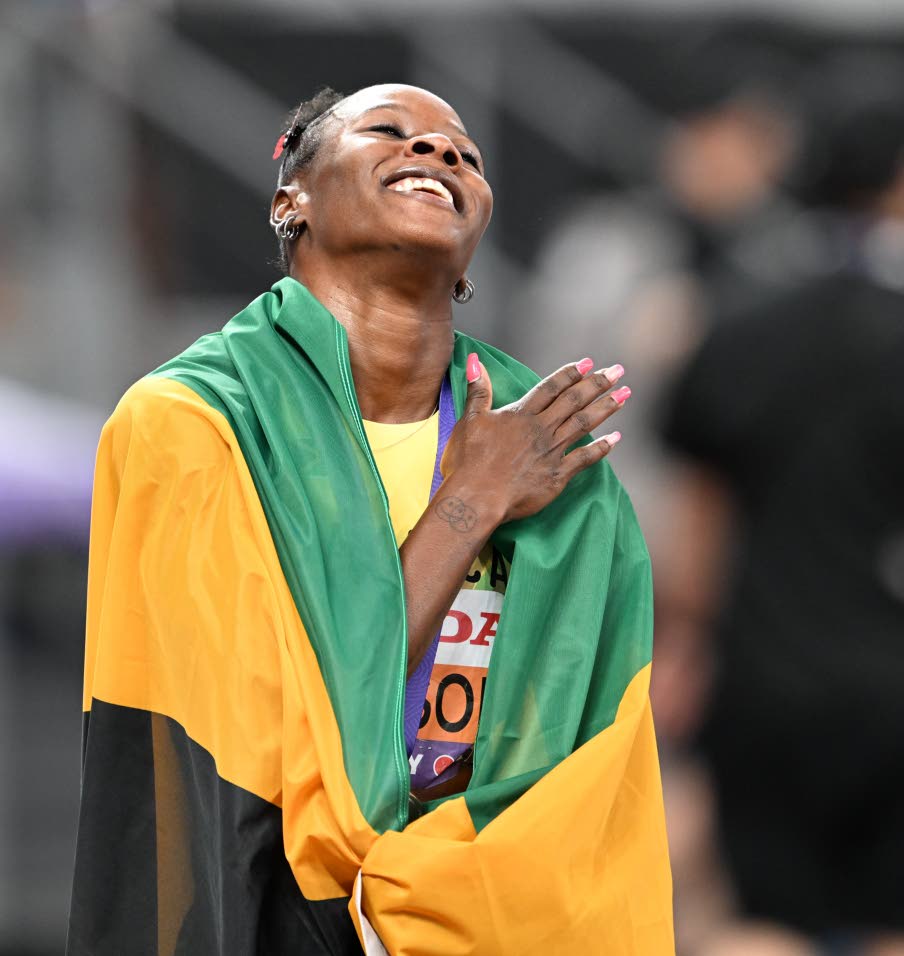
Shericka Jackson of Jamaica celebrates winning the bronze medal in the women’s 200m final race during the World Athletics Championships in Tokyo, Japan, on Friday. (Garfield Robinson)
.


