$1-B roast
Melissa brews big loss for Blue Mountain coffee industry
Jamaica’s Blue Mountain coffee industry, pinned under the merciless grip of inclement weather for the past four years, has been dealt a punishing blow by Hurricane Melissa estimated at losses of $1 billion, according to sector expert Norman Grant.
“We had estimated that the crop would be about 270,000 boxes of coffee. So we are estimating that approximately 100,000 boxes were lost, because what happened is that some of the trees were also damaged,” Grant, chairman of Jamaica Coffee Exporters Association, told the Jamaica Observer on Friday.
“So 100,000 boxes at $10,000 per box, we are estimating the loss to be about $1 billion just on the farm gate value alone,” said a dismayed Grant.
According to Grant, the sector had been suffering successive losses each wet season for the past four years, resulting in an accumulated deficit of $2.5 billion.
“[In] the rainy period during 2022-23, we lost 50,000 boxes. So over the last four years the 5,000 coffee farmers have sustained losses estimated at about $2.5 billion. That’s huge! And that is why I’m saying that [the loss this year] is colossal,” he added.
One of the roads leading to coffee factoris in the Blue Mountains is badly damaged by rain associated with Hurricane Melissa.
Data provided by the Observatory of Economic Complexity state that Jamaica is the 58th largest exporter of coffee in the world, exporting US$26.2 million of the product in 2023, and an average of US$25 million (approximately $4 billion), yearly.
On Friday, Grant described the damage done by Hurricane Melissa to the Blue Mountain coffee industry as catastrophic and extensive, saying that preliminary reports showed that about 40 per cent of the crop that was matured and ready to harvest prior to the storm’s landfall had been ravaged.
Grant, who is also CEO and managing director at Mavis Bank Coffee Factory, said that many roads leading to factories in the Blue Mountains were either blocked or reduced to mud paths, resulting in factories being inaccessible for up to three days after Melissa’s onslaught on October 28. Some areas, he said, are still cut off.
“That is in the parishes of St Thomas, St Andrew, and Portland. We’ve also lost access [due] to major cutaways in some critical roads that lead to the processing operations of the factory. So you’re talking about roads from Gordon Town to Mavis Bank.
“You have the Mavis Bank Coffee Factory, for about two or three days we could not access the factory. Thank God those roads are [now] open. You have up in Clifton Mount [coffee factory], Papine to Clifton Mount via Newcastle. You have Coffee Traders who have their plant up there that they can’t access. They have not been able to access the plant because of a huge cutaway on the Newcastle Road, and right now they’re cutting a road through Holywell just to gain access,” he explained.
Grant also expressed concern over the loss in telecommunications, saying that, though most utility poles were spared, electricity has not been restored in some key areas.
“There’s no light, there’s no communication. Communication is coming back now, we have Starlink at Mavis Bank, but there’s no lights from Gordon Town throughout the hills. And we are making an appeal to JPS (Jamaica Public Service Company) — because a lot of the poles were not down — to come in quickly. I wrote to JPS and I wrote to [telecoms provider] Flow for them to come in and do a quick assessment,” he said.
He suggested that the agriculture ministry, in an effort restore production, “implement the Coffee Crop Resuscitation and Establishment Programme (CREP) by investing and allocating $300 million per year for five years in provision of a million coffee seedlings, fertiliser, chemicals, tools, and pumps to 5,000 coffee farmers. There should also be a programme for the maintenance of the farm roads network, as well as the sustainable programme for river training”.
The CREP initiative, which was introduced last year by Agriculture Minister Floyd Green, was proposed with a view to boost productivity with a target of 450,000 boxes per year.
Grant said that, while he understood the Government’s keen attention on western Jamaica, which received the brunt of Category 5 Melissa’s fury, he is asking for urgency in providing aid to the thousands of coffee farmers whose livelihood is once more at stake.
“We know that the west is significantly affected, but the prime minister wants economic activities and productive activities to start in the parishes of Portland, St Thomas, Kingston, St Andrew, and St Catherine that were least affected. So I think that we certainly need tremendous help to commence production at this time,” he said.
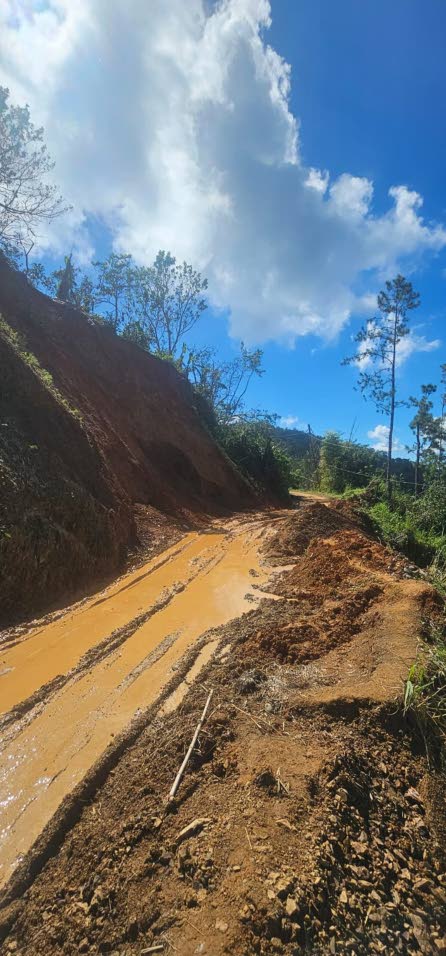
One of the roads leading to coffee factories in the Blue Mountains that as been reduced to a mud path, resulting in factories being inaccessible for up to three days, according to Jamaica Coffee Exporters Association Chairman Norman Grant.