Power play
Govt rejects JPS’s bid for early licence extension, lends company US$150m to speed up power restoration
In a move to fast-track national power restoration, Energy Minister Daryl Vaz announced on Tuesday that the Government has approved a US$150-million loan to the Jamaica Public Service Company (JPS) while firmly refusing to grant any early extension to the utility’s licence beyond 2027.
Vaz told the House of Representatives that the emergency funding is intended to speed up repairs and bring the electricity grid back to normal far sooner than the timelines previously suggested by JPS. He said the cash — expected to be used at an estimated amount of about US$75 million a month — would allow the company to mobilise crews and equipment needed to restore power knocked out by Hurricane Melissa on October 28.
Vaz said the Government has agreed to lend JPS the money on the basis that the company will use it to “restore the entire grid, save and except for any special area that may not be reachable, but the major areas by the end of January, latest early February”.
He made clear that the loan is strictly separate from the broader issue of JPS’s all-island service licence, which expires in 2027.
Vaz explained that if the Government did not respond with a position by July 2025 it would trigger an automatic 10-year extension of the licence.
“So you’d be talking about a licence that was given in 2001, renewed in 2016, which expired in 2027, to go from 2027 to 2037 under the same existing conditions,” Vaz said.
He insisted that the Administration had “skilfully separated” the restoration financing from licence negotiations to prevent any delay in getting funds to the field. He also said Cabinet approved the measure after consultations with the Ministry of Finance and other senior officials, and that technical oversight would be put in place to ensure public money is spent as promised.
Vaz also stressed that the Government’s approach preserves its negotiating leverage over the future of the electricity sector, particularly as JPS had lobbied for a 15-year extension in exchange for accessing financing on its own. He argued that the loan allows restoration to proceed without committing the country to unfavourable terms ahead of the 2027 licence expiry.
“So there is no risk to the Jamaican Government or the taxpayers. What we have done is skilfully separated a negotiation of a loan and untied from all of these proposals of extensions. I want to point out to you very carefully, any negotiation that involved the licence or amendment of licence would retard the period of time when we need to get the money,” he added.
According to Vaz, the loan will span five years with an interest rate still to be finalised by the Ministry of Finance. JPS will, however, have the option to repay within two years.
Vaz said this provision factors in the point at which the licence expires — either JPS will secure a renewed licence and refinance on its own, or, failing that, the Government would be positioned to acquire the utility’s assets.
“If they have a licence, they can attract financing, and if they don’t have a licence, the Government has already indicated to them, based on our June-July 2025 letter, that we are prepared to acquire the assets of the Jamaica Public Service, which means that our money is protected fully,” said Vaz.
The minister also noted that updated assessments had placed the hurricane damage at about US$350 million — significantly lower than earlier estimates of between US$480 million and US$600 million — but still well above the immediate loan value. JPS has, meanwhile, suspended dividends until full restoration is achieved.
As the debate unfolded, Opposition spokesman on energy Phillip Paulwell raised concerns about transparency, seeking clarity on the interest rate, valuation mechanisms should the loan convert to equity, and the source of the remaining funds required to complete restoration. He urged the Government to secure key concessions in exchange for the loan, particularly around grid access, renewable energy flexibility, and cheaper power for industrial zones.
“You can’t lend money without that very important element being known,” Paulwell cautioned, pressing for what he described as basic financial disclosure.
Paulwell argued that the Government should not overlook the opportunity to demand structural reforms from JPS in return for the loan. He pointed to long-standing concerns about monopoly control, electricity pricing, and the barriers private operators face in supplying power during emergencies or commercial operations.
He suggested that the loan should be used to push for greater flexibility in times of crisis, especially where communities with working private solar or alternative systems are unable to legally share power with neighbours while awaiting JPS restoration.
“Today, due to a hurricane, if my neighbour has a solar system that is working two days after the hurricane, and I am on JPS, damaged and out of power for months, my neighbour can’t run a wire across my fence and give me electricity because that person would be in breach of the licence. I am suggesting, Minister, you get them to waive that requirement,” he said.
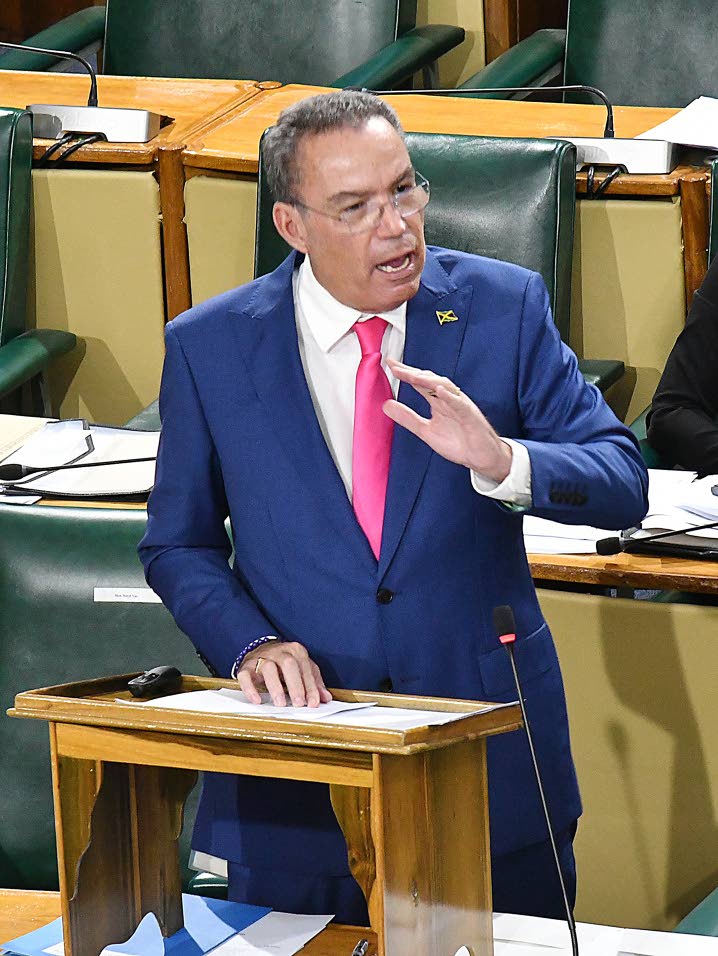
Energy Minister Daryl Vaz making a statement to the House on Tuesday. He said the Government has approved a US$150-million loan to the Jamaica Public Service Company while firmly refusing to grant any early extension to the utility firm’s licence beyond 2027. Photo: Karl Mclarty