



Together we will rebuild stronger
In the aftermath of the very destructive and deadly Hurricane Melissa, which ravaged our western parishes of St Elizabeth, Westmoreland, Hanover, St James, and Trelawny, the Jamaican spirit, at home and abroad, is alive and well, what with the relentless efforts of the caring among us to seek out and assist those who have been affected in one way or another, materially, physically, and emotionally.
It is said that out of every adversity there should come some good. In this instance, as we enter the rebuilding phase, we should resolve to come out of this disaster better and stronger. In this era of climate change, it is unlikely that this generation has seen the last of an event of that magnitude which is driven by global warming. Melissa, according to physics lecturer Dr Jayaka Campbell of the The University of West Indies, Mona campus, is not an anomaly but rather an early indication of a dangerous new reality of our warming world. In other words, we need to “tek sleep and mark death”. Dr Campbell also suggests that actions which mitigate any degree of warming — investing in resilient infrastructure and making vulnerable regions more adaptive to such hostile conditions — can make the “difference between survival and catastrophe for millions of people”.
As we approach the rebuilding stage of our recovery, let us be mindful of the lessons learnt. Hurricanes, particularly at Category 5, are destructive and deadly. It is unlikely that we will see a reversal in this developing trend of strong hurricanes on an annual basis. So what are our options? We have to be climate smart, mitigate, and adapt — or perish.
Unfortunately, small island developing states (SIDS) such as Jamaica contribute very little to climate change; in fact, quite minuscule compared to that of large industrialised countries, with our contribution being less than 1 per cent of global greenhouse gas emissions. Yet we are the more vulnerable and bear the lion’s share of the wrath of the effects of climate change, which includes excessive rainfall, flooding, rising temperatures, droughts, sea level rise, and destructive hurricanes such as Category 5 Melissa. It is, therefore, up to us to play our collective part by further reducing our contribution to climate change through measures such as reducing our reliance on fossil fuels and using renewable energy sources (solar, wind, hydropower, biomass, geothermal, ocean, and hydrogen). Jamaica’s target for the implementation of renewable energy as an alternative source of electricity is 50 per cent by 2030. Currently, we are at 12 per cent, primarily driven by wind, solar, and hydropower.
It is imperative that we build our infrastructure to be resilient, by, inter alia, ensuring that our buildings are designed to be more resistant to climate hazards.
Black River in St Elizabeth, which is the first town in the western hemisphere to have electricity, was decimated by Hurricane Melissa and described by Prime Minister Dr Andrew Holness as “Ground Zero”. That parish capital will, therefore, have to be rebuilt. It was previously earmarked by the prime minister as Jamaica’s next city, with its redevelopment to focus on heritage restoration, education, and tourism.
The Urban Development Corporation (UDC) has been given the responsibility to identify a suitable area in the parish to locate the new purpose-built city. Certainly, the climate resilience of such a location must be a major consideration. But when we drill down to infrastructure, one question that needs to be asked is: Will the undergrounding of utility service cables be placed on the table? I am not an expert in this field, but I am sure that economics will be at the forefront of such a discussion. However, when one juxtaposes this method with the sight of hundreds of utility poles across the island looking like broken and fallen match sticks, you cannot help but give consideration to an alternative approach.
Our attention should also be focused on our coastlines and how we allow development to take place in proximity to the foreshore, especially in the case of public beaches where commercial activities are allowed.
There are limitations which are set out in land titles as to how close a building or structure can be constructed to a boundary. These are called restrictive covenants. The restrictive covenant for a residential property in St Thomas, which shares a boundary with the Caribbean Sea, reads as follows: “No building or structure shall be erected on the said land nearer than 30 feet to any road boundary which the same shall face nor less than 5 feet from any other boundary…” In the case of the sea, the boundary is high water mark (HWM). Part of the challenge with these properties is the rise in sea level due to global warming and, therefore, the inward movement of the boundary (HWM). Note that the setback from the roadway is six times that of the setback from the sea. Make of that what you will.
What is even more alarming is the fact that there are similar beachfront properties for which no restrictive covenants are endorsed on the certificates of title limiting the distance to which infrastructure may be constructed. Yet, where they do exist, there is very limited or no enforcement.
In this new era of the built environment we must, as a consideration for the safety of life and property, ensure that such restrictions be expanded to greater distances from boundaries with the sea, declare certain coastal areas no-build zones, and where buildings are allowed, enforce the restrictions.
We now have the opportunity to ensure that buildings and other structures which were constructed within such areas, but demolished by Melissa, are not reconstructed. The municipal corporations have to be more strident in their role of protecting the environment and thereby preserving a sustainable future for our island home, Jamaica, land we love.
But they cannot do it alone. All hands must be on deck. All available expertise to guide our recovery must be engaged. The Faculty of the Built Environment at the University of Technology, Jamaica, with its two schools, the Caribbean School of Architecture and the School of Building and Land Management, together with our School of Engineering, are well placed to provide technical support.
As we traverse the many rural communities in the west that have been ravaged by the hurricane, it is very heartening to witness the spirit of the Jamaican people, the hope that they exude, and the determination to fight back. Some are already in the field tilling the soil to feed the rest of us. But they, too, need significant assistance in introducing resilience into their rebuilding process.
Many are facing homelessness and are literally picking up the pieces of their houses and recycling the materials to aid in reconstruction. Not even when new materials are used can some of our building practices stand up to the now ferocious winds which accompany these climate-induced hurricanes. We must, therefore, provide guidance to our populace, through public education, on the minimum standard for residential buildings, starting with a simple studio unit, which will hopefully be within the reach, perhaps with some assistance, of any ordinary Jamaican.
Let us join hands as this recovery will not succeed without the collective effort of every Jamaican who means this country and its people well. We are thankful for the overwhelming support which we are receiving from the international community.
With this approach, Jamaica will rebuild stronger and better.
Dr Glendon G Newsome is a commissioned land surveyor, associate professor, and vice dean (acting) in the Faculty of the Built Environment, University of Technology, Jamaica. Send comments to the Jamaica Observer or ggnewsome@cwjamaica.com.
Glendon Newsome.
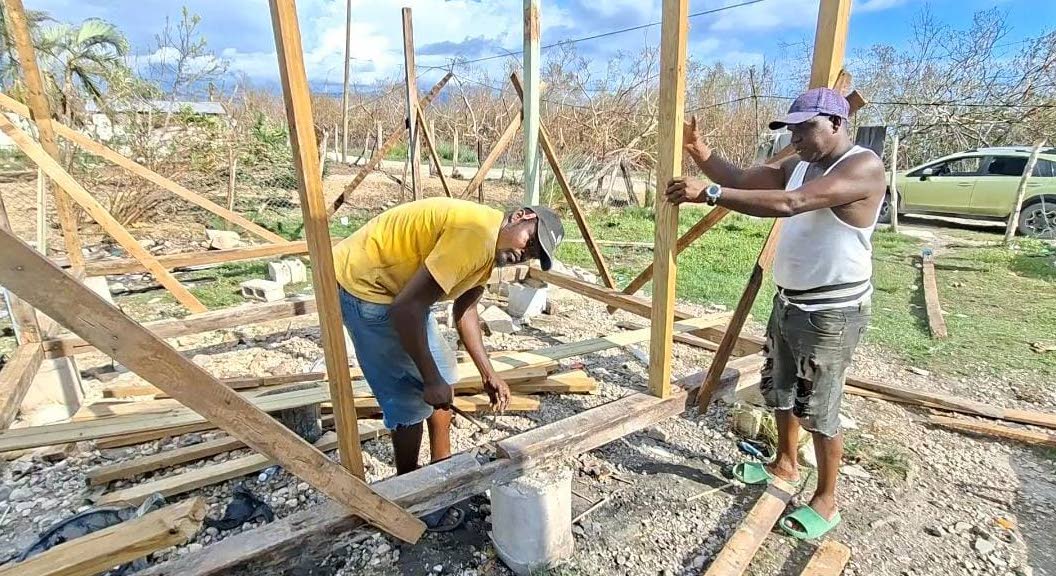
Wharf Road, Westmoreland, residents Travis Williams (left) and Elvis Nepaul giving a helping hand to a neighbour who is rebuilding after Melissa destroyed his house. (Photo: Rosalee Wood Condell)


