Predators active
Caregivers warned to be ‘paranoid’ after Hurricane Melissa as children are under threat
WITH thousands of children left to the elements, and increased threat from predators due to their homes and other safe spaces being wrecked by Hurricane Melissa, professor at The University of the West Indies Zoyah Kinkead-Clarke has urged caregivers to “be paranoid” in watching over them, even while calling for urgency in the construction and repair of safe spaces for the minors.
The observation came while preparations were being made for the hosting of a two-day Regional Colloquium on Early Childhood Education at The University of the West Indies (UWI) Regional Headquarters in St Andrew which ends today.
The conference, themed ‘Building Strong Foundations: Advancing Early Childhood Education Through Policy, Practice and Partnership’, is being held in collaboration with the Jamaica National (JN) Foundation, the Early Childhood Commission (ECC), the UWI School of Education, and the Dudley Grant Early Childhood Resource Centre.
Tuesday, Kinkead-Clarke, who is professor of early childhood care and education and deputy dean of graduate studies in the Faculty of Humanities and Education, and manager of the Dudley Grant Early Childhood Resource Centre at the university, told a Jamaica Observer Press Club that the disaster wreaked by Hurricane Melissa has increased the risk of abuse on a level even greater than what occurred during the COVID-19 pandemic when schools were shuttered.
“During the pandemic we had a heightened level of children who were victimised sexually, or through neglect, or they were poly-victimised [made victims in multiple ways],” Kinkead-Clarke told Observer Press Club editors and reporters.
According to Kinkead-Clarke, with walls of protection and separating fences literally down or blown to smithereens, there is heightened urgency for literal places of safety.
Last Friday, Education Minister Senator Dr Dana Morris Dixon, in a statement to the Senate, described damage to the physical infrastructure of educational institutions as monumental, with the lives and routines of 111,177 students and approximately 5,000 staff members across public educational institutions upended.
Morris Dixon said 21 public tertiary institutions and 679 schools were affected by the Category 5 hurricane which made landfall on the island’s south-western coast on October 28, causing major damage to schools mainly in St Ann, Trelawny, St James, Hanover, Westmoreland, St Elizabeth, and Manchester.
At the same time, acting director general of the Office of Disaster Preparedness and Emergency Management, Commander Alvin Gayle last week said by way of building counts for dwellings, approximately 156,000 dwellings were damaged, with some 24,000 of that number being total losses.
“In early childhood we classify schools as a protective factor, so when children have access to schooling it helps to cushion them from many of the difficulties that are likely to happen when they are not in school. What the Child Protection and Family Services Agency will tell you is that during the summers there is an increased level of sexual and other forms of victimisation of young children, and so what COVID-19 did was present two years of summer. That’s fundamentally what happened. And so when we think about it we need to provide that opportunity and a space for children to get that protection,” Kinkead-Clarke emphasised.
“So protection cushions them from the harsh realities that are likely to occur so I encourage parents to be vigilant. You have to be vigilant even when there is not a catastrophe such as Melissa but now that we have this catastrophe, be mindful of who you are leaving your children withdon’t take it for granted. I encourage parents to be paranoid. Don’t take it for granted that because you know someone means you can trust someone, and so if it means you have to carry them wherever you are going, do so.
“Many times young children end up being victimised for a number of reasons, and (legal) cases with young children often don’t work out in their favour because it takes years. COVID was five years ago, why are there cases still before the courts? Those young children are likely to have forgotten critical details that they would need to share,” added Kinkead-Clarke.
She argued that the protection of children must become a communal effort.
“This is where the community has to come on board, the Church has to come on board; this is where family members really have to pull their weight. But we realise that many times children are not victimised by strangers – they are victimised by persons who they know,” she pointed out.
In the meantime Allison Montgomery, Programme Officer School of Education Mona, said the security breaches created by the Category Five hurricane, as it tunnelled through the island’s south-western coasts, might make what occurred during the pandemic seem like child’s play.
“In my opinion, this crisis we are faced with is worse than COVID. At least in COVID you could control certain factors – children were within their homes. Given what we know, they are literally without homes [now] and the burden that is being experienced is being experienced by all stakeholders,” she pointed out.
According to Montgomery, the situation is such that, “parents are not able to parent as they would because their mental health is compromised as well”.
“And so we will need to think creatively about how we help the parents, teachers, because they all experienced loss –loss of income, loss of housing, loss of security – and so it’s taking a toll so broadly that we have never faced anything of this magnitude before. So, it will take creativity and lots and lots of help to navigate a path forward,” said Montgomery.
“So as we think about the children we also have to think about the caregivers. The community itself has been compromised because the Church, the community centre, lots of places have been breached. And so, we have to think where would be a safe space and how it is we can get some safe spaces up and running and cater to the mental health of the providers of the care,” Montgomery added.
She was supported by lead for the Youth and Education Programme with Jamaica National Foundation, Sydoney Preddie, who pointed out that, “Melissa has really displaced a lot of persons and there is a lot of socio-economic disparities and lack. Jamaica is experiencing lack like never before – especially for persons who have lost everything,”
Professor at The University of the West Indies Zoyah Kinkead-Clarke (right) making a point while and general manager of the JN Foundation Claudine Allen listens in during a meeting of the Jamaica Observer Press Club on Tuesday. (Photo: Joseph Wellington)
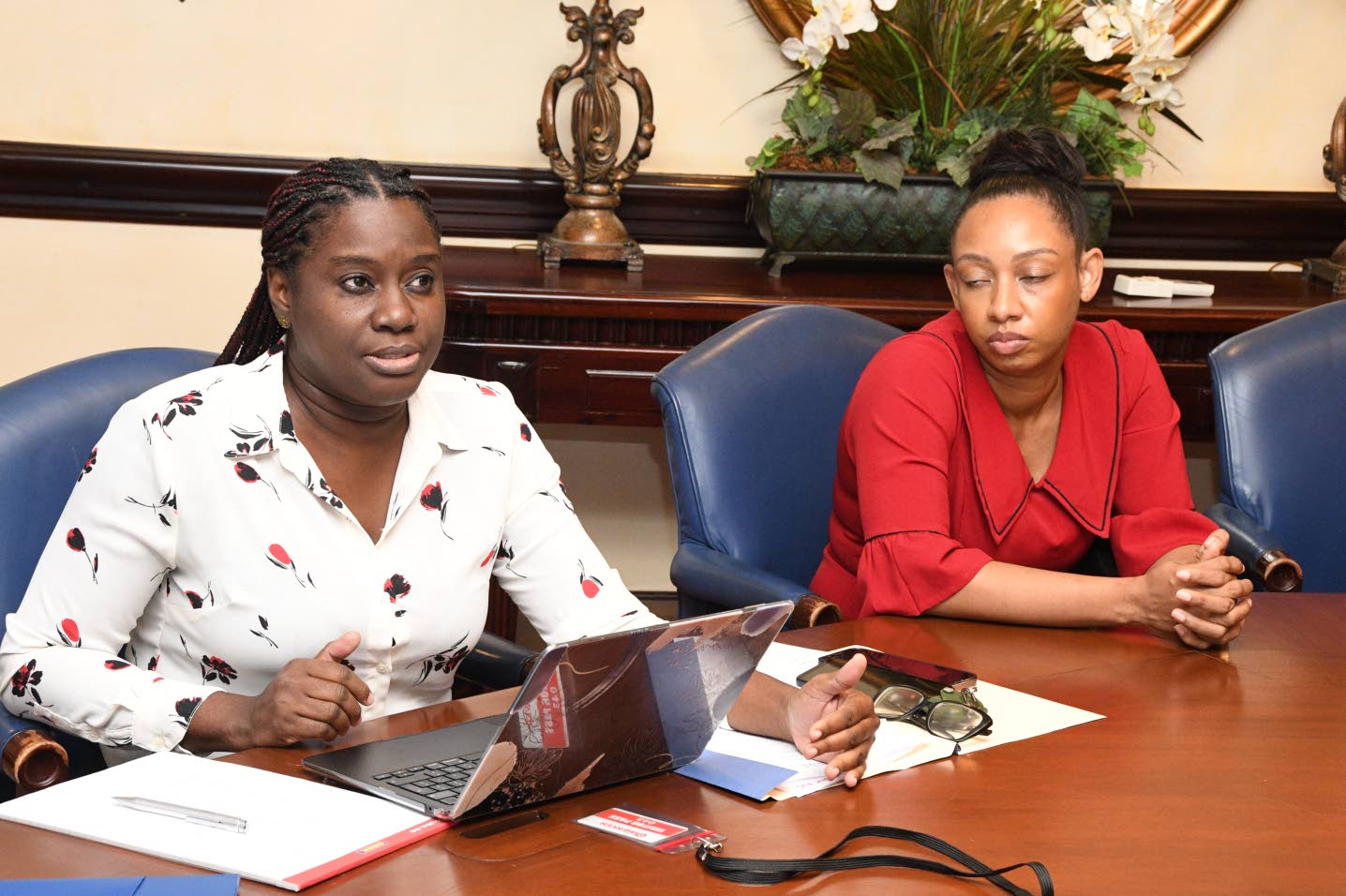
Allison Montgomery (left), programme officer at the School of the JN Foundation, Claudine Allen Education. and Youth and Education Programme with the Jamaica National Foundation Sydoney Preddie, sharing their views during the Jamaica Observer Press Club on Tuesday. (Photo: Joseph Wellington)