95% of schools now engaging students
Education ministry says teaching and learning continuing despite repair activities and people using classrooms as shelters
Permanent secretary in the Ministry of Education Dr Kasan Troupe has reported that 986 schools are now engaging students in the aftermath of Hurricane Melissa, but acknowledged that many are relying on tents, rotation systems, or hosting arrangements.
However, she defended classifying them as operational, arguing that under emergency protocols it is continuity of learning, and not the state of the physical campus, that determines a school’s status.
During Wednesday’s sitting of the Public Administration and Appropriations Committee (PAAC), Troupe presented an update on the ministry’s Hurricane Melissa recovery efforts. She reported that Jamaica’s school system has largely rebounded, although temporary classrooms, adjusted schedules, and questions over the accuracy of reopening data remain.
Troupe said that Jamaica’s principals have been updating a live national database throughout the week, resulting in a rapid shift from the earlier figure of approximately 150 schools being closed, which was presented during Tuesday’s Standing Finance Committee.
“The last data set that was consulted revealed 850 [schools open], but since morning our principals have been actively entering the data because we have an active database and I’m proud to report to Jamaica that 95 per cent of our schools are engaging students in teaching and learning and emotional recovery. I would like to indicate that 986 schools are open for teaching and learning [and] only 24 schools are not physically open but the students are being connected through the rotation and the hosting model,” she noted,
However, the announcement drew scrutiny from Opposition spokesman on education, Damion Crawford, who questioned how schools accommodating shelter residents could simultaneously be considered “open”.
Crawford pointed out that 55 schools remain in use as shelters, raising concerns about student safety and the separation of learning spaces from displaced families.
In response, Troupe emphasised that being open does not necessarily mean full physical restoration.
“Within an education in emergencies framework you have to do rotations, you have to do remote, you have to look at all the modalities that are available to ensure continuity of learning and emotional recovery,” said Troupe.
She added that strict measures are in place to keep learning areas and shelter spaces separate on school grounds to ensure student safety.
“Well those centres that we have, those schools that are being used as learning centres for continuity, the blocks are managed. So there’s a shelter manager in the shelter, [and] there’s a conversation and a relationship, so persons are secured in a particular location on the blocks that are removed and there’s segregation,”
Furthermore, she clarified that some of the schools used as shelters have only a small number of students who are coming to school physically.
“The students are being engaged on rotation, teachers are involved, and we consider that operational. But of those 55 schools, just to say that some of them might only have like seven or eight students in the shelter, so it wouldn’t take up the entire school space,” she further clarified.
Troupe also highlighted the considerable support the ministry has received from international partners to help stabilise the system more quickly than anticipated. UNICEF, she noted, has provided temporary learning tents for some of the most severely damaged schools, enabling classes to resume even while construction teams begin repairs on the main buildings.
Crawford, however, continued to press the ministry on whether simultaneous construction and instruction could pose safety risks. He questioned how students could be adequately protected in environments where repair crews are operating and heavy equipment is present.
Responding to these concerns, Executive Director of the National Education Trust (NET) Latoya Harris-Ghartey assured the committee that stringent safety protocols are enforced at every site.
“We have at least 25 schools updated this morning that we’ve issued commencement letters to the contractors…I know on the weekend, at least three of those schools, the boarding was going on. Usually we have contractors going into schools and working, but there are safety mechanisms that they have to take into consideration and put in place. So they work with the principals to segregate that area. And that becomes a work space for the contractors,” she explained.
She added that many contractors carry out major tasks on weekends or after regular school hours to further minimise disruption.
Despite these challenges, both Troupe and Harris-Ghartey expressed confidence that the education sector is on a steady path towards full recovery.
The permanent secretary praised the resilience shown by educators and communities in ensuring that learning continues under difficult circumstances.
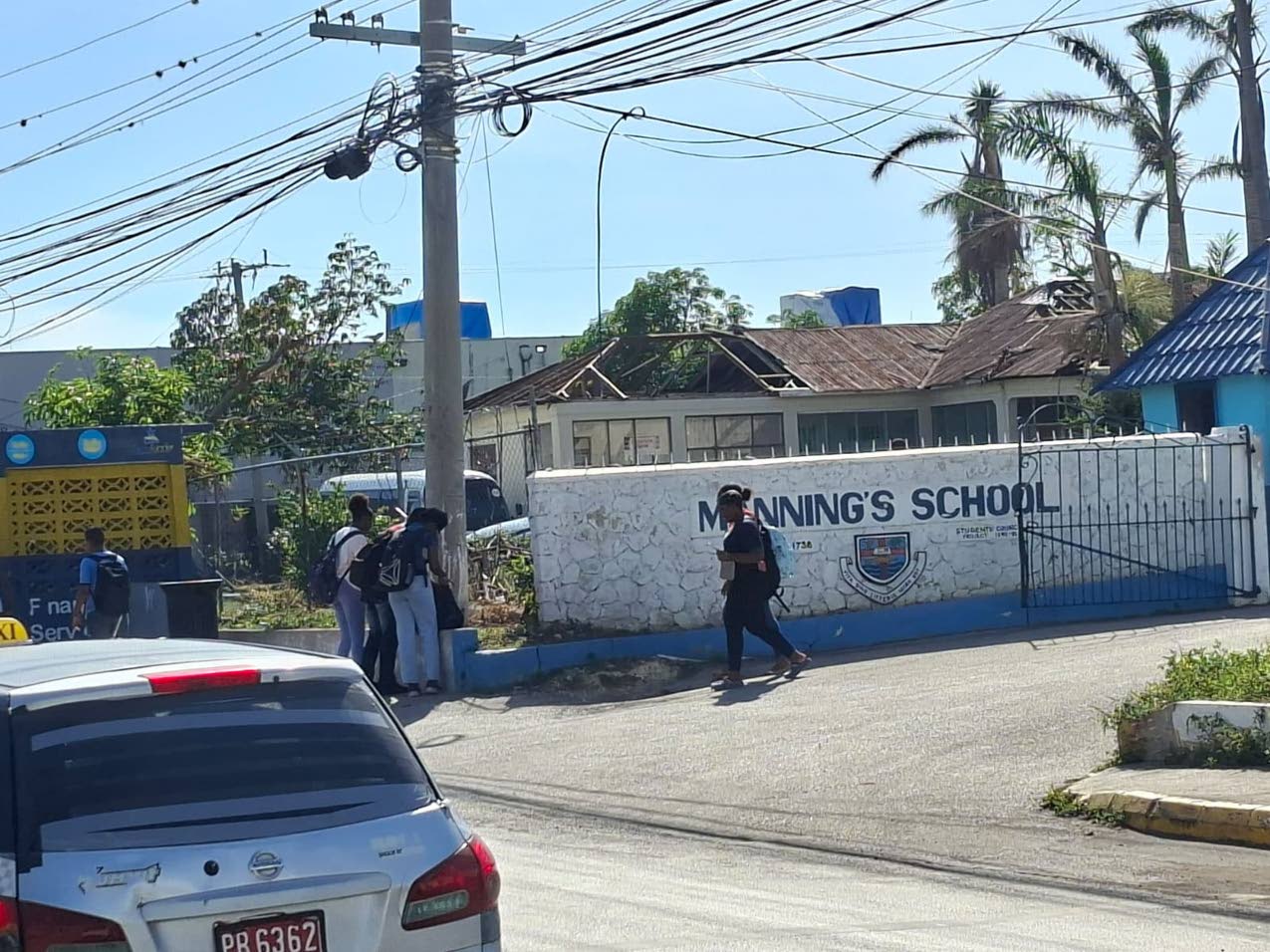
The Manning’s School in Westmoreland, which was badly damaged by Hurricane Melissa, is among those continuing teaching and learning on a rotating basis. (Photo: Rosalee Wood Condell)