



Adjournment in gang trial might be ‘demanded’, says lawyer
Judge expected to decide on start date today
ATTORNEY John Clarke, the man representing Tesha Miller, the alleged leader of a faction of the Klansman Gang — 25 members of whom are set for trial in the Home Circuit Division of the Supreme Court — says while presiding judge Justice Dale Palmer is reluctant to grant the adjournment being sought by the prosecution, it might be “demanded” based on several issues.
Clarke, in a submission before Justice Palmer last Friday when the matter was called up at the Supreme Court in downtown Kingston, took issue with indications by the Crown that, given several outstanding documents. there would be “ongoing disclosure” during the course of the trial, which was unable to begin on January 7 due to outstanding material critical to the matter.
Justice Palmer, who on Wednesday had indicated that he was not minded to grant an adjournment to June, which had been sought by the Crown, had been expected to rule last Friday as to the start date following submissions from the prosecution and the defence.
On Friday the prosecution — led by Acting Deputy Director of Public Prosecutions Janek Forbes — said DNA reports for samples from some of the accused, documents dealing with chain of custody, expert statements, and some scene of crime reports were still outstanding. Furthermore, he said the spelling of the names of several of the defendants needed to be clarified.
According to Forbes, indications by the State’s Forensic Lab were that the DNA “analysis will take approximately six to eight weeks”.
“And then there is the peer review process and the completion of the report, which will take the usual time frame. They indicate that they will endeavour to complete this in a shorter time; however, they indicate that the analysis period, there is no shortening of that period. I say that whilst appreciating your Lordship’s ruling that there will be no adjournment…in the context…perhaps some of these disclosures can be made during the trial,” Forbes submitted.
He, in the meantime, said the Communications Forensics and Cybercrime Division (CFCD) has indicated it will complete its work in six weeks.
“The CFCD is important as there were devices taken from at least two of the accused, and there were two devices taken from one of the two main witnesses and, certainly, in respect of one of these devices, it is of utmost importance. There are CFCD reports that are on the file; it’s not that the CFCD have not provided any reports,” Forbes told the court, adding, “We are in your hands in respect of the actual start date.”
Disclosure refers to the duty of the prosecution to provide the accused with copies of, or access to, any material held by the prosecution which might reasonably be considered capable of undermining the case for the prosecution against the accused or of assisting the case for the accused — regardless of whether that material will be introduced as evidence.
Clarke contended last Friday that the course of action being proposed by the Crown could jeopardise the matter.
“Re the ongoing disclosure, I would wish to urge upon the court that while the Crown has an ongoing duty to provide disclosure that are crucial to matters before the court, the rights we are attacking is the right of the guaranteed right of the accused to a fair trial and the right to adequate time and facilities for the preparation of their defence,” Clarke said.
The attorney, in insisting that preparation should be done before trial begins and not in the middle of the trial, said, “If I receive material crucial to my client in the middle of the trial that could amount to the rights of my client being abrogated by this common-law concept of ongoing disclosure, in those circumstances I ask the court to pay regard to these constitutional rights and special caution to the fact that when the accused are called upon to plea, they need to plead on all the material that touch and concern the defence,” Clarke said, adding that “the adjournment of the trial, though inconvenient, may be demanded based on those issues”.
Colleague defence attorney Denise Hinson, in the meantime, in a submission on behalf of her client Nashaune Guest, objected to having a sample taken from him.
“Our principal reason is the indication [by the prosecution] that he is asking for a sample just in case a profile is developed from what is already at the lab. The item has been at the lab for five years, there has been no profile developed from whatever was submitted to the lab, for which the comparative sample is being sought. It is my submission that to compel the accused to give his sample five years later, in circumstances where there has been no profile developed from what the lab already has with which it can be compared to see if there is match or not, is unfair in all the circumstances,” Hinson said.
Forbes, however, said this was not the case.
“We are not saying we are hoping that the lab will develop a profile. The incident we are speaking of is alleged to have taken place in February 2020, up to, certainly, 2023, when the witness gave his statements, this matter was treated as matter where there were no suspects. In those circumstances the DNA analysis would not have commenced because the lab operates on a priority basis… between 2020 and at least March of 2023, there would not have been that need for that analysis, certainly in respect of Mr Guest,” the acting deputy director of public prosecutions told the court.
Justice Palmer, in delaying his ruling, said given the additional submissions he would wait until Monday to indicate his decision regarding a trial date. In adjourning the matter, the bail for accused medical doctor Paul Robinson was extended while the remaining defendants who attended the hearing via
Zoom were remanded.
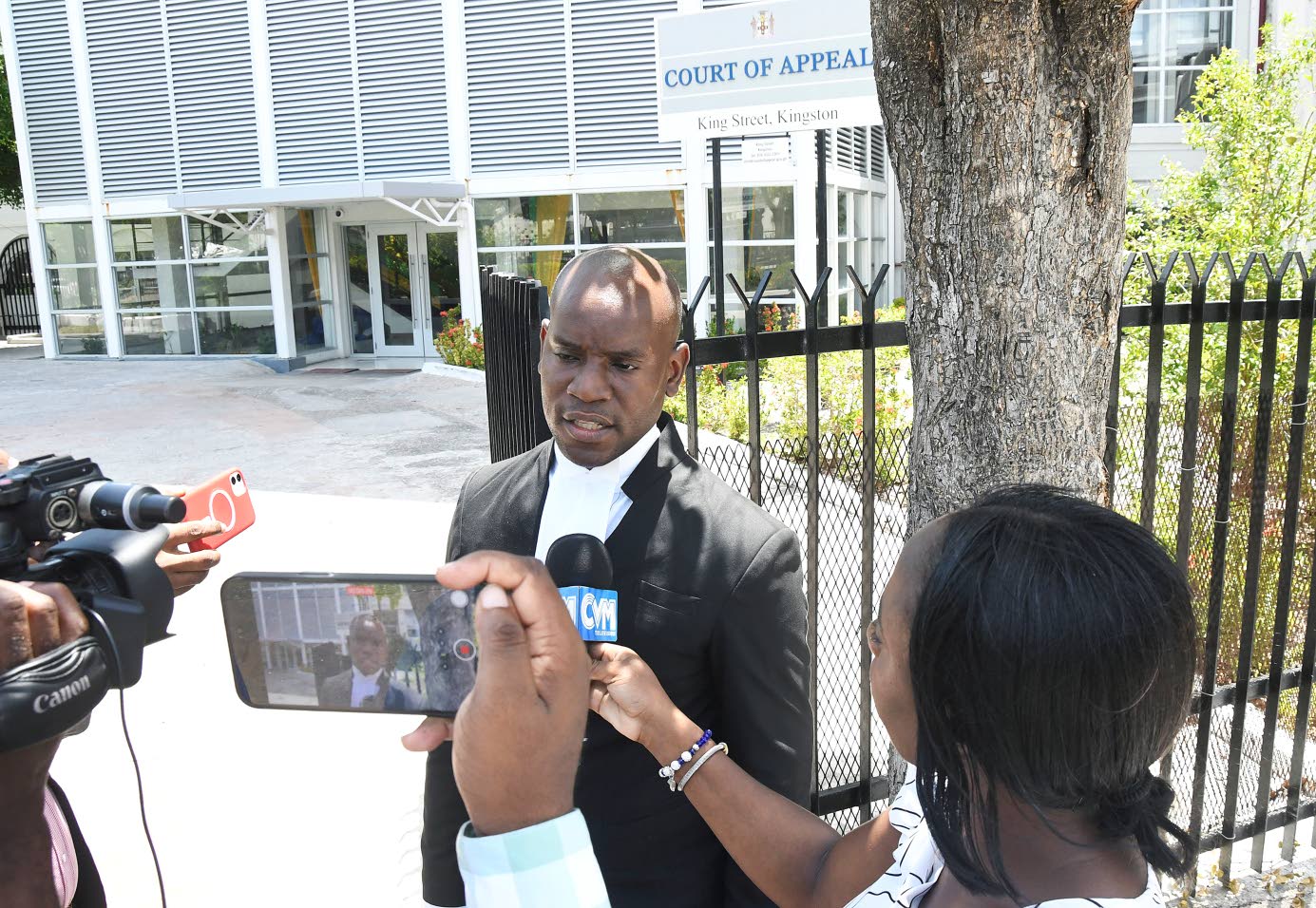
In this file photo, defence attorney John Clarke is speaking with journalists outside the Supreme Court building in downtown Kingston.


