



AI’s threat to labour
Major corporations in the US, such as UPS, Amazon, Intel, and Accenture, carried out considerable lay-offs last year. Greater efficiencies from artificial intelligence (AI) were cited as a significant factors for the following job losses: UPS separated 20,000 operational roles; Intel, 24,000; Microsoft, 15,000; Amazon, 14,000; Dell Technologies. 12,000; Accenture, 11,000; and I could go on.
Ultimately, profit is the lifeblood of business. It is said that when America sneezes we in Jamaica catch a cold. The replacement of millions of human workers with automation and AI-enabled logistics is not going away. It is coming. As we say locally, “Ah nuh guh it ah guh, ah come it ah come.”
Consider this: “If generative AI lives up to its hype, the workforce in the United States and Europe will be upended, Goldman Sachs reported this week in a sobering and alarming report about AI’s ascendancy. The investment bank estimates 300 million jobs could be lost or diminished by this fast-growing technology.” (Forbes, March 31, 2023)
A social/economic shock wave is heading our way. Those who don’t realise that are living in la-la land.
HISTORICALLY LOW UNEMPLOYMENT IN JA
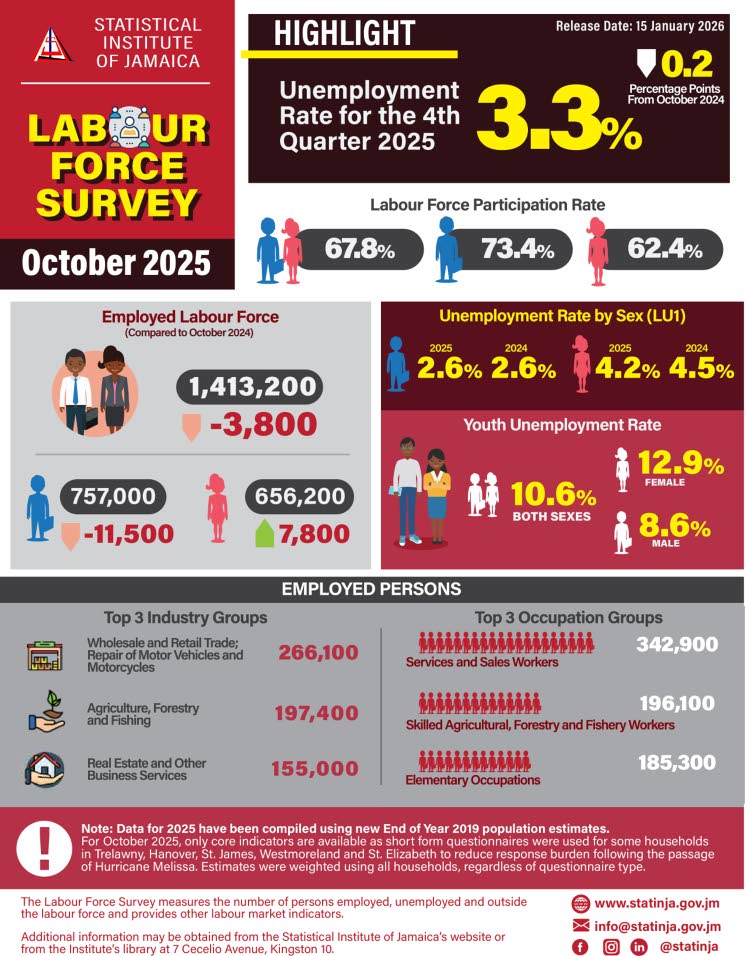
Earlier this month this newspaper reported, among other things: “Jamaica’s unemployment rate stood at 3.3 per cent at the end of October 2025, when compared to 3.5 per cent in October 2024.
“This was revealed on Thursday by the Statistical Institute of Jamaica (Statin) in its October Labour Force Survey (LFS).
According to Statin, employment levels in October 2025 remained largely unchanged compared with the same period of 2024. It said a total of 1,413,200 individuals were employed, reflecting a decline of 3,800 individuals. It said the number of unemployed persons was estimated at 48,800, down from 51,300 the previous year.” (Jamaica Observer, January 14, 2026)
The mentioned latest unemployment numbers confirm that we have the lowest unemployment since we started keeping those records decades ago. This does not mean things are hunky-dory. We have to be very mindful about some urgent and new realities confronting us, and similarly urgent ones that are heading to our shores at the speed of a massive river which is in spate.
Unemployment once defined poverty. That reality is old hat today, because we now have the working poor, due to low skill, low pay, and rising inflation globally.
Jamaica is not insulted from these realities. Early in 2025 I said this, among other things, in this space: “Over many decades Jamaica has been trapped into a low-wage, low-tech, and low-growth vortex. These handicaps have greatly helped to suffocate our national progress and, consequently, diminished respect for Jamaica, especially on the international stage.” This is a reality I have been raising an alarm about here for several years. I am not the first to do so.
Here is a related reality which, if ignored, will cause certain peril. AI’s impact on the global workforce is going to massively expand beginning in this year and in the years to come. Many experts in the field of AI and other disciplines have said so. Many globally renowned experts say that some massive developments in AI took place in 2025 and several seismic build-outs are predicted for 2026. I made reference to some of those giants in the field of AI in my column here last Sunday.
Anyway, some experts have forecast that many more big companies in the USA and other parts of the world are set to lay off many more workers this year than in 2025. Many experts say AI is a double-edged sword in some ways.
Consider this, for example: “The World Economic Forum’s Future of Jobs Report 2025 projects that, by 2030, 92 million existing jobs could be displaced globally due to technological shifts.” The same report estimates that 170 million new roles will be created in that period, resulting in a net increase of 78 million jobs.
Some experts say a net increase is mere pie in the sky. While the tug-of-war between technology pessimists, optimists, and realists rages internationally, Jamaica’s best bet is to get our workforce ready for the inevitable and disruptive consequences of AI and AI-enabled technologies.
I believe it is going to be “hell and powder house”, as we say locally, if we don’t adequately prepare. As night follows day, many companies in Jamaica will soon start to downsize and shift to get AI-ready.
FIRST ON THE CHOPPING BLOCK
Professor emeritus of computer science at the University of Toronto Geoffrey Hinton, winner of the 2018 Turing Award, often referred to as the Nobel Prize in Computing, and winner of the 2024 Nobel Prize in Physics, is known as “a godfather of AI”. He has been warning about the risks of AI for some time. Professor Hinton forecasts the AI Revolution will be on the scale of the Industrial Revolution.
Recall, the Industrial Revolution replaced a lot of agricultural labour. AI is going to replace a lot of “mundane intellectual labour”, Professor Hinton predicts. He adds: “It is going to cause a huge shift in employment.”
Some experts say any entry-level type job which is done with a computer can or will be replaced by AI and AI-enabled technologies sooner than later. Several experts predict that we could begin to see a massive and global displacement and replacement of human labour within the next three to 10 years.
Professor Hinton says many are finding it hard to take the AI threat seriously. He says many people find it hard to believe that we might be creating alien beings that are smarter than ourselves. Some experts predict that, given the speed of developments in AI, we could get to where machines are smarter than humans by 2045. Nineteen years away is not a very long time.
Anyway, as mentioned, several experts say that within the next three to 10 years, any entry-level type job which is done with a computer will be first on the chopping block. This means that thousands of especially young people who work in, for example, the business process outsourcing (BPO) and related sectors are at serious risk of being given a pink slip soon.
Last time I checked, some 70,000 Jamaicans — mostly female — had jobs in the BPO and related sectors. I suspect each of those 70,000 workers has at least two dependents. The implications of that are obvious. Thousands of other jobs in this country fall into the category of any entry-level-type job which is done with a computer. The times when overall unemployment fluctuated between 10 per cent and 15 per cent and youth unemployment reached 33 per cent to 35 per cent must never be allowed to return. Youth unemployment was 34 per cent in 2014, for example.
WHERE/WHAT’S THE PLAN?
The Industrial Revolution, which many scholars say began in 1760, happened because of cheap and available energy. Cheap energy is basic to meaningful and sustained economic growth. That has been the case since Prometheus, a titan in Greek mythology, is said to have stolen fire from the gods and given it to humankind.
Prior to the Industrial Revolution, getting a job was largely dependent on how physically strong a human being was. Post the Industrial Revolution, physical power was quickly and violently replaced with machine power. Trained humans, however, possessed a big advantage over the machines. Critically, the machines could not operate themselves.
Cognitive and intellectual controls have been the sole preserve of human beings since recorded time. Without serious and binding local and international legislations that reality could be upended if — more likely, when — AI systems achieve what is called The Singularity.
The AI Revolution is like no other before. As I said here last Sunday, “Anuh guh it ah guh, a come it ah come.”
What is this Administration’s actionable plan to address the job displacements and replacements that will soon begin impacting especially entry-level, computer-based jobs? Given experts’ projected timelines, Jamaicans should by now be hearing about concrete measures to mitigate these imminent and inevitable consequences.
HOW WILL WORKERS BE PROTECTED?
What specific retooling programmes have already been devised and are being implemented for the 70,000 workers in the BPO and related sectors who are very likely to be first on the chopping block?
Is Jamaica contemplating Universal Basic Income (UBI)? Universal Basic Income (UBI) is a financial system in which the Government provides every adult citizen with a regular, unconditional sum of money, aimed at alleviating poverty and ensuring economic security.
Some countries are discussing UBI as a method that could be used to support displaced workers. What is the national policy to prepare Jamaicans for the AI Revolution?
Minister without portfolio in the Office of the Prime Minister with responsibility for efficiency, innovation, and digital transformation, Senator Ambassador Audrey Marks needs to tell the country.
Dr Andrew Wheatley, minister without portfolio at the Office of the Prime Minister responsible for science, technology and special projects needs to break his stony silence too.
Some historians argue that the main reason the response to the Industrial Revolution was so violent is that governments made very little — or no — preparation to address the massive social and economic problems caused by the displacement and replacement of workers.
Luddites! This may well be a familiar word to some. A Luddite is someone opposed to new technology or automation. It is a term originating from early 19th century English textile workers who protested machinery by destroying it, fearing job displacement and declining quality. Most Luddites, as I understand it, were not anti-technology, but more so against its misuse to devalue skilled labour.
How did the British respond to the Luddites? Several repressive laws were passed by the British Parliament between 1811 and 1812 specifically to suppress the Luddite movement. For example, one piece of legislation elevated ‘machine breaking’ (a form of industrial sabotage) from a minor offence to a capital felony punishable by death (hanging).
Fast-forward to now, some experts are saying we will — or could — soon begin to see massive demonstrations around the world as the displacement and replacement of human labour speeds up over the next three to 10 years. I believe Jamaica is in for some significant shocks regarding job losses.
Regarding what some experts say is the inevitability of artificial superintelligence (ASI), there may well be a silver lining. Consider this headline: ‘AI ‘godfather’ Yoshua Bengio believes he’s found a fix for AI’s biggest risks and become more optimistic by ‘a big margin’ on humanity’s future’. The
Fortune article of January 15, 2026 said this and more: “In a new interview with Fortune, however, the deep-learning pioneer says his latest research points to a technical solution for AI’s biggest safety risks. As a result, his optimism has risen ‘by a big margin’ over the past year, he said.”
Yoshua Bengio is a professor at Université de Montréal. His work helped lay the foundations of modern deep learning. Professor Bengio has been warning about the risks of super-intelligent systems to humanity for some time.
AI IS POLITICAL
The matter of AI and its immediate and longer-term impact on the lives and livelihoods of populations globally will be the hottest political issue in the coming years, I forecast. It will cause several illegitimate regimes and some ill-prepared democratic governments to crumble.
Generic statements by the State about AI are not enough in 2026. AI concerns all Jamaicans. Those who foolishly say that they are not concerned with AI had better believe that AI is concerned with them. Pardon my taking slight liberties with Athenian Pericles who famously said: “Just because you do not take an interest in politics doesn’t mean politics won’t take an interest in you.” AI has great potential for improving the lives of humans, particularly in the fields of health and education. Let’s develop it and make sure to control it with necessary safeguards.
Garfield Higgins is an educator and journalist. Send comments to the Jamaica Observer or higgins160@yahoo.com.
..

Yoshua Bengio, one of the architects of modern deep learning.

Minister without portfolio in the Office of the Prime Minister with responsibility for efficiency, innovation, and digital transformation, Senator Ambassador Audrey Marks

Andrew Wheatley, minister with responsibility for science, technology and special projects in the Office of the Prime Minister (Photo: Naphtali Junior)


