



‘Life is terminal,’ says death doula
... warns Jamaicans unprepared; urges conversations around end-of-life care
DEATH doula Patrice Dwyer is urging Jamaicans to plan for death, noting that “life is terminal”.
Dwyer, a non-medical professional who provides holistic and compassionate support to individuals nearing the end of life and their families, explained that finances are often a major challenge. She noted that many Jamaicans maintain strict privacy around their financial information, and when emergencies arise, funds cannot be accessed, leaving families in distress and uncertainty.
She added that conversations about burial arrangements and asset sharing are also controversial, with many families — left not knowing what their loved one would want — falling into conflict over decision-making.
“I’ve seen family members depressed because they wanted to execute what the family member wanted, but they don’t have the means to do it, and you’re going to go and borrow money, if you can, to execute something to honour your loved one — so it has to be balanced. Finances come up a lot because it’s something like a bank account; we have a little thing here [in Jamaica] where it’s not everybody you want in your business…but it creates a problem,” said Dwyer.
“It’s not even just the death process itself, but if you’re sick and your name is the only name on your bank account, you can’t speak for yourself; it’s one card, but nobody knows the PIN [personal identification number], nobody knows anything. You have money that could care for you, but nobody can access that money — that’s a crisis right there.
“Then you don’t have a will, and then you die, and then [family members] start to fight over everything, and they can’t get the money anyway. You know whose money that is now? The Government’s,” she told the Jamaica Observer.
A lymphoedema therapist with an interest in palliative care, which entails supporting people with terminal illnesses, Dwyer said she often works with cancer patients, seeing them through to their final breath. She shared that it was while watching a documentary called Time of Death that she learned about the term death doula, which sparked her interest.
She shared that she never gave it much thought afterwards, but when her mother got sick and she had to wear the hat of caregiver, the experience highlighted the practical things Jamaicans do not discuss around a relative dying. Dwyer said she got certified in 2021 and has since helped more than 20 families with end-of-life decision-making and the grieving process.
She encouraged conversations around death and end-of-life care, noting that while Jamaicans shy away from the topic out of fear that they might welcome death into their family, not having a plan in place is worse.
“Oftentimes it’s a little late when a family member will come in and say, ‘We need some help,’ because maybe they don’t even know the wishes of their loved one, but they’re having conflict because the family is trying to make the right decision in terms of care in particular, and also in terms of getting across to other loved ones who don’t understand the fact that, say, this person is dying and what that’s like and so they’re rushing — we need to do this, we need to do that,” said Dwyer, noting that multiple four-hour sessions are often a reality in her line of work.
She said one particular area of conflict is the decisions around the method of burial.
“A simple decision around burial, cremation, and I will also add body donation — which is available in Jamaica — can create war in a family because one family member will say, ‘I don’t want them to burn my mother’s body’, ‘I don’t want this’, ‘I don’t want that’, or worse, ‘What my mother’s body doing up at [The University of West Indies] for them to cut it up for?’ because nobody had any conversations around it, so nobody knew,” she told the Sunday Observer.
She added: “If the person didn’t say, and even if the person did say and a family member disagreed with it, or they told one person and they didn’t tell another person, there was nothing written down, nothing formally done, who is to say who is right in this? It’s people’s personal beliefs that come out in that,” she said.
Dwyer shared that she has had experiences in which a patient, unable to speak or communicate, had to sit and watch as family members decided over their course of treatment, unable to share what they would want in the moment. She said the interaction further emphasised the importance of living wills detailing a person’s desires regarding future medical treatment in circumstances in which they are no longer able to express informed consent. However, she noted that it is just one of the many things to consider.
“There are those of us who say, ‘Well, I don’t have anything to will to anybody.’ Yeah, you do; we always have, but planning has gone past wills. Planning has gone into things like creating trust and setting people up on your accounts whom you trust. If you buy stocks, you don’t know until after you [are sick or dying] that you want to add somebody, but you can’t add anybody after you buy it already. You have to sell it and buy back…Have conversations, make plans, talk to your family,” she stressed.
Dwyer noted that conversations about the custody of young children, the funeral home or the medical facility a person desires are all discussions that need to be had. Additionally, after the family member has passed, she said it is important to talk about the loss and grieve together.
“I had a young person who said she’d recently lost three close people back to back, and she couldn’t have a conversation with her family around it. Nobody wanted to talk about it, and she was feeling very depressed and down. She saw my [Zoom meeting entitled ‘Let’s Talk Endings and Everything In Between’] come up on her feed, and she decided to come in because she didn’t know where else to go.
“I realised, based on the conversations in that little setting, how many of us really want to go out there and have these conversations but we don’t find a safe space to do them, so that’s my role. I want to normalise speaking about this,” she said.
Dwyer warned that grief never goes away, and if a person seeks to bury those feelings, one day the rush of emotions will come flooding in.
“Have conversations. Make plans. Talk to your family,” she stressed.
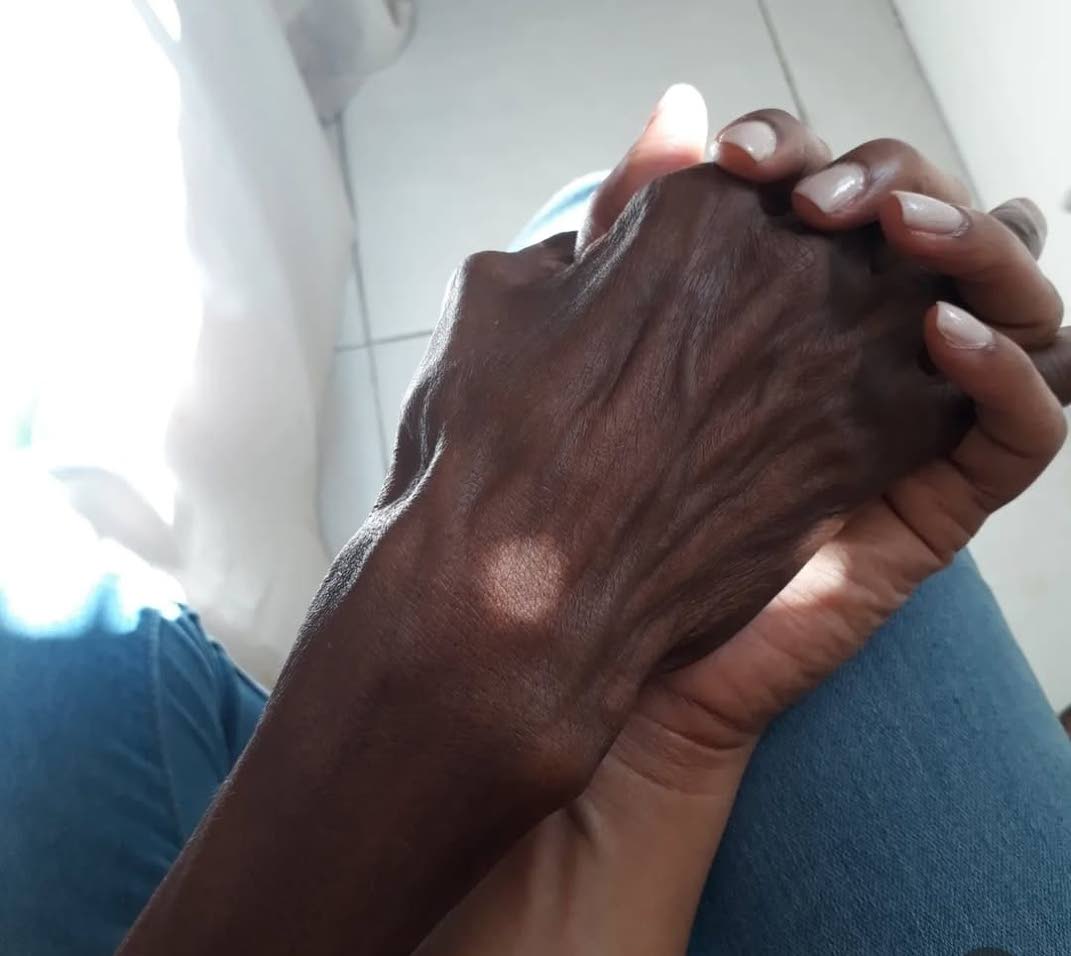
Patrice Dwyer holds her mother’s hand during the final moments of her life.


