Subscribe Login
Jamaica Observer
ePaper
The Edge 105 FM Radio Fyah 105 FM
Jamaica Observer
ePaper
The Edge 105 FM Radio Fyah 105 FM
    • Home
    • News
      • Latest News
      • Cartoon
      • International News
      • Central
      • North & East
      • Western
      • Environment
      • Health
      • #
    • Business
      • Business Bites
      • Social Love
    • Sports
      • Football
      • Basketball
      • Cricket
      • Horse Racing
      • World Champs
      • Commonwealth Games
      • FIFA World Cup 2022
      • Olympics
      • #
    • Entertainment
      • Music
      • Movies
      • Art & Culture
      • Bookends
      • #
    • Lifestyle
      • Page2
      • Food
      • Tuesday Style
      • Food Awards
      • JOL Takes Style Out
      • Design Week JA
      • Black Friday
      • #
    • All Woman
      • Home
      • Relationships
      • Features
      • Fashion
      • Fitness
      • Rights
      • Parenting
      • Advice
      • #
    • Obituaries
    • Classifieds
      • Employment
      • Property
      • Motor Vehicles
      • Place an Ad
      • Obituaries
    • More
      • Games
      • Elections
      • Jobs & Careers
      • Study Centre
      • Jnr Study Centre
      • Letters
      • Columns
      • Advertorial
      • Editorial
      • Supplements
      • Webinars
    • Home
    • News
      • Latest News
      • Cartoon
      • International News
      • Central
      • North & East
      • Western
      • Environment
      • Health
      • #
    • Business
      • Business Bites
      • Social Love
    • Sports
      • Football
      • Basketball
      • Cricket
      • Horse Racing
      • World Champs
      • Commonwealth Games
      • FIFA World Cup 2022
      • Olympics
      • #
    • Entertainment
      • Music
      • Movies
      • Art & Culture
      • Bookends
      • #
    • Lifestyle
      • Page2
      • Food
      • Tuesday Style
      • Food Awards
      • JOL Takes Style Out
      • Design Week JA
      • Black Friday
      • #
    • All Woman
      • Home
      • Relationships
      • Features
      • Fashion
      • Fitness
      • Rights
      • Parenting
      • Advice
      • #
    • Obituaries
    • Classifieds
      • Employment
      • Property
      • Motor Vehicles
      • Place an Ad
      • Obituaries
    • More
      • Games
      • Elections
      • Jobs & Careers
      • Study Centre
      • Jnr Study Centre
      • Letters
      • Columns
      • Advertorial
      • Editorial
      • Supplements
      • Webinars
  • Home
  • News
    • International News
  • Latest
  • Business
    • Business Bites
  • Cartoon
  • Games
  • Food Awards
  • Health
  • Entertainment
    • Bookends
  • Regional
  • Sports
    • Sports
    • World Cup
    • World Champs
    • Olympics
  • All Woman
  • Career & Education
  • Environment
  • Webinars
  • More
    • Football
    • Elections
    • Letters
    • Advertorial
    • Columns
    • Editorial
    • Supplements
  • Epaper
  • Classifieds
  • Design Week
Stable banks, shifting risk
The Bank of Jamaica’s headquarters in downtown Kingston. The central bank says loan delinquencies have risen only modestly following Hurricane Melissa, though credit conditions will be closely watched as temporary moratoria expire.,
Business, Caribbean Business Report (CBR)
BY DASHAN HENDRICKS Business content manager hendricksd@jamaicaobserver.com  
February 6, 2026

Stable banks, shifting risk

How Jamaica’s lenders rewired who gets credit

Bank of Jamaica data show non-performing loans increasingly concentrated in households and real estate, while credit growth to agriculture and tourism lags the wider system – raising questions about what kind of economy the banking sector is really financing.


JAMAICA’S banks look safer than they did a decade ago. Bad loans are down from their post-crisis peak, capital buffers have improved, and total lending by deposit-taking institutions has more than doubled since 2017.

But a closer look at the Bank of Jamaica’s own numbers shows that financial stability has come with a quiet rewiring of who gets credit — and who bears the risk when the next downturn hits.

A long-run series of non-performing loans (NPLs) published by the Bank of Jamaica, covering March 1999 to December 2016, shows how credit stress has migrated across sectors over nearly two decades. A newer dataset, tracks the stock of loans by sector from March 2017 to November 2025. Taken together, they tell a story not just of cleaner balance sheets, but of a banking system that now leans much more heavily on household and property-related borrowing than in the past.


From balanced risk to household-heavy NPLs

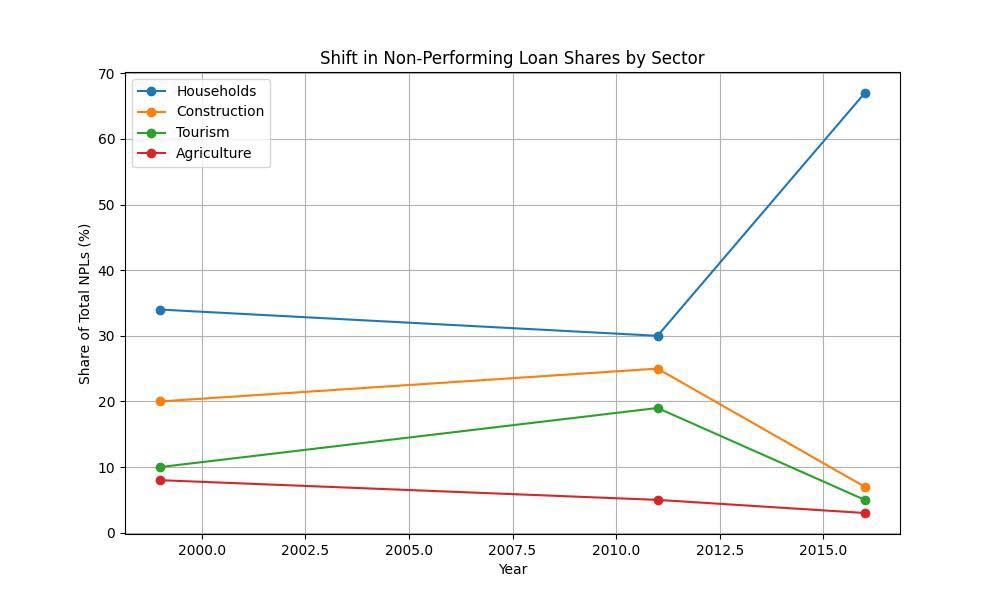
At the turn of the millennium, bad loans were spread more evenly across the economy. In March 1999, total non-performing loans over 90 days past due stood at about $6.7 billion. Individuals and households accounted for roughly one-third of that (about 34 per cent), with the rest spread across sectors such as construction, agriculture, distribution and tourism.

By the time the system hit its post-global financial crisis peak at the end of 2011, the picture had changed dramatically. Total NPLs had climbed to just over $31.5 billion — nearly five times the 1999 level. Construction and tourism together accounted for almost 44 per cent of those bad loans, while households still represented close to a third. The spike was broad-based, but highly concentrated in a few stress-prone sectors.

What happened next was not simply a cyclical clean-up. By December 2016, the stock of NPLs had fallen back to around $18.4 billion. But the composition had shifted decisively. Households now accounted for about 67 per cent of all non-performing loans, more than double their share in 1999. Construction’s contribution had dropped to about seven per cent. Agriculture, manufacturing and transport were each down in the low single digits.

In other words, by 2016, the banking system’s residual credit problem was no longer spread across a range of business sectors. It was overwhelmingly lodged with individuals and households.


Loan growth has doubled down on households and property

The newer table, covering March 2017 to November 2025, shows what banks have done with their cleaner balance sheets.

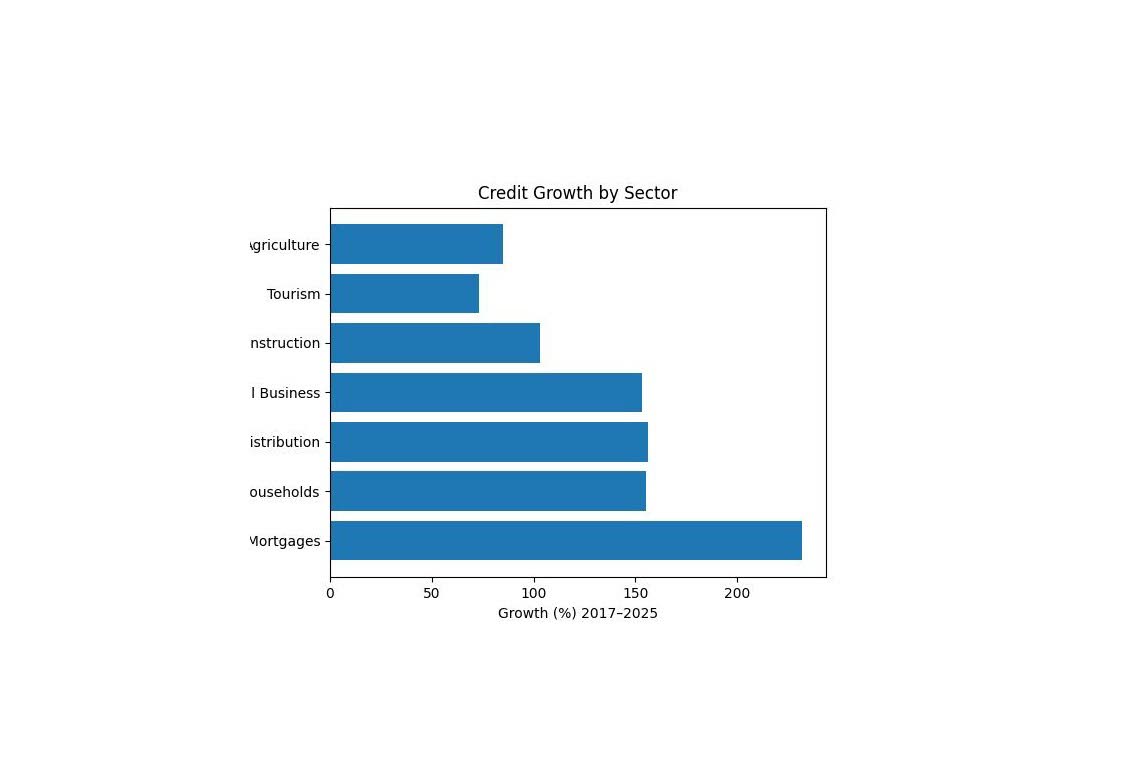
Over that period, the stock of loans by deposit-taking institutions rose from roughly $659 billion to about $1.6 trillion, an increase of just over 142 per cent. Beneath that headline, though, some portfolios have grown much faster than others:


Individuals and/or households: up about 155 per cent, from roughly $333 billion to $848 billion.


Residential mortgages: up about 232 per cent, from around $157 billion in early 2017 to roughly $521 billion by November 2025.


Local business loans overall: up about 153 per cent, from roughly $220 billion to $558 billion, with especially strong growth in:


Distribution: up about 156 per cent (from roughly J$54 billion to J$139 billion).


By contrast:

Agriculture: up about 85 per cent, from about $8.6 billion to $15.9 billion.


Tourism: up roughly 73 per cent, from about $43.6 billion to $75.5 billion.


Construction lending has roughly doubled over the period — from about $27.6 billion to $55.9 billion — but still grew more slowly than mortgages and significantly slower than household credit overall.


The pattern is not of a banking system retreating wholesale from businesses. Local business loans have broadly kept pace with the system. Rather, the expansion has been tilted: towards households, housing and distribution-related activity, and away from some of the more volatile, export-linked or climate-exposed sectors.


A safer system – but safer for whom?

On their own, these shifts are not inherently good or bad. Households need mortgages and consumer finance; businesses depend on distribution chains; banks have to price risk.

But the combination of the two datasets raises awkward questions.

First, if households now generate most of the system’s residual NPLs, and banks have simultaneously expanded household and mortgage lending much faster than overall credit, future shocks will land more heavily on consumers and the property market than on traditional corporate borrowers.

Second, slower relative growth in agriculture and tourism — sectors that drive foreign exchange and rural employment — may be rational from a narrow risk-return perspective, but it also means the financial system is not leaning into some of the areas policymakers say they want to grow.

Third, the decline in the share of NPLs from construction and other historically risky sectors could reflect genuine improvements in underwriting and project quality – or simply lower exposure because banks have pulled back after the last crisis.

Without more recent NPL ratios by sector, it is impossible to say definitively which of these explanations dominates. But the direction of the numbers suggests that the banking system’s stability is increasingly anchored in the capacity of households to service debt and of the property market to hold its value.


Growth, inequality and concentration

There is also a broader development question.

Mortgage-led and consumption-heavy credit booms tend to feel good in the short run: house prices firm up, construction sites are busy, retail turnover is supported. But they do not always translate into the kind of productivity and export gains that raise long-term living standards.

The BOJ data show a system where:

credit to distribution and consumer-facing activity has grown faster than the loan book as a whole;


agriculture and tourism, which are more exposed to climate and external shocks, have grown more slowly; and


household debt has become both the main source of legacy bad loans and a rapidly expanding share of new credit.


That mix helps explain why banks can report strong prudential indicators even as parts of the real economy still feel under-financed or vulnerable to shocks.


For now, Jamaica’s banking system is widely seen as one of the country’s strengths: well-regulated, better capitalised, and less directly exposed to public-sector credit risk than in past decades.

The question hanging over the next cycle is whether the economy that system is financing — more leveraged households, more housing debt, relatively slower credit growth into some productive sectors — can deliver enough income, exports and resilience to keep those loans performing.

Financial stability, in other words, has been earned not just through better risk management, but by changing who gets credit and where the remaining risk sits. The data suggest that, increasingly, the answer is: with Jamaican households.
.

.

.

{"xml":"xml"}{"jamaica-observer":"Jamaica Observer"}
img img
0 Comments · Make a comment

ALSO ON JAMAICA OBSERVER

Jah Rain releases ‘Rivers of Freedom’ EP
Entertainment, Latest News
Jah Rain releases ‘Rivers of Freedom’ EP
KEDIESHA PERRY Observer writer 
March 17, 2026
Reggae artiste Jah Rain has sights sets on another successful EP following the release of his latest, Rivers of Freedom , on March 11. It was produced...
{"jamaica-observer":"Jamaica Observer"}
Slot vows to win back support of frustrated Liverpool fans
Latest News, Sports
Slot vows to win back support of frustrated Liverpool fans
March 17, 2026
LIVERPOOL, United Kingdom (AFP) -- Arne Slot insists he can win back the support of Liverpool's frustrated fans after admitting he "must have done a l...
{"jamaica-observer":"Jamaica Observer"}
Cuba scrambles to restore power as Trump threatens takeover
International News, Latest News, Regional
Cuba scrambles to restore power as Trump threatens takeover
March 17, 2026
HAVANA, Cuba (AFP) -- Cuba scrambled Tuesday to restore power after a nationwide blackout that hit the communist-run island just as US President Donal...
{"jamaica-observer":"Jamaica Observer"}
Jamaicans being warned of sophisticated property scams after sign theft
Latest News, News
Jamaicans being warned of sophisticated property scams after sign theft
March 17, 2026
The Realtors Association of Jamaica (RAJ) is issuing an urgent advisory to the public to exercise discernment and caution when engaging in real estate...
{"jamaica-observer":"Jamaica Observer"}
Latest News, News
‘Say no to colonisers’: Jamaicans protest in support of Cuban Gov’t
March 17, 2026
KINGSTON, Jamaica – More than 150 people marched around National Heroes Circle in Kingston on Tuesday to express their solidarity with the Cuban gover...
{"jamaica-observer":"Jamaica Observer"}
GK pushes reformulation as better option than sugar tax
Business, Latest News, News
GK pushes reformulation as better option than sugar tax
KELLARAY MILES Business reporter milesk@jamaicaobserver.com 
March 17, 2026
AS local manufacturers get ready to take on the recently imposed Special Consumption Tax (SCT) on non-alcoholic beverages and sugary drinks, food and ...
{"jamaica-observer":"Jamaica Observer"}
May Pen Hospital saves life of patient stabbed in the heart, Tufton lauds medical team
Latest News, News
May Pen Hospital saves life of patient stabbed in the heart, Tufton lauds medical team
March 17, 2026
In a stunning display of medical mastery, a multidisciplinary team of medical professionals from the May Pen Hospital has saved the life of a patient ...
{"jamaica-observer":"Jamaica Observer"}
Man feared dead after vehicle plunges into Rio Cobre
Latest News, News
Man feared dead after vehicle plunges into Rio Cobre
March 17, 2026
ST CATHERINE, Jamaica -- A man is presumed dead after the vehicle he was driving veered off a section of the road leading to the Flat Bridge and plung...
{"jamaica-observer":"Jamaica Observer"}
❮ ❯

Polls

HOUSE RULES

  1. We welcome reader comments on the top stories of the day. Some comments may be republished on the website or in the newspaper; email addresses will not be published.
  2. Please understand that comments are moderated and it is not always possible to publish all that have been submitted. We will, however, try to publish comments that are representative of all received.
  3. We ask that comments are civil and free of libellous or hateful material. Also please stick to the topic under discussion.
  4. Please do not write in block capitals since this makes your comment hard to read.
  5. Please don't use the comments to advertise. However, our advertising department can be more than accommodating if emailed: advertising@jamaicaobserver.com.
  6. If readers wish to report offensive comments, suggest a correction or share a story then please email: community@jamaicaobserver.com.
  7. Lastly, read our Terms and Conditions and Privacy Policy

Recent Posts

Archives

Facebook
Twitter
Instagram
Tweets

Polls

Recent Posts

Archives

Logo Jamaica Observer
Breaking news from the premier Jamaican newspaper, the Jamaica Observer. Follow Jamaican news online for free and stay informed on what's happening in the Caribbean
Featured Tags
  • Editorial
  • Columns
  • Health
  • Auto
  • Business
  • Letters
  • Page2
  • Football
Categories
  • Business
  • Politics
  • Entertainment
  • Page2
  • Business
  • Politics
  • Entertainment
  • Page2
Ads
img
Jamaica Observer, © All Rights Reserved
  • Home
  • Contact Us
  • RSS Feeds
  • Feedback
  • Privacy Policy
  • Editorial Code of Conduct