



Calm in 100, Park lanes, but residents concerned over ongoing curfew
A sharp decline in major crimes in the St Andrew North Police Division has brought relief to the long-troubled 100 Lane and Park Lane communities.
But while residents welcome the respite and praise the constabulary for keeping them safe, they are growing impatient with a rolling curfew in place since last December, saying it is affecting their freedom of movement and ability to earn a living.
“It feels good to see what they are doing and the results that we are seeing, because the place a run good, nothing not happening now. But if the police are trying to elevate the community there has to be some sense of freedom,” Tevin Taylor, who said he has been living at 100 Lane for five years, told the
Jamaica Observer during a police walk-through of that community and neighbouring Park Lane last Friday.
“The kids that are growing now, a lot of them, their minds are tense because they are not getting any enjoyment. This will lead them to focus on other things because now they are restricted,” Taylor argued.
The curfew was first imposed after the murder of 50-year-old Janet Baker in a drive-by shooting at Park Lane on November 30, 2025. Police said the security measure was put in place to reduce criminal activity and maintain public order in both communities which have long been plagued by gang violence.
The constabulary’s Serious Crimes Report for January 1 to February 21, 2026 show that no murders were committed in the St Andrew North Division, compared to six for the same period last year. At the same time, there have been three shooting incidents, compared to 11 last year, a 72 per cent reduction.
On Friday, during the police walk-through, other residents shared Taylor’s views.
Pointing to an abandoned area which once served as a football field for children, Shauntae Williams said the community lacks a recreational centre for children.
“It was a football field but over the years, because of the violence, it has not been in use. And there is a lot of bushes over there that needs to be cut down so it can be reconstructed and the children could get like a netball or football court to try to see if they could come together and build back as one,” she said, adding that the absence of a recreational centre contributed to the high crime rate that once plagued the area.
“Our community really needs the help, so if there is anyone out there that can really step in and help us we would really appreciate that, because we do need our children to be raised properly and not turn to violence. It would be good to see the children every day coming out with a positive mindset and not saying because my community is violent I cannot succeed,” the mother of two added.
One resident of Park Lane, who spoke on condition of anonymity, said despite the curfew’s effects on economic activity, particularly the staging of entertainment events, she feels safer with the heavy police presence in the area.
“I am glad they are here. I was born and raised in the community, 50-odd years now since I am living here. I am not affected by the curfew; when them say ‘leave’, I leave; when them say ‘inside’, I go inside — sometimes I don’t even wait on them to tell me to go inside,” she told the Observer.
“I have seen a lot of changes; the only thing [is] we not getting any enjoyment because we normally have our bingos and round robin and we can’t do it again, that’s the only thing,” she said.
Another resident highlighted the difficulties that the curfew has created for pan chicken vendors.
“The chicken man them a feel it more because they gave them until 12:00 [midnight] but sometimes that is when people would just be buying, so it’s staggering for them — because remember, they throw partner, so they are asking for more time on the road,” the resident said.
In the meantime, superintendent in charge of the division, Randy Sweeney, told the Observer that since the curfew was implemented he has had dialogue with residents to ensure that the measure is not being interpreted as oppressive and lose its effectiveness.
“I don’t want it to come off as businesses being stifled, so even with that, we give them the go-ahead to operate up until a later time. But we don’t want persons to congregate, so we advise them to purchase and move. We try our very best to facilitate some of these things while maintaining our presence and the security of the community; we don’t want people to be congregating,” Sweeney explained.
He added that the measure is a proactive move to reduce the likelihood of murders, adding that the constabulary’s main responsibility is to protect lives, and if steps are not taken to protect them, residents will not have freedom.
“A lot of good persons are from these communities, a lot of bright persons too, but I can tell you these [criminals] are sabotaging the communities by virtue of their actions, by virtue of their intimidation, and we, as the police, will not tolerate that. It’s against that background that we have our curfews; we have a 24-hour foot patrol in this particular community and they are being [supported] by a service vehicle,” he said.
Pointing to the results of the curfew, Sweeney appealed to residents for “a little bit more understanding”.
“The results have shown, they themselves have said it, so just continue to work with us,” added Sweeney.

Deputy Superintendent Glendale Murdoch (centre), of the Constant Spring police, plays football with young boys at 100 Lane off Red Hills Road, St Andrew, last Friday, during a walk-through of the community by the cops from the St Andrew North Police Division.
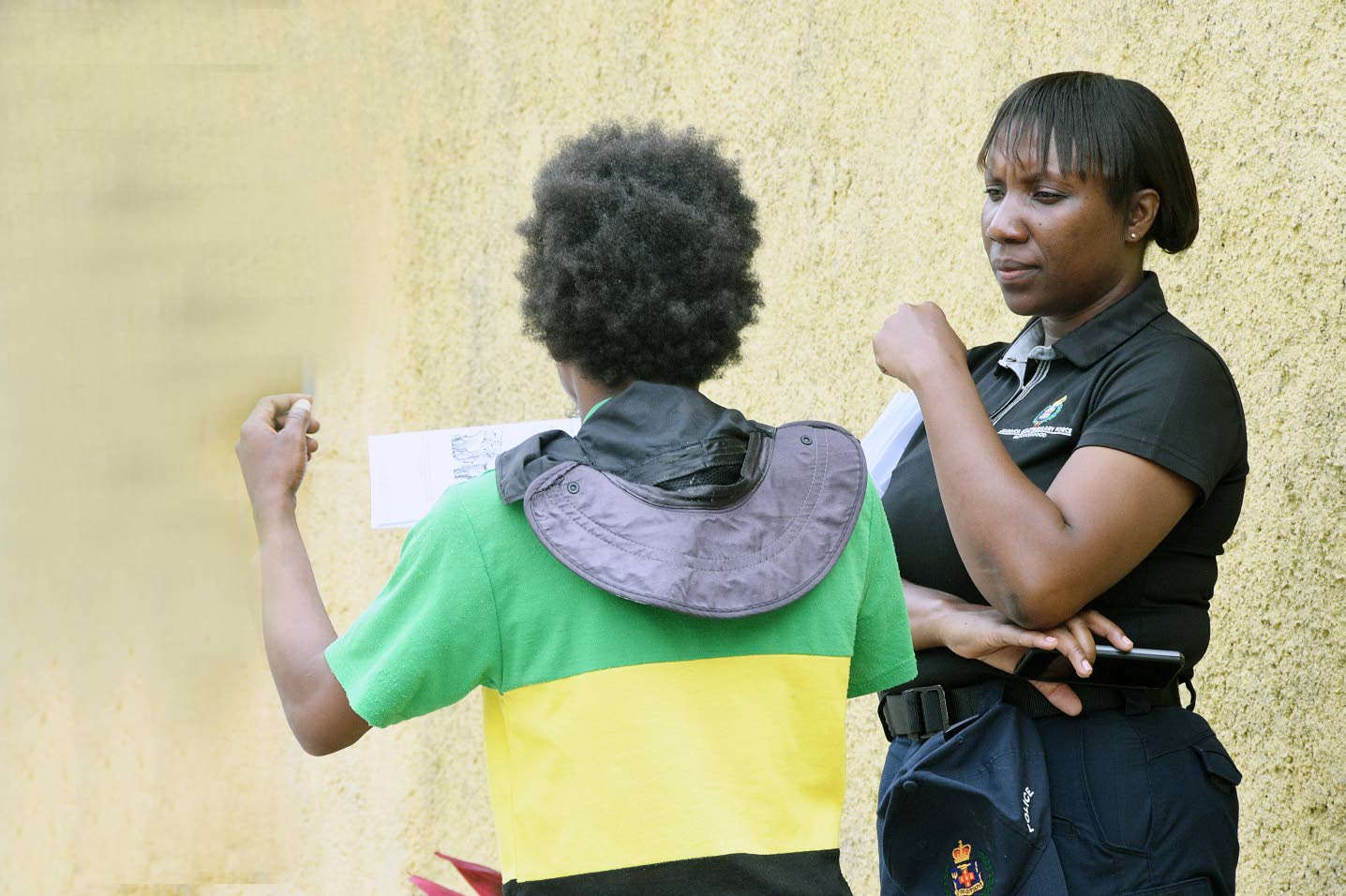
Constabulary Communications Network Liaison Officer Constable Jodian Layton (right) speaks with a resident of 100 Lane off Red Hills Road last Friday during a police walk-through of that community and neighbouring Park Lane.


