



Groundwater at risk
Samuda links backyard pits to Kingston and St Andrew potable water crisis
AS questions continue to be asked about sewerage charges facing people not attached to the public system, Minister of Water Matthew Samuda says traditional backyard pits used across much of Kingston and St Andrew are posing a grave danger to the capital’s underground water supply.
Against that background Samuda is adamant that expanding the sewer network across the Corporate Area is essential to protect the source which could provide potable water for many residents of Kingston and St Andrew.
Speaking during this week’s Jamaica Observer Monday Exchange Samuda said the widespread reliance on septic tanks and soak-away pits is gradually contaminating the groundwater, putting the country’s long-term water security at risk.
He revealed that the damage is no longer theoretical, noting that several major wells have already been taken out of service because of pollution linked to sewage from backyard pits.
According to Samuda there are eight major wells in Kingston and St Andrew which produce more than two million gallons of water each day that is unable to be tapped because of contamination from backyard pits.
Groundwater, which lies beneath the surface, has historically been one of Kingston’s most reliable sources of potable water. However, when sewage from septic systems seeps into the ground over time, it introduces nitrates and other pollutants into the aquifer, making the water unsafe to drink and forcing authorities to abandon affected wells.
Samuda said restoring and protecting this underground resource requires a shift away from individual backyard waste systems towards modern sewer networks designed to safely transport and treat waste water.
“I can’t guarantee your water supply in 20 and 30 years without the restoration of your water table and I can’t restore the water table without sewering Kingston and I can’t sewer Kingston without charging those who are in the legal proximity to sewers the cost that is there,” explained Samuda.
His comments come amid frustration from homeowners who say they are being asked to pay sewerage charges even if they are not yet connected to the system, or must bear the cost of linking their homes to sewer lines installed along their streets.
While acknowledging those concerns, Samuda said the expansion of sewer infrastructure is not optional if the country hopes to prevent further degradation of its groundwater.
“So literally it is understandable how people feel about it, but there isn’t a choice and it is not dissimilar within our utility construct relative to anywhere else in the Commonwealth. It’s a normal charge and Jamaica has for decades not paid the true cost of its portable water and sewerage,” added Samuda.
For decades, much of Kingston and St Andrew developed without comprehensive sewer infrastructure, relying instead on backyard pits to handle household waste. While effective in less densely populated areas, those systems can become a major source of pollution as urban populations grow and groundwater extraction increases.
Environmental specialists have long warned that untreated waste water leaking into the ground can gradually compromise entire aquifers, reducing the number of usable wells and placing greater strain on remaining water sources.
Samuda said this reality has forced the Government to accelerate plans to expand sewer coverage across the capital, describing the effort as essential to protecting the country’s most valuable water reserve.
He stressed that expanding sewer networks is not simply about modernising sanitation, but about preserving Jamaicans’ access to potable water.
The National Water Commission (NWC) has repeatedly urged people, whose homes are adjacent to the main sewer lines, to connect to the system.
Once one is within 300 feet of the line the laws allow NWC to charge the houseowner sewerage.
Connecting to the main sewer network provides a further benefit for homeowners whose soak-away pits have become saturated.

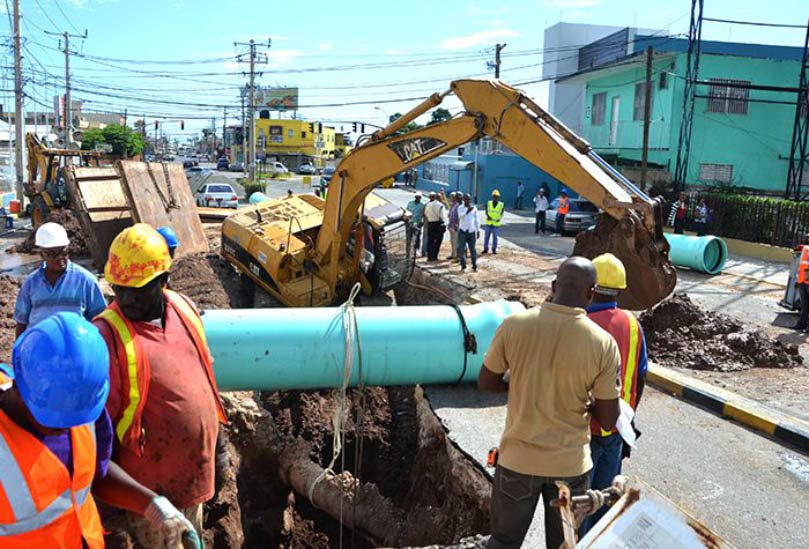
Teams from the NWC and NWA repairing a collapsed sewer main on Constant Spring Road. (Photo: JIS)


