



Boyz’s World Cup exit no surprise
Former national footballer ‘Zun’ Clarke says Jamaica built a side, not a team
THAT the Reggae Boyz did not qualify for this summer’s FIFA World Cup was not surprising to former national footballer Michael “Zun” Clarke.
Just over two weeks before the final qualification window closed on the Boyz in their 0-1 loss to Democratic Republic of the Congo on March 31, Clarke had told the Jamaica Observer that one of the main errors in the local set-up was that Jamaica had put together a football side, rather than a team.
Clarke, who also played for local club Cavalier and was a Manning Cup champion at Tivoli Gardens High School, based his argument on the fact that the Reggae Boyz have a large contingent of players, mostly from England, who are in the squad because of their Jamaican heritage.
But he wasn’t impressed with their style of play, arguing that too often the Reggae Boyz lose possession of the ball easily and are found wanting in ball-control skills.
“You cannot win games like that… To how they’re playing, with all of those foreign players, I would say they would stand a better chance using the local players. And why I say that is that when foreign players get together, they’re not a team, they’re a side — because everybody is doing their own thing,” he said.
“A team sticks together [while] a side just come and play… To build a team you have to keep a team together so they know each other, know each others’ likes and dislikes, you know where on the pitch they like to play… that’s why you have positions. So, when people gel you get a better ball game,” Clarke argued.
“I think you have to start at the grass roots… meaning that your local players, you pick a set and you keep them together, mould them. That’s what most coaches do; they start them off from young and they mould them until they get like a work of art out of them. Brazil do it. All of the coaches that you see are always working; they have camps in which you know these are a set of players that you’re going to nurture them. I think that’s what Jamaica needs to do,” Clarke told the Observer.
While Clarke said he was “overwhelmingly happy” for the overseas-based players who got a chance to represent Jamaica, he had reservations about the depth of their commitment.
“I don’t think they’re thinking country first, they’re thinking club. They’re not going to go to a 50-50 ball to get injured because they’re thinking about the club,” he argued.
He also shared a view held by some football fans and experts that most of the English-born players accept the Jamaica Football Federation’s invitation “because they cannot make the English team”.
“If they could have made the English team they would have, [and] they would be playing for England. So [when they get the call from] Jamaica is like, ‘Okay, I get a chance to go World Cup? Let me come play for Jamaica,’ ” Clarke said.
He recalled Jamaica’s historic qualification for the 1998 tournament in France, pointing out that that squad comprised mostly local players during the qualifiers.
“If you look at that team, it was only three foreigners, three people from England played. All of the others were native Jamaicans,” he said.
The three England-based players he referenced were Paul Hall, Fitzroy Simpson, and Deon Burton.
After Jamaica qualified, other England-born players — among them Robbie Earle, Marcus Gayle, Frank Sinclair, and Darryl Powell — joined the squad.
While Jamaica did not make it past the group stage in France — finishing third in Group H with a 2-1 victory over Japan after losing 3-1 to Croatia and 5-0 to Argentina — Clarke was among millions of Jamaicans who watched with immense pride as the Reggae Boyz played at world football’s highest level.
But like many Jamaicans, Clarke supports five-time champions Brazil and he expects that the South Americans will win the 2026 World Cup being hosted by Canada, the United States, and Mexico starting June 11.
“Brazil is always my team. If they get eliminated then I start to look at somebody else, but first choice is Brazil, always, always, from we were young growing up because, you know, we Jamaicans play like a Brazilian-style game, we play like an exciting type of football. So, yeah, Brazil is always my team,” he emphasised.
Asked who he would regard as the best player Jamaica has ever produced, Clarke, without hesitation, said Herbert “Dago” Gordon, the former national, Boys’ Town, and Trench Town High attacking midfielder who died in November 2013.
“Dago is my idol — magician dat,” Clarke said.
Outside of Jamaica, Clarke has Brazilian Pele on his list of top players. So too Argentine Mario Kempes, Brazilians Dunga and Neymar, as well as Argentinian Lionel Messi whom he calls One lef.
Why?
“A one lef him have,” Clarke responded with a smile, pointing out that the celebrated player is known for being a left-footed footballer.
“If I was playing against him I would mark him out; once you mark him from him left foot, all him do is just dribble across the field, he doesn’t dribble to the goal,” Clarke said with a chuckle.
“I like a player who can use both feet. While I was playing, I could use both feet. People always ask which of my feet is stronger [and] I would say, ‘You have to decide that for yourself,’ because I could kick it from anywhere with any foot — hard,” he said.
“A player that can use both feet, that’s my type of player… but Messi is good though, I have to give him his props. If I leave him out I’ll be biased.”
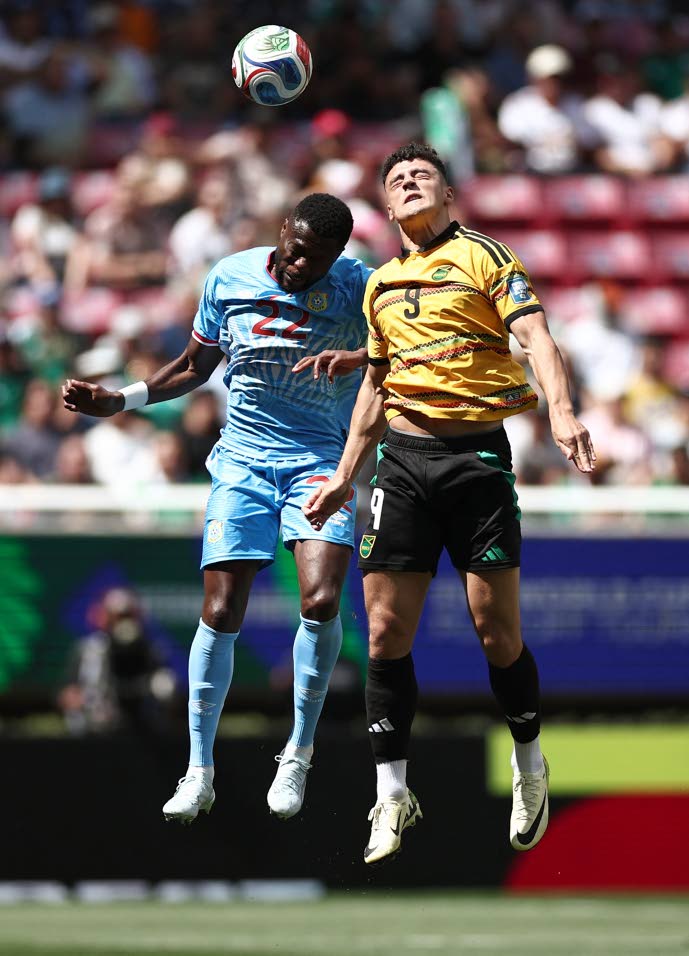
DR Congo defender Chancel Mbemba and Jamaica forward Bailey Cadamarteri (right) jump to head the ball during their FIFA World Cup Play-offs final at Akron Stadium in Zapopan, Jalisco state, Mexico, on Tuesday, March 31. (Photo: AFP)


