Banks jack up fees as profits climb
...BOJ pushing for ease of access
JAMAICANS are being asked to pay more to move, withdraw and manage their own money as commercial banks raise fees across the financial system, even as the sector posts sharply higher profits.
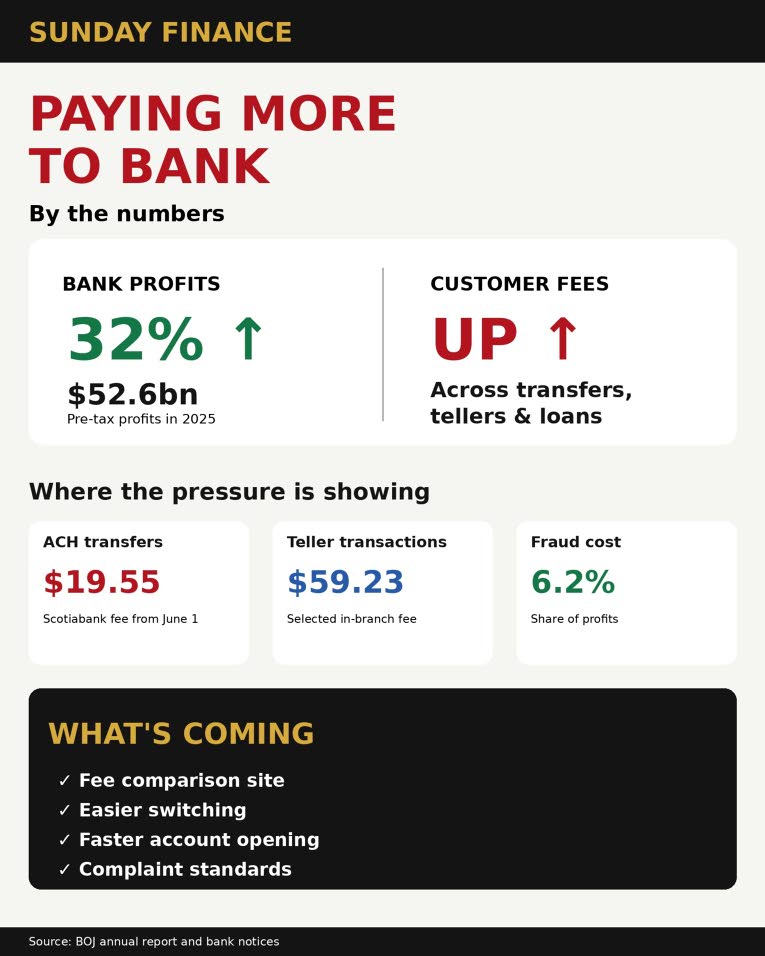
According to the Bank of Jamaica’s (BOJ) 2025 annual report, pre-tax profits for deposit-taking institutions (DTIs) grew 32 per cent from $39.7 billion in 2024 to $52.6 billion in 2025. The higher earnings were driven by operating income rising 7.6 per cent, outpacing the 2.5 per cent increase in operating expenses.
“In a context where the growth in pre-tax profits outpaced growth in operating income, the profit margin for the system increased to 16.2 per cent in 2025 from 11.3 per cent in 2024. Concurrently, the return on equity increased to 14.4 per cent, from 11.3 per cent in 2024,” the BOJ stated in its annual report.
Even as profits rise sharply, banks have been increasing fees as operating costs are expected to climb this year.
The Bank of Nova Scotia Jamaica Limited (Scotiabank Jamaica) informed customers on Tuesday that it would be introducing a charge for the automated clearing house (ACH) facility. Scotiabank hiked credit card, loan processing fees and business banking fees in May 2025.
“Previously, we offered this service at no cost, however due to changes in the current operating environment a fee of $19.55, including GCT, will be introduced on June 1, 2026,” Scotiabank told customers on Tuesday.
Instagram and X (formerly Twitter) users vented frustration with the announcement that they’d now face a charge to move their money. One Instagram user exclaimed, “Can we get a break!”
Scotiabank and CIBC had been among the few banks not charging for ACH transfers, though both still incur costs through J E T S, the interbank payments operator.
J E T S, jointly owned by several DTIs, handles cheque settlements, ACH and the Multilink system among banks. Most banks charge less than $20 per ACH transfer, with the recipient not paying any cost to receive the funds.
The pressure builds
Scotiabank’s new ACH fee comes at a time when it did not charge customers to send or receive money using the real time gross settlement (RTGS) facility after Hurricane Melissa. The BOJ suspended its RTGS charge to DTIs after the storm, with all other participants not charging their customers to send or receive funds using this service up to December 31. Scotiabank restored this charge on February 13 to its customers.
National Commercial Bank Jamaica Limited (NCBJ) and JMMB Bank (Jamaica) Limited recently increased their incoming and outgoing RTGS fees charged to customers. However, the BOJ reduced its RTGS charge from $100 to $30 in May 2022.
Due to BOJ regulations the RTGS facility must be used for electronic transfers above $1 million, as any ACH transfer above that threshold attracts a $5,000 fee that is passed on to customers.
Because both the sender and receiver are charged under the RTGS system, recent fee increases by commercial banks could significantly boost earnings per transaction as billions of dollars move through the platform each year.
The cost of moving money is only one of several charges weighing on Jamaican consumers in recent months. JMMB Bank increased fees on April 17 which saw higher fees for recalled RTGS transactions, local and manager’s cheques, and higher secured loan commitment fees. NCBJ increased their fees in December 2025 which saw higher fees for in-branch services, foreign drafts, returned cheque and unpaid cheques fees, and higher business account service charge thresholds.
“As is customary, JMMB routinely reviews its fees within the context of both our operations and the needs of our clients. Following our most recent review, we have adjusted some fees in alignment with our guiding principle of fairness in how fees are applied, our core value of love, and our commitment to having your best interest at heart,” said JMMB Bank in a March 3 email.
Sagicor Bank Jamaica Limited (SBJ) adjusted its fees on March 18 which saw the introduction of a $59.23 charge for certain in-branch deposit and withdrawal transactions. This only applies when a customer is withdrawing less than $100,000 or depositing less than $200,000 when an automated banking machine (ABM) is available.
First Global Bank Limited (FGB) also adjusted its fees in November 2025 which saw increases in loan commitment, credit card and incoming wire transfer fees.
Banks argue that further fee increases may be necessary in the coming months as labour, security and financing costs continue to rise. The current minimum wage is set to increase by $1,000 on June 1, potentially increasing costs for the thousands of security guards and couriers used to protect and move cash. Slower economic activity and rising past-due loans could also weigh on bank earnings.
Up to early 2022, banking customers generally faced lower fees on a range of services. Several banks did not charge for ABM withdrawals, fees for loans were lower, and other related fees cost less. However, rising interest rates and operating costs saw various banks cap the number of free ABM withdrawals, raise in-branch costs, and reduce their physical banking footprint. Fraud also cost an average 6.2 per cent of pre-tax profits in 2025, according to the BOJ.
Even as banks report stronger profits, consumers are being forced to stretch tighter budgets amid rising food and energy prices. Although the central bank does not regulate banking fees, it is trying to improve access to information for the general public.
The BOJ is preparing to launch a website that will allow the public to compare fees charged by financial institutions. The central bank is also advancing account portability which would make it easier for customers to move their accounts between institutions, and its e-KYC initiative will also simplify opening new accounts at other banks. It is also working to introduce minimum operating standards for handling customer complaints.
“The Account Portability project builds on the e-KYC initiative and is aimed at promoting competition and consumer choice within the banking system by making it easier for customers to move their existing accounts between financial institutions,” the BOJ said.