



Behaviour breakdown
Expert warns of deeper social issues behind youth challenges
ANALYSING reports of behavioural issues among Jamaican youth, international consult clinical behavioural specialist psychologist Dr Coretta Brown Johnson says the findings are concerning and highlight the need for training and intervention at the national level with concentrated and consistent approaches.
She noted that while many policies exist, there is a need to closely examine how they are being applied across different levels — from schools to homes and communities — with a view to reviewing, re-evaluating their effectiveness, and making the necessary improvements.
According to data from the National Children’s Registry, Jamaica continues to record high levels of behavioural issues among youth, including running away, truancy, substance use, and being beyond parental control. Reports have steadily increased so far this year, rising from 506 incidents in January to 550 in February and 677 by March 26, totalling 1,733 cases.
Over the past five years, incidents have remained consistently high, fluctuating from 5,284 in 2020 to a peak of 6,800 in 2023 before dipping slightly and rising again to 6,649 in 2025.
Bullying is also a growing concern, with 49 cases reported up to March 26, 2026. January recorded the highest number at 22 incidents, followed by 11 in February and 16 in March. Reports have also trended upward over time, increasing from 130 incidents in 2022 to 167 in 2025.
Recent violent incidents involving schoolchildren have further heightened concern. These include the stabbing death of a student from Seaforth High School in Morant Bay following a dispute, as well as the charging of a 17-year-old student of Ocho Rios High School for the murder of his schoolmate, 16-year-old Devonie Shearer, who was reportedly attacked at the institution on March 4. In another incident that went viral, students of Jamaica College were seen violently beating a fellow student whom they accused of stealing.
Dr Brown Johnson pointed to deeper systemic issues driving these behaviours, arguing that the root causes often lie within key agents of socialisation, including the home, school, and the wider cultural environment.
“It’s all linked. A child is impacted by all elements within his or her environment,” she told the Jamaica Observer.
“The family is a primary agent of socialisation…Social issues are prevalent at all levels, and the child interfaces with the local to broader levels daily. If mom or dad does not have the means to send a child to school or sustain and provide for him or her, the prevailing effects are usually a lack of focus, a lack of confidence/esteem issues, behavioural challenges, loss of educational opportunities, and criminal engagement. Hence, the link is there and intertwined into the prevailing results over time,” she explained.
She noted that adverse childhood experiences can significantly affect a child’s psychological, emotional, and social development, often manifesting in behavioural problems.
“If a child does not feel safe, they will eventually take matters into their own hands; if they are not intrinsically valued pre and postnatally, many issues can arise,” she said.
The psychologist further highlighted the importance of establishing clear boundaries early in a child’s life, warning that behaviours labelled as “beyond control” often develop gradually due to inconsistent discipline.
“Adults are supposed to be the ‘boundary creators’ and ‘boundary holders’ to assist a child in properly regulating, knowing how far to go until consequences are leveraged. Absconding from school is like missing work for days on end with no real need or reason; what is practised as a child cements in adulthood, hence, consequences should be applied swiftly and consistently at the level required to impact the behavioural outcomes required,” she explained.
“A child should be made to understand the impact of repeated action, whether positive or negative,” she stressed.
She added that schools, as core agents of socialisation, play a critical role in identifying and managing behavioural challenges.
“Each school, at its level, will and should have measures in place to mitigate. We may need a process whereby, much like data is tracked academically, we do so behaviourally and suggest interventions accordingly before the issues become chronic. That, too, will increase the need for effective programmes and systematic communication towards effective resolutions,” she told the Sunday Observer.
Minister of Education Dr Dana Morris Dixon also described the recent violent behaviour among students as both concerning and disturbing.
Responding to recent incidents, she linked the challenges being faced in schools to broader social conditions, including circumstances within homes and communities, noting that schools alone cannot address the problem and that discipline requires stronger support from families and the wider society.
Speaking during last Thursday’s sitting of the joint select committee reviewing the Child Diversion Act, Morris Dixon said that while troubling behaviour in schools requires stronger intervention, not every case should be handled through the criminal justice system.
Her comments came as the committee examined proposals to use the Child Diversion Programme to address issues such as school fights, bullying, and petty theft, which have increasingly been linked to wider concerns about student violence.
She also pointed out that welfare-based interventions are already being implemented under the Child Care and Protection Act, particularly through the Child Protection and Family Services Agency which works directly with families and schools.
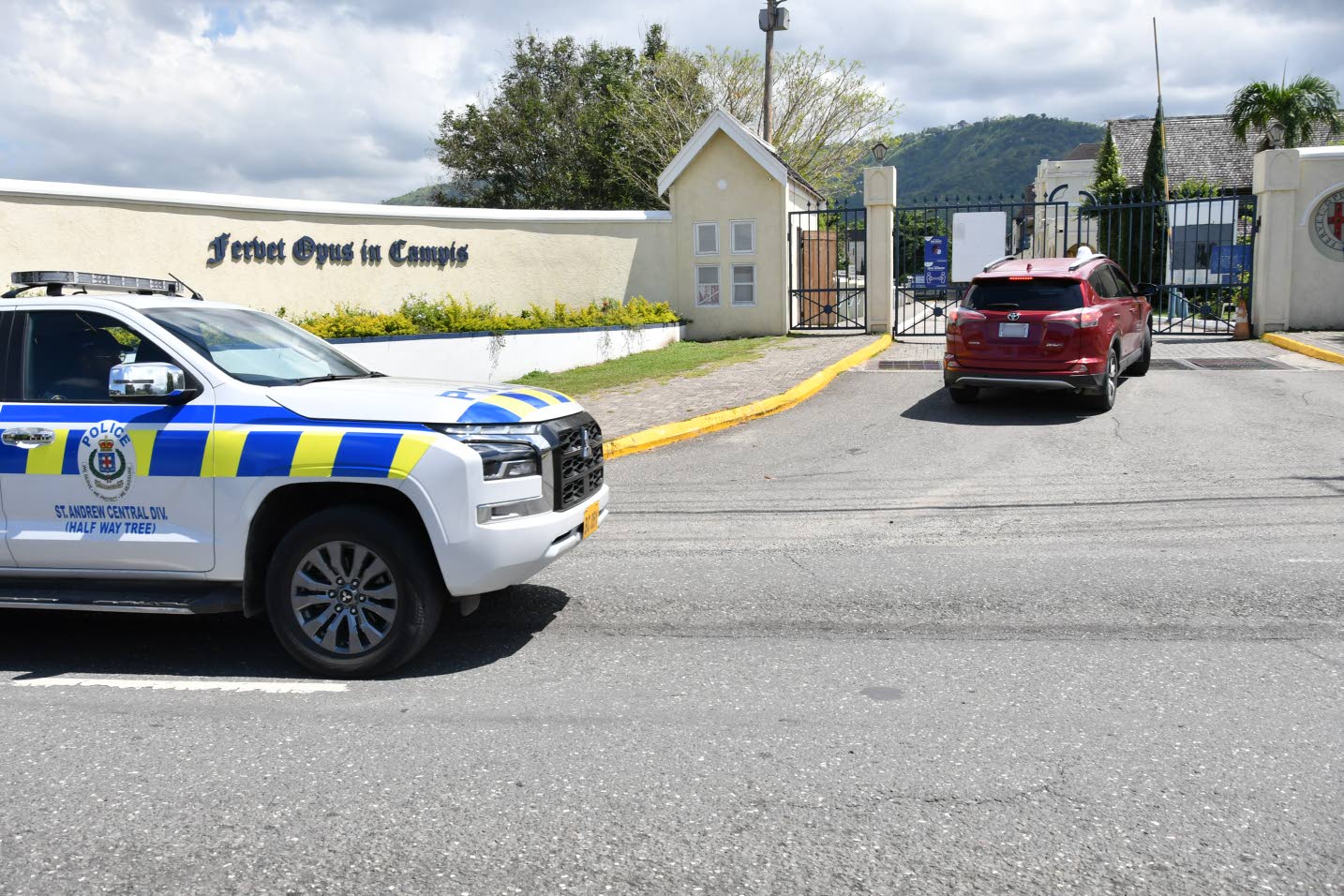
A police service vehicle outside Jamaica College where a student was reportedly arrested following a viral video depicting a physical assault on a peer. (Photo: Garfield Robinson)


