Parked by petrol prices
Worker cuts commuting costs by leaving car behind and taking the bus
Jason Hunt pulled into a commercial complex in Kingston on Wednesday morning, easing his ageing car into the parking lot more carefully than usual.
His mission that day was different.
He was not looking for the easiest spot near an entrance or somewhere he could make a fast getaway between store calls. He wanted shade. He wanted safety. He wanted somewhere the vehicle could sit for hours without attracting attention, because once he turned off the engine and walked away, he would not be seeing it again until dusk.
When he found the space, he locked the doors, checked them twice, and started walking toward the transport centre.
For the first time in years, Hunt was leaving his car behind and taking the bus to work.
“I never imagined I would be doing this again,” he told the Jamaica Observer with a laugh. “Once I bought the car, I told myself I was finished with long waits and bus life. But when you look at the numbers now, you have to humble yourself and do what makes sense.”
The 39-year-old merchandiser, typically visits close to 10 stores a day across Kingston and St Andrew. His route can take him through central Kingston, out to Harbour View, across Three Miles and into other sections of the Corporate Area. The job requires him to have a vehicle, but lately, owning the car and using it for work have become two very different things.
With petrol prices climbing again, Hunt says driving from store to store was costing him roughly $3,000 a day in gas. On a monthly salary of about $130,000, including a gas allowance, the numbers were becoming impossible to ignore.
So, he made a calculation many Jamaican workers are now quietly making for themselves: The car could still serve the family, but it could no longer serve the workday.
Instead of burning fuel all day in traffic, he would park in the morning, use public transport to move between stores, then collect the car after work and drive home.
“That little car is still important to me because it is how I take the children to school and move my family around. But if I use it for the whole workday now, it is like I am working just to buy gas,” he said.
Not long ago, that decision would have sounded unthinkable to him.
For years, the car represented escape from a transport system he had grown tired of enduring. Before buying it, Hunt spent long days in the sun waiting on buses, got drenched when rain fell, and remembers being splashed by passing vehicles while standing at the roadside. There were days when a bus to his area could take an hour and a half to arrive. Taxis were faster, but over time became more expensive and less practical for a man raising a family.
Three years ago, after weighing the risks, he bought a 2003 motor car from a friend for $350,000.
It was no showpiece. The seats now need repair and the body bears the marks of age. But it gave his household something increasingly valuable: Control. He could get his children, now aged three and 10, to and from school more safely. He could reach work on time. He could move with some dignity and predictability.
“When I bought it, people probably looked at it and laughed and said, ‘What is he doing with that old-man car?’ But they never knew what it meant to me. That was freedom. If rain was falling, I could pick up my children. If I got an early call for work, I could move. Sometimes people see an old car and see problems. I see help,” Hunt said.
Keeping the vehicle on the road, however, has required constant ingenuity.
Just last month, he spent about $70,000 on parts and servicing. He believes the bill could have been three times as high had he relied entirely on a formal mechanic. Over the years, Hunt says he picked up basic repair skills from YouTube videos and from watching a neighbour work on cars. He shops online for parts after comparing overseas prices with local stores, and regularly checks used-parts dealers and garages where vehicles are being dismantled.
For him, car ownership has never been about image. It has been about making life workable.
But then fuel prices began moving rapidly and are predicted to rise even higher over the coming weeks.
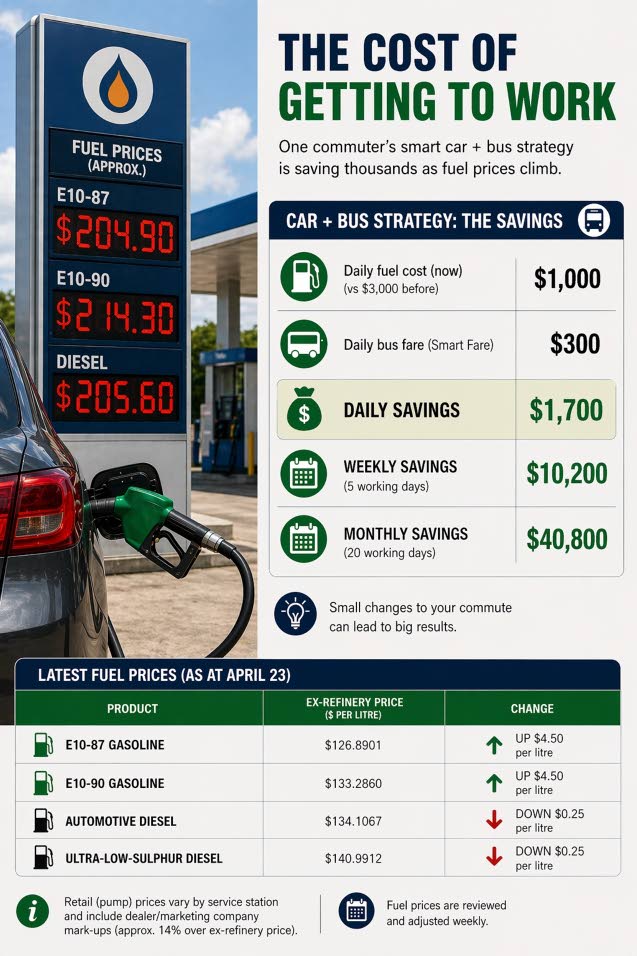
Motorists have been hit by another round of increases, with Petrojam’s latest ex-refinery prices showing both grades of gasoline rising by $4.50 effective Thursday, April 23. The 90-octane price moved to $188.57 per litre and 87-octane to $181.13, before retailer mark-ups are added. Fuel prices have been under pressure amid tensions in the Middle East and the rollback of the Government’s temporary cap on weekly increases.
For Hunt, those were not policy numbers. They were household numbers.
“People hear about war overseas, refinery prices and all these big issues on the news. In my house, it translates simply — can I afford to fill up or not? That is what it comes down to,” he said.
The turning point came in a conversation with a friend after he mentioned how much money was disappearing into the tank each week.
“Why not park the car and take the bus around town and go on foot in-between the stores where you can?” the friend suggested.
He decided to try.
Hunt told Sunday Finance that he went to the Half-Way- Tree Transport Centre Monday morning and signed up for the Jamaica Urban Transit Company Limited (JUTC) SmartFare card. What he found surprised him. The bus was air-conditioned. There were charging outlets. The atmosphere was calmer than he remembered. And somewhere along the route, he found himself laughing at the kind of lively Jamaican conversations that can turn an ordinary commute into entertainment.
Meanwhile, the recently revised fees for JUTC allow adults using the SmartFare card to pay $50 per trip or $100 if cash is used; while seniors pay a concession fare of $25. Children, students and the disabled who are also eligible for concession fares, will pay $20.00.
“I am not going to lie, I expected pure stress. But the bus was cool, I charged my phone, and people were talking and laughing. Jamaican people can turn any ride into a comedy show,” he said.
By changing strategy — driving only to the parking location, taking the bus between stores, then using the car again to head home — Hunt’s daily fuel bill has fallen to about $1,000. He then spends an additional roughly $300 on bus fares using the SmartFare card.
That brings his total daily transport cost to around $1,300, a saving of about $1,700 each day.
Across a six-day workweek, the savings can reach $10,200. Over the course of a month, it can amount to more than $40,000 — meaningful money in a household trying to cover rent, food, school costs and vehicle upkeep on a monthly income below $150,000.
But not every day runs smoothly. Buses can still be delayed, and a merchandiser working against the clock cannot afford too many disruptions. But he says the system has improved enough to make the plan workable.
Still, Hunt believes his story exposes a situation many workers understand well. He reasoned that often employers require a vehicle as proof of readiness and mobility. Yet for lower-income employees, the cost of owning and operating that vehicle can consume the very income the job provides.
“Sometimes I wonder how much people in offices really know about what regular workers deal with. They can say own a car, be on the road, be productive. But they do not see insurance, parts, tyres, gas, school fees, lunch money. One surprise expense alone can throw off everything,” he said.