



From teen shadow to advocate
Jezzell Reid reflects on fulfilling journey as classroom aid, calls for better pay
AT just 19 years old, Jezzell Reid jumped at the opportunity to become a shadow for a 16-year-old boy diagnosed with autism, an experience that was both fulfilling and eye-opening as it revealed the realities of individuals with special needs.
Now 26 years old, she is an academic coach at Kingston Online Learning Centre, where she continues to help students excel while also pursuing a degree in journalism. Reflecting on her six years’ experience as a shadow — which spanned 2019 and 2025 — she advocated better pay for shadows in Jamaica, noting that while classroom aides who are trained to provide one-on-one support to children and adolescents with special needs are in high demand, they are undervalued.
She recalled that the opportunity to be a shadow was presented to her while working with Youth Reaching Youth, a sub-branch of the Swallowfield Gospel Chapel in Kingston that facilitates Caribbean Secondary Education Certificate (CSEC), Caribbean Advanced Proficiency Examination (CAPE), and HEART/NSTA Trust classes and examinations for young people who left high school without any external exam certification.
She said she was informed that a family was in desperate need of a shadow, and she did not hesitate to accept the role because of her helpful nature.
“That’s the path the Lord led me on, and I just continued. I do work with troubled kids and teens in my community through my youth club and stuff like that, and I’ve been doing that for a while, but as the Lord said, ‘You need to be with special needs children,’ ” she told the Jamaica Observer.
She said her experience allowed her to understand the thought processes and behaviours of individuals with special needs, which fuelled her love and appreciation for children with special needs.
“Once I was able to pick up on those, we were able to form almost, like a little sibling relationship of sorts, because we are not that far off in terms of age…he would be 22 years old [this year], and I’m 26…so I started looking at it as working with a younger brother, and it made it much easier,” said Reid.
She continued: “It was insightful because we may see [children with special needs] and they are depicted a certain way on TV, but getting to know them, you realise that they’re some of the sweetest group of people you’d ever know. They just express said love in a very different manner, and sometimes that can be a little overbearing for us, but that’s just who they are,” she said.
Reid said the experience left her with lifelong memories as they laughed together on field trips, captured moments through pictures, reflected on the activities of the day, and took on all the challenges that came with autism.
“A lot of times we see persons approach it from a rigid standpoint, because in Jamaica we have these times when we say, ‘Nothing wrong with the pickney, they just don’t want to try,’ but that’s not necessarily the case. Once we don’t take it from such a rigid standpoint, and we actually loosen up and give them the opportunity to shine, that’s where they do flourish, so that’s what I tried to do, and it really made it an experience,” she told the Sunday Observer.
She said she felt particularly proud when she realised that her methods were impactful. She recalled the moment her student and his team secured gold at the Jamaica Cultural Development Commission (JCDC) for a drumming piece, stating that it is forever cemented in her memory.
“It was such a joyful moment because he was there, and he was just smiling. Now, normally, he isn’t someone who would just smile. He is normally very stoic, so to see him there and knowing that, hey, it was a journey, and I was able to be on that said journey with them, there’s a sense of accomplishment to know that he succeeded in something and I had a part to play in it,” she recounted.
While her experience over the years had been fulfilling, she said it was also eye-opening as she learnt the realities of other shadows in the system who were not as fortunate as she was and did not have the positive experiences she had. While there is a great demand for shadows, she said many shy away from the duty because of the lack of adequate pay and less than ideal working conditions.
She advocated for a change, noting that individuals who devote their time to children with special needs deserve respect and appreciation for their hard work.
“As a shadow, you’d say, for the most part, they do a lot. Teachers do a lot in the classroom, but for most shadows their work does not just end in the classroom. Some shadows have to go home with the child; they have to be there until the parents leave work or even well after that. Shadows are like surrogate parents, but at the same time, those efforts aren’t necessarily acknowledged most of the time, so it’s kind of disheartening when you think about it, especially for those who have this as their main source of income but, at the same time, the efforts are not being reflected in the pay. It’s kind of crazy when you think about it,” said Reid.
In a recent petition, the Government was called on to intervene on behalf of school shadows to provide fair compensation. The petitioners argued that despite meeting increased professional requirements, many school shadows continue to earn salaries below the national minimum wage. The country’s national minimum wage is $16,000 per 40-hour workweek, to be increased to $17,000 in July.
The petitioners described the situation as unjust, unsustainable, and inconsistent with Jamaica’s labour laws and commitment to equity in education. Shadow teachers are provided through the Ministry of Education’s Special Education Unit. It provides technical support that encompasses education for students aged three to 21 years with various special needs, including students who are deaf or are afflicted with other hearing impairments; students who are blind or have visual impairment; students with learning disabilities, intellectual disability, emotional and behavioural disorders, and autism; as well as students who are gifted and talented.
In a Jamaica Observer interview in 2022, then Jamaica Independent Schools’ Association (JISA) President Dr Andre Dyer said some parents, in footing the costs on their own, were paying sums of between $30,000 and $90,000 per month, depending on the qualifications of the shadow. Some were paid as low as $15,000 if the school subsidised.
In 2024, then Education Minister Fayval Williams said there were approximately 500 shadows in the system and that improved compensation was an area of focus by the ministry.
Reid also revealed that her final-year research project at The University of the West Indies examined whether the demand for shadows exceeds the available supply, finding a significant gap that needs to be addressed. She argued that fair compensation is a critical first step, not only to ensure shadows can earn a liveable wage but also to guarantee that students who require one-on-one support are able to access it.
“Everybody needs that one person in their corner and sometimes mommy and daddy are at work doing the best they can to make sure the school fees are paid, so sometimes all you have in your corner is your shadow, if you have one…There’s a need for it, but there’s also a need for someone to say, ‘Hey, this is why you should be a shadow,’ because just because the demand is there doesn’t mean that anybody and everybody’s going to readily jump on it. We need the money,” she stressed.
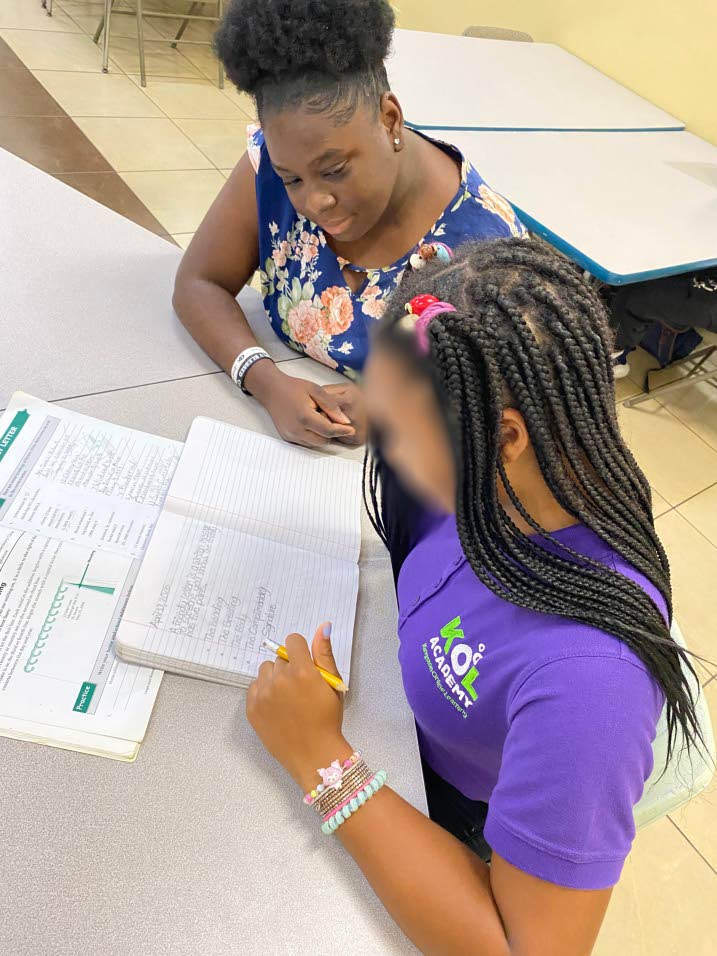
Jezzell Reid (left), an academic coach at the Kingston Online Learning Centre, assisting a student at the institution which provides academic services for students from Grades 1-12 using the United States curriculum.


