



Unity Primary now covered
GoldenEye Foundation grant to Bunkers Hill school will fix problematic uncovered walkway
GOOD HOPE, Trelawny — Principal of Unity Primary and Infant School Marilyn Salmon has welcomed a grant from the GoldenEye Foundation that will finally address the absence of covered walkways for students and staff at the Bunkers Hill institution.
Speaking during the grant presentation ceremony hosted by GoldenEye Foundation at Good Hope Estate on Friday, Salmon said the funding will support the covering of a walkway at the school, which was established in 1904, noting that although a 2025 inspection by the National Education Inspectorate (NEI) rated the institution satisfactory, it raised safety and security concerns.
“Students, teachers, parents, everyone had to move between buildings in the rain. That was a major issue,” Salmon said.
She noted that the NEI’s “satisfactory” rating reflected only a basic standard, and the school has since been striving to move into the “good” or “exceptionally high” categories.
The need for proper walkways became even more urgent following the impact of Hurricane Melissa in October 2025, when sections of the school, which also serves as a designated shelter, sustained damage. Salmon pointed out that the situation was especially difficult for vulnerable groups such as the elderly and young children who had been housed at the school during the hurricane.
“During that time, persons had to move through the rain to access bathroom facilities. It highlighted just how critical covered walkways are,” Salmon said.
With the support of the GoldenEye Foundation, co-chaired by founder Chris Blackwell and Marika Kessler, the long-standing issue is now being addressed.
“Our school is 122 years old. That’s 122 years of students walking through the rain. GoldenEye decided that was too long. Now, we will finally have a covered walkway where students, teachers, and visitors can move safely. No more delays, no more children getting wet just to go to the bathroom,” Salmon said, expressing gratitude for the intervention, describing it as transformative for both teaching and learning.
“I’m truly grateful for this. Not only am I grateful, but every single member of staff and every student is exceptionally grateful,” she added.
“We are preparing for the next NEI report. And this time, we are aiming higher.”
The grant forms part of a broader nearly $5-million allocation to schools and community institutions in Bunkers Hill under a structured development programme spearheaded by the foundation. Unity Primary and Infant and Wakefield Primary and Infant, along with five basic schools, were grant recipients.
The primary schools received $900,000 from their $1-million grants, the remainder of which will be handed over upon completion of their respective projects, while the basic schools that received $300,000 upfront from their $350,000 grants will be provided with the remaining $50,000, also at the end of their projects,
According to the foundation’s executive director Travis Graham, the intervention combines immediate relief with long-term development, similar to the foundation’s established work in Oracabessa.
Graham explained that the initiative was deliberately redirected to Bunkers Hill following Hurricane Melissa last October, where damage was most severe and where Blackwell has long-standing ties through his Pantrepant farm.
Initial efforts included the distribution of care packages and tarpaulins, repairs to more than 20 homes, and the installation of solar lights in 26 households that had been without electricity for months. A major health fair also benefited nearly 400 residents, providing dental, optical and general medical services through partnerships with the Caribbean School of Medical Sciences, Jamaica, the Rotary Club of New Kingston and several State agencies.
The programme has since expanded into capacity-building initiatives, including grants to schools, the health centre, and the community development committee. Funding is tied to proposal writing, project execution, and reporting to ensure accountability.
An agricultural component is also being rolled out in collaboration with the Rural Agricultural Development Authority and the Social Development Commission. This will provide farm support and establish two mini agro-parks featuring aquaponics, hydroponics, beekeeping and crop production.
“We want to strengthen local groups so they can continue these projects independently while keeping economic activity within the community,” Graham said.
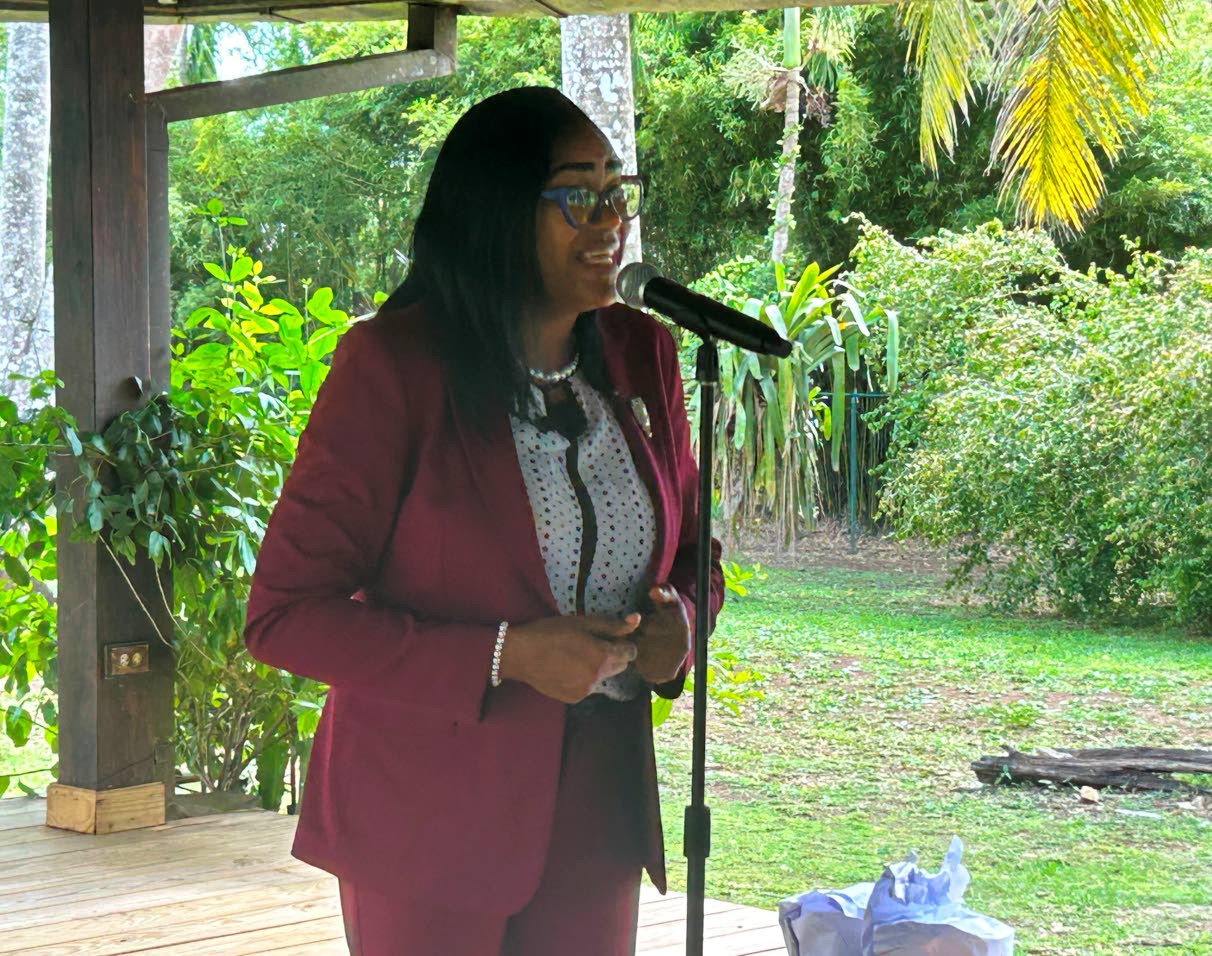
Principal of Unity Primary and Infant School, Marilyn Salmon, speaking during the grant presentation ceremony hosted by GoldenEye Foundation in Good Hope Estate, Trelawny on Friday (Horace Hines)


