



Container pile-up
PAJ explains congestion challenges in warehousing facilities in Montego Bay
SIX months after Hurricane Melissa hit Jamaica there remains a pile-up of goods at the port and in warehousing facilities in Montego Bay, St James.
Consolidated containers that arrived in the island in February are yet to be stripped.
This was revealed on Wednesday by president of the Port Authority of Jamaica (PAJ) Professor Gordon Shirley when he appeared before the Public Administration and Appropriations Committee (PAAC).
Shirley, who appeared to give an update on the state of the ports and warehousing facilities, some of which were severely damaged by Melissa, made the disclosure as he responded to a question from PAAC Chairman Peter Bunting.
In terms of the current backlog, Shirley revealed, while answering a question from Bunting, that there are consolidated containers that came into the country in February that have not yet been stripped.
“Those goods, under normal circumstances, would have been cleared well before now and are still there,” said Shirley.
Noting that customers have goods in those containers, Shirley said, “We are concerned that we get to those containers as quickly as possible to allow them to remove their goods.”
When Bunting enquired whether individuals were incurring higher demurrage charges as a result, Shirley reminded that the Government had waived all the statutory fees and the terminal had also waived fees. He said conversations have been had with the shipping lines to secure concessions in relation to the shipping charges.
Shirley explained that the congestion was not caused by individuals/entities who import or export full container loads. Rather, he explained that containers made up of pallets of goods and barrels are usually consolidated at warehouses, some of which are on the terminals or off the terminals.
“Those goods, after the fees have been paid and Customs has done their work, would be discharged to the importers,” Shirley said. He stressed that, “We don’t have a problem and did not have a problem with full container load containers at any time.”
He told the committee that the pile-up in the warehouses was caused by a confluence of factors, one of which was the impact of the hurricane. He displayed photographs during a PowerPoint presentation that showed the impact of the hurricane on the terminal and warehouse buildings in Montego Bay.
One building was so severely damaged it will have to be replaced, and the Seaboard Warehouse that is located off the terminal, but which contributes a lot to the clearance of goods, was also badly damaged.
Shirley said the surge of relief cargo also contributed significantly to the pile-up.
“That coincided with the Christmas peak volumes,” said the PAJ boss, who added that, “Jamaicans on a whole tend to ship barrels to their relatives or to themselves during the Christmas peak period.” He said this increase in cargo is usually observed from October to January.
“As you recall, the hurricane took place on the 28th, so we got a surge of new cargo of persons sending in relief cargo, separate from household cargo. And that was compounded by the fact that…some persons would have put their relief cargo on top of the normal household cargo.”
Shirley said that apart from the increased volume, there was some confusion following the announcement by Government that some goods would receive waivers as a result of the relief effort. He said some people who were sending barrels felt that if some hurricane relief supplies were in the barrel, the barrel would be exempted.
“When Customs said no it created somewhat of a problem,” he said.
The situation was compounded further by what Shirley described as the “much slower pace” at which people have come to clear barrels since the start of the year — both in Kingston and Montego Bay.
“They just did not turn up at the same pace,” he said.
“What we were told is that many persons who expected duty-free, or their barrels and so on to be treated as relief, they didn’t get it, they ended up just abandoning it…” Bunting told Shirley. He noted that these barrels will end up clogging the warehouses for a long time “unless there is some weeding out and disposing of these after a period of time”.
Responding, Shirley said there are a number of measures being taken to deal with the backlog, apart from extending the hours and expanding the available storage for those goods, since there is no way of telling which items are abandoned and which are not.
“So the effort to try to deal with it was to extend opening hours and to create more storage plus waiver of customs duties and taxes and storage fees.” This, in addition to working to secure discounts on demurrage fees.
Shirley said those interventions helped to reduce the backlog in Kingston.
The authorities are now looking to transport goods to the King’s Warehouse, formerly Queen’s Warehouse in Kingston, and also the possibility of auctioning off those goods that have remained in facilities beyond the time allowed by law.
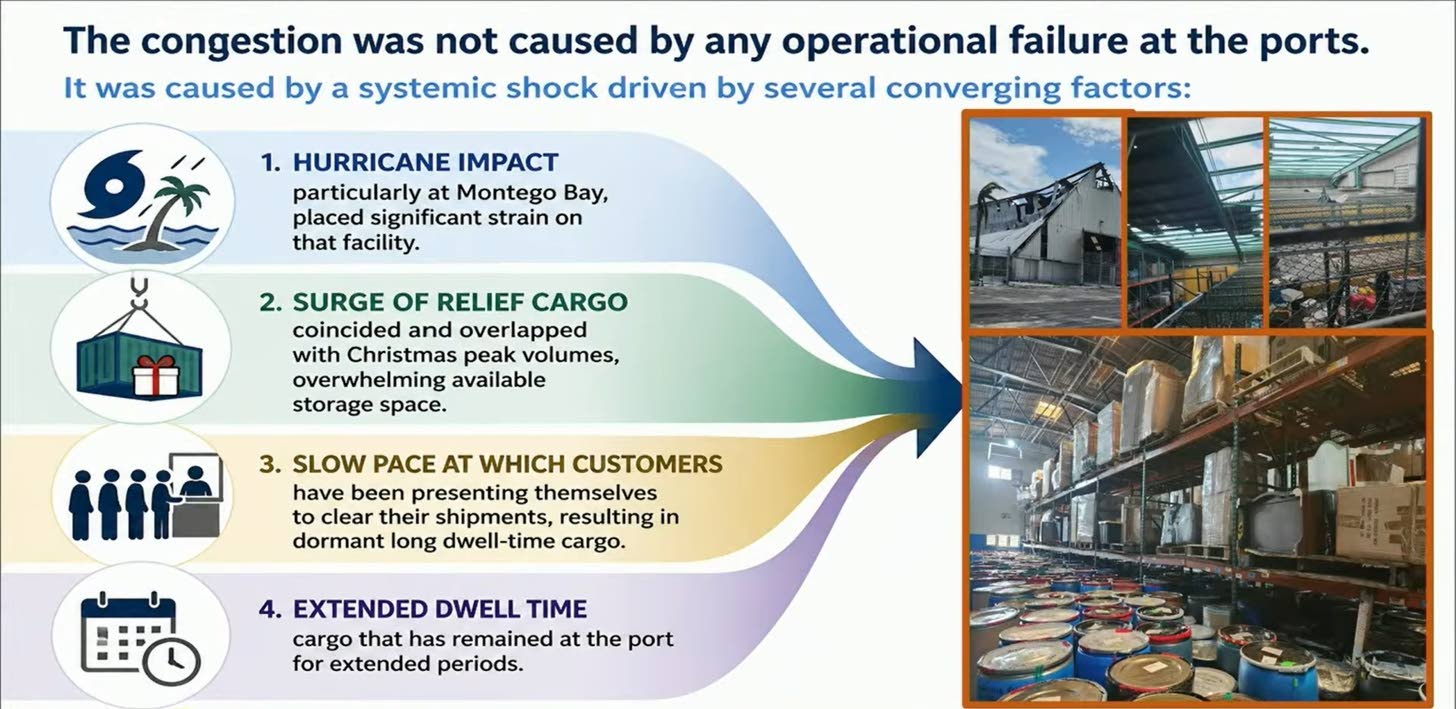
Slide shared by PAJ President Professor Gordon Shirley showing the factors impacting the congestion at the warehousing facilities.


