



Brokers hike commission rates on equity trades
Investors are set to pay more in fees as three brokers adjust their commission rates for equity transactions where the sector continues to report higher earnings.
Barita Investments Limited (BIL) recently informed its clients that it would be adjusting its fee schedule on June 1. This will result in adjustments to cheque related fees, outgoing real time gross settlement transfers and credit facility fees.
There will now be a flat 2.00 per cent commission rate applied to local equity transactions with a base amount of $550 charged for any transaction below $27,500. Trades above $1 million will have a commission rate ranging from 1.00 to 2.00 per cent, which can be negotiated with the broker.
This is a distinct change from the previous fee schedule where a 0.75 per cent commission was applied to all trades done on JtraderPro. This is an electronic portal developed by the Jamaica Stock Exchange (JSE) to allow broker clients to conduct their transactions electronically.
“These updates ensure that our services continue to meet industry standards, support the wide range of financial solutions we offer, and reflect the value we aim to provide to you,” BIL said in an email.
Jamaica Money Market Brokers Limited (trading as JMMB Investments) adjusted its fee schedule on April 17 across a wide range of categories. These included higher RTGS fees, cheque-related fees and return/recall transfer fees. There was a reduction in the GOJ/BOJ bid placement fee from 0.146 per cent to 0.10 per cent, but the minimum fee remained at $5,175.
Equity investors who conduct their trades digitally on the
Moneyline platform saw the commission rate on their trades move from 0.50 per cent to 0.70 per cent, but the amount charged went from 0.435 per cent to 0.609 per cent. For clients that required assistance outside of the
Moneyline platform, the commission rate went from 1.50 per cent to 2.00 per cent.
JMMB Securities Limited (JMMBSL) was awarded the second runner up award by the JSE Best Practice Committee in December 2025 for revenue generation and market activity in 2024. JMMB Group’s 2025 annual report highlighted that JMMBSL was first in the number of trades, second in trade volume, and sixth in trade value for 2024. Thus, a rise in commission rates brings in additional revenue where the Main Market and Junior Market had $60.58 billion and $6.36 billion, respectively, in value traded for 2025.
“As is customary, JMMB routinely reviews its fees within the context of both our operations and the needs of our clients. Following our most recent review, we have adjusted some fees, in alignment with our guiding principle of fairness in how fees are applied, our core value of love, and our commitment to having your best interest at heart,” JMMB said in a recent email.
VM Wealth Management Limited also adjusted its equity commission rate in a similar manner to Barita where the lower rate for Jtraderpro is no longer applicable. Clients at VM Wealth were previously charged 0.75 per cent for trades done on Jtraderpro while a rate ranging from 1.50-2.00 per cent was applied for in branch transactions. As of March 1, clients are now subject to a trading fee of 2.50 per cent per transaction with transaction requests made outside of the VM Wealth Client Portal now attracting a fee of $1,500 per transaction.
“These updates will allow us to continue investing in enhanced digital capabilities, improved service channels, and the dedicated support teams that serve you every day. Your relationship with us is important, and we remain committed to delivering efficient, secure, and high-quality service to support your financial goals,” VM Wealth told clients.
While the broker space typically has a flat 2.00 per cent commission rate, a discounted rate was usually applied to digital transactions which required less direct interactions with clients. This incentivised users to conduct trades online and at a more frequent pace which generated more revenue for the brokers. However, these fee adjustments reflect a shift in views by brokers who must prepare for the new twin peaks regulatory framework and other regulatory changes to their respective parent companies.
According to the Financial Services Commission (FSC), total revenue grew 17 per cent to $87.77 billion for the unaudited December 2025 calendar year. This improved revenue generation was attributed to higher non-interest income activities, primarily debt securities trading profits. A five per cent reduction in expenses to $72.51 billion left the sector reporting $15.26 billion in profit before tax (PBT). These earnings correspond to 19 out of the 33 securities dealers whose primary activities are dealing in financial securities.
“The reason for the positive jump in profit before tax is attributed mainly to growth in operating revenue along with a fall in expenses concurrently,” the FSC stated.
The PBT for the December 2024 period was restated from $0.87 billion to a loss before tax of $1.54 billion. There was no comment for the variation between the two reports.
While total assets contracted one per cent to $973.43 billion, equity/capital improved two per cent to $147.96 billion. The aggregate capital adequacy ratio for these 19 firms improved from 20.41 per cent to 22.49 per cent, twice the statutory minimum of ten per cent.
Broker assets/funds under management (FUM) grew 10 per cent to $1.83 trillion with collective investment schemes (unit trusts and mutual funds) valued at $416.47 billion, nine per cent higher than the prior $383.11 billion. While this is a relative improvement on a year-on-year basis, the FUM balance was $1.72 trillion in December 2022 with collective investment schemes worth $346.80 billion. The FUM balance was $1.59 trillion in December 2021 with collective investment schemes worth $364.5 billion.
Thus, whilst asset values by fund managers remains at record high levels, the growth in those assets has slowed down, with equities in managed funds growing at a slower rate. So, whilst the banking and securities sectors continues to report higher earnings, the public is being asked to pay more to access various services which are already going digital.
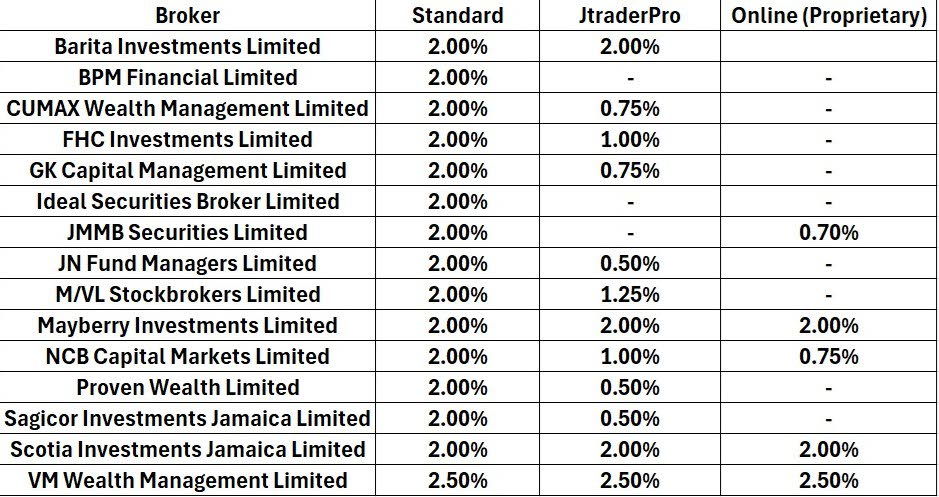
A table showing broker commission rates effective June 1, 2026. .


