



Heat on former UHWI chairman
Chai Chong faces fiery PAC interrogation over failed CEO recruitment drama
Government Members of Parliament (MPs) Zavia Mayne and Heroy Clarke turned Tuesday’s Public Accounts Committee (PAC) sitting into a courtroom-style grilling as they fiercely questioned former University Hospital of the West Indies Board Chairman Wayne Chai Chong over the hospital’s controversial overseas CEO recruitment process.
They also questioned whether the dissolved board had fully approved key aspects of the appointment process, including payment of travel expenses for the overseas candidate, while revisiting the bitter fallout and governance tensions that ultimately ended with the board’s dissolution.
The heated exchanges reopened one of the most controversial chapters in the recent history of the UHWI — the failed search for a permanent chief executive officer which preceded the collapse of the former board in late 2023 and sparked accusations of ministerial interference, governance breakdown, and dysfunction within the institution.
Throughout the sitting, both Government MPs repeatedly challenged Chai Chong’s account of events, particularly surrounding the extent of support within the board for the overseas candidate and the decisions taken during the recruitment process.
At one point, Clarke aggressively pressed the former chairman over the issue of airfare and travel expenses for the preferred candidate, questioning whether the board had genuinely authorised the payments.
“Did you authorise, did you instruct, did you ask, did you recommend anyone on the board to pay the travelling amount to the person that came from wherever you said she came from?” Clarke asked.
Chai Chong insisted the decisions were not unilateral and maintained that the board had approved the arrangement.
“The board indicated that it wanted to see the individual and complete final due diligence with that individual, and that individual lives overseas so that final due diligence is necessary to be conducted,” Chai Chong said.
The issue became more contentious after Clarke questioned whether the board had actually been fully aligned behind the recruitment exercise.
Chai Chong rejected suggestions that he had acted independently of the board and repeatedly stressed that the recruitment exercise had been handled through a formal process involving professional external recruiters.
He explained that the board had concluded early in its tenure that finding a permanent CEO was one of its most urgent priorities, particularly given the operational and governance challenges facing the hospital at the time.
“Certainly, as a board, the person that is most important to us is the CEO who we will hold accountable for the performance of the institution. You needed to have someone in place who is permanent, who is conducting the activities and the goals of the institution,” Chai Chong said.
He told the committee that the board decided the role was too important to be handled internally and therefore opted to hire a professional executive recruitment firm to conduct an international search.
“We appointed an entity that had a very strong reputation. This company has done hiring for the Government of Jamaica and several leading institutions in the country. An international search was launched,” he explained.
According to Chai Chong, the recruitment process attracted more than 90 applicants from Jamaica and overseas, including candidates from the United Kingdom, Australia, the wider Caribbean, and the United States.
He further disclosed that the board had sought private sector assistance to supplement the salary package after being advised that existing Government compensation guidelines would not attract the calibre of executive needed to lead the struggling institution.
However, the exchanges intensified after Clarke persistently pressed Chai Chong on whether he could recall the amount spent on bringing the preferred overseas candidate to Jamaica.
“You can’t recall? But you know it’s a she, and you can’t recall the money that was paid over to the she, and you were a part of the board at that time, and you were the chairman?” Clarke asked pointedly after Chai Chong repeatedly stated that he could not remember the figure involved.
After Chai Chong again insisted that he could not recall the amount, Clarke openly questioned his credibility.
“You know, I came in here this morning and I looked at your face and I said, ‘Here is an honest man’. But then you take all that away from me just now,” Clarke remarked.
Mayne, who is also state minister in the Ministry of Finance, questioned whether the full board had genuinely settled on appointing a candidate who lived overseas and had already reached retirement age, an issue which surfaced during the hearing.
“The question of retirement age was not one that was raised with us initially at the board level. However, we sought clarification once it was brought up and we were satisfied at the board level that that was not an issue,” Chai Chong explained.
The sitting also shed fresh light on the governance issues which complicated the recruitment effort.
Chai Chong disclosed that the preferred candidate had ultimately refused to sign a contract after raising concerns about the hospital’s reporting structure.
“The candidate indicated that the most important person for them to be able to achieve the objectives of the institution was the senior director of clinical services and in their experience in the other organisations that she was in charge of, that person needed to report to the CEO position. So she felt that unless she could be guaranteed by the board that we were able to resolve that position and that situation, she would not be able to effect her duties,” Chai Chong said.
The hearing later shifted to the dramatic breakdown between the board and the Government during the leadership transition period.
Opposition MP Christopher Brown, who represents St Mary South Eastern, questioned Chai Chong about claims that the health minister intervened after the board attempted to move in a different direction regarding the acting CEO position following the failed overseas recruitment process.
Chai Chong maintained that he resigned because he believed the authority of the board had effectively been undermined.
“Well, I felt that if the board had taken a decision, which is one of the most critical decisions that a board has to make as to the position of the CEO, and if that decision was being overturned, then in essence the board was being told that it had no power, and I was not willing to continue serving where decisions of the board could be overturned without any kind of consultation with the board,” he said.
The exchange quickly became more confrontational after Mayne challenged Chai Chong’s account of the board’s collapse and suggested that the health minister had never interfered in the manner being described.
“It is very unusual. I want to put it to you, Mr Chong, that the minister did no such thing and that you are upset because the minister described you as being dysfunctional,” Mayne argued during the heated sitting.
Chai Chong pushed back against that assertion, insisting that he resigned because he believed the authority of the board had been undermined.
“Well, I believe the description of dysfunction took place long after I resigned. So, in that situation, your assertion that I did so because my board was being described as dysfunctional would not be correct,” he said.
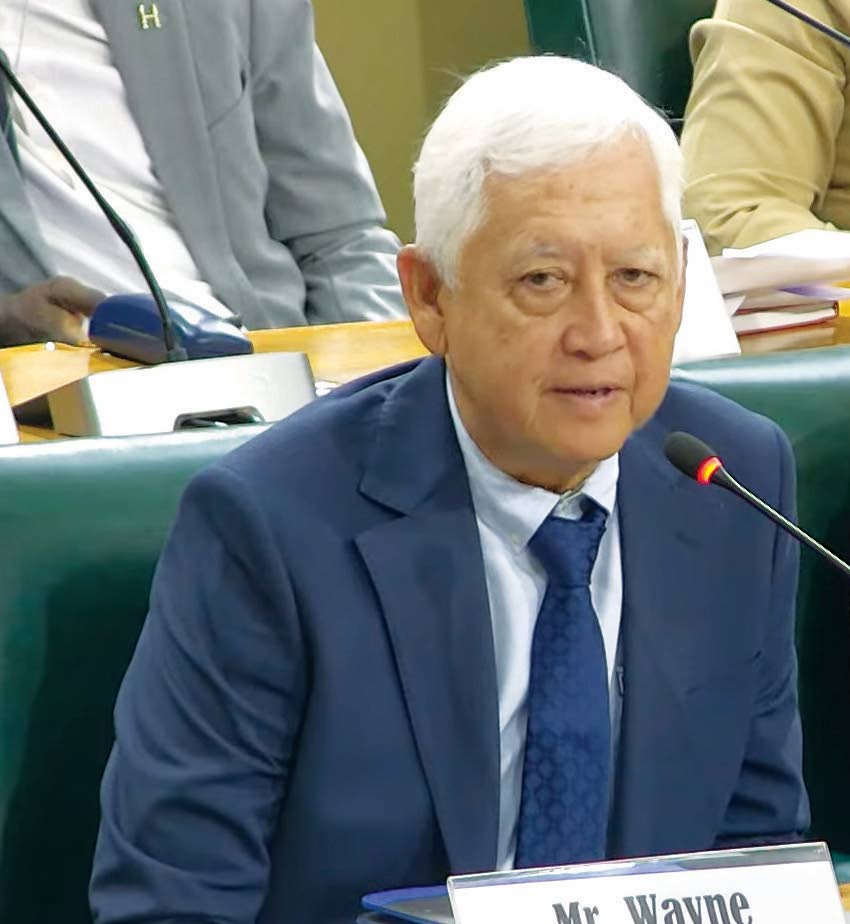
Former University Hospital of the West Indies Chairman Wayne Chai Chong answering questions during Tuesday’s Public Accounts Committee meeting.


