



Hovering above violence
Drone soccer coach says exposure to technology can help reshape behaviour in Jamaican schools
AGAINST the backdrop of mounting concern over fights, bullying, and other violent incidents in Jamaican schools, drone soccer coach Dervon, Mckellop says his drones in schools initiative is giving students a constructive alternative by steering them towards technology, discipline and teamwork, instead of conflict.
The initiative, which operates under the banner “Harms Down and Drones Up”, introduces students to drone technology, aerial robotics and drone soccer, which is a rapidly growing international sport which combines competitive gameplay with drone piloting and strategy.
Mckellop, who recently guided Jamaica’s drone soccer team to gold at the International Palm Springs Drone Fest in California, said the programme was developed not only to expose students to emerging technology, but also to create a positive outlet for young people at a time when violence in schools remains a major national concern.
“It ties into a social initiative that I’ve also developed, which is called Arms Down and Drones Up, and I want to emphasise on that because in recent months, we have seen so many flare-ups of violence in schools, you know, students being injured. So it ties back into that social initiative where students get to express themselves in a creative form by putting down any form of arms, whether it’s bullying, whether it’s physical fighting or hurting somebody, to channelling their energies and their focus, their creativity, into a sport like drone soccer, [and] into an aerial robotics programme,” he said during a recent interview with the Jamaica Observer.
The initiative has already reached several schools across Jamaica, and according to Mckellop, the programme expanded significantly over the past year despite limited resources and the absence of direct government support.
He said the team conducted drone sessions at Eltham High School in St Catherine, before moving into Manchester, where activities were carried out at Cross Keys High School, Winston Jones High School, Pratville Primary, and New Forest Primary and New Forest High School.
“We actually also donated a drone soccer ball to New Forest High School on that visit because we wanted them to start building the skills there,” he added.
The programme has also extended beyond Jamaica’s borders.
Mckellop said organisers recently partnered with the Lions Club of Tortola and the Ministry of Education in the British Virgin Islands to host an aerial robotics competition involving three schools.
According to him, the project later received recognition in Trinidad after competing against initiatives from more than 16 countries.
The growing interest, he said, reflects the impact the programme is having on students, many of whom are being exposed to drone technology for the first time.
“Just imagine a kid who never touched a drone before, when the first time they hold the controller and they realise that they can fly the drone, every one of their faces lights up. The kids alone just experiencing this is so amazing to know that whatever you’ve done, you’ve impacted them for a lifetime. Overall, I can tell you, schools and the teachers and the administrators are very excited about this. the students are soaking up everything that we have taught them,” he said.
He revealed that although organisers had initially targeted 75 schools during the 2025-2026 academic year, disruptions caused from Hurricane Melissa last October prevented them from reaching that goal. Even so, demand for the programme has continued to grow rapidly.
“Right now, we have over 15 schools waiting, at least for the 2026-2027 school year, to attend across Jamaica alone. So that’s how impactful the drones in school programme is,” Mckellop said.
Drone technology has increasingly been integrated into industries such as agriculture, security, construction and logistics globally, while drone sports and robotics competitions continue to gain popularity among younger audiences. In countries such as South Korea, drone soccer has already evolved into a professional competitive sport with organised leagues and prize money.
Mckellop believes Jamaica has an opportunity to position itself early in that growing industry by introducing students to the technology from a young age.
“So what we’re doing, we’re going to individual schools, and once they reach out to us… we are going there. All we need is some support to just get there because sometimes it is financial burden when we have to go there,” he said.
Despite the challenges, he insists the long-term goal remains unchanged — building a generation of students who see technology, innovation and sport as opportunities rather than limitations.
“We’re going to continue to do our country proud, and all I’m asking for is just a little bit of help, just to help push us to that level that we need to get [so], that we can eventually get corporate sponsorships, you know, to continue to help this sport to grow,” he said.
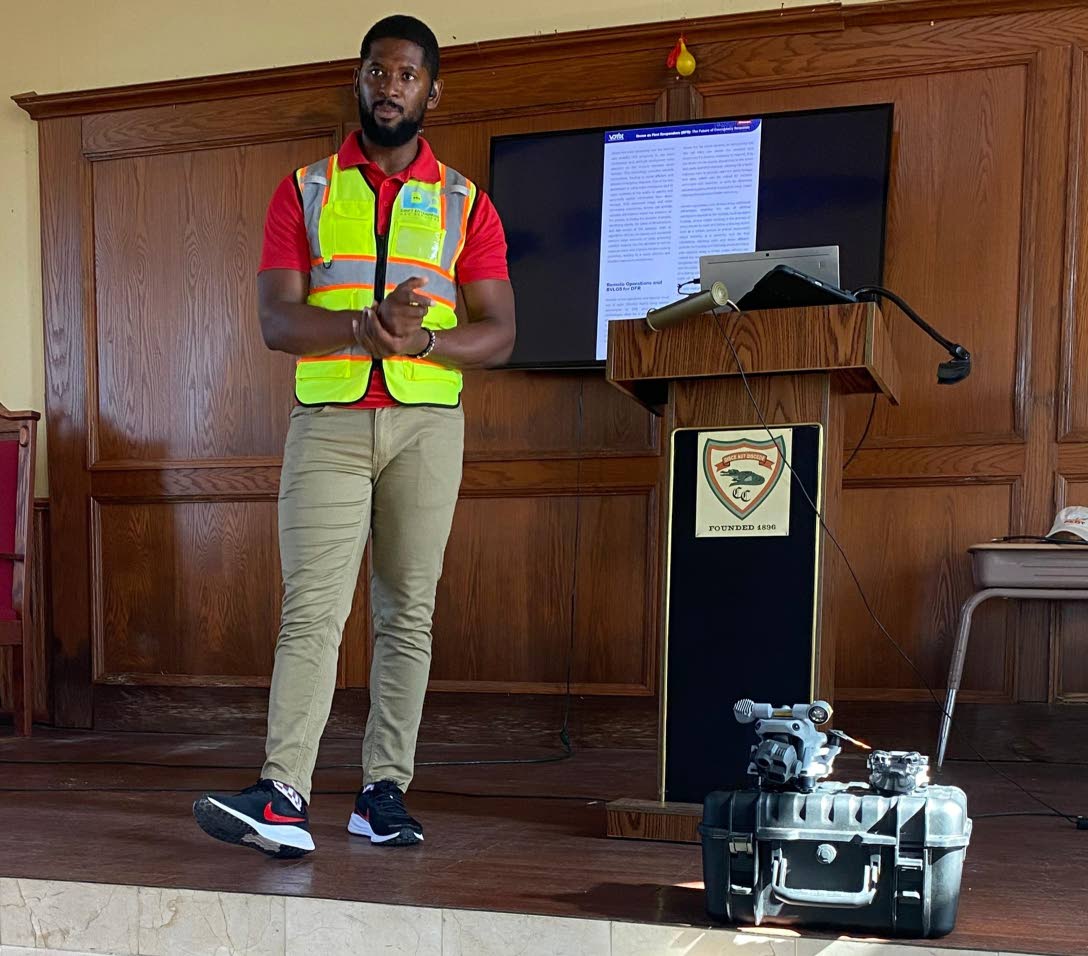
President and coach of the Jamaica Drone Soccer team, Dervon Mckellop teaching a theory session on drones to police officers recently at the Cornwall College Chapel.


