



Melissa insurance claims backlog fuels frustration
...top insurer calls industry’s delayed response a “significant failure”
SIX months after Hurricane Melissa battered western Jamaica, frustration is building among policyholders who say insurance payouts are still lagging, leaving some businesses and homeowners struggling to fully recover from the island’s most destructive storm in decades.
The discontent comes as senior figures within the insurance industry itself acknowledge that the sector’s response to the catastrophe exposed weaknesses in how claims are processed and settled, after the Category 5 system tore across last year.
Speaking during a panel discussion at the Insurance Association of Jamaica’s business conference, BCIC CEO Peter Levy drew a distinction between the financial resilience of insurers and the industry’s performance in getting claims settled.
“The results and the balance sheets of the insurance companies are strong…in that category, I would say that the grade is A+,” Levy said, before conceding that the claims response “has not been an A”.
“I think it’s easy to overlook that it’s individuals, families, small businesses who need to get back their life to some degree. And it is a significant failure, I think, that the response that we were able to deliver has not been able to come through earlier than it has.”
Levy went further, indicating that there were likely still more Melissa-related claims outstanding than settled, more than six months after the storm.
“We still have probably more claims not settled than settled at this point. I don’t know what’s the situation for the rest of the industry but that’s from BCIC,” he said.
The comment carries added significance given BCIC’s position in the local market. The Fair Trading Commission, in reviewing BCIC’s acquisition of JN General Insurance, previously noted that the combined entity would control the largest share of Jamaica’s property insurance market.
Efforts by the Jamaica Observer to get updated figures from the Insurance Association of Jamaica (IAJ) on processed versus unresolved Melissa-related claims across the wider industry were unsuccessful up to press time.
For businesses across western Jamaica, the delays are becoming more than an administrative issue.
In an interview with the Business Observer, Jason Russell, president of the Montego Bay Chamber of Commerce, said slow settlements can directly affect whether companies are able to retain staff, pay suppliers, and reopen operations after a disaster.
“We’re talking about the life and death of a business. A business can’t wait a year to get paid,” Russell said, arguing that delayed settlements threaten business continuity at a time when companies are already trying to recover from severe disruptions.
“If you’re not paid out in a matter of weeks, you lose staff, you lose customers. The ability for you to rebound and get back in the game has been severely affected — and that’s what insurance is supposed to do,” he added.
Melissa, which slammed into Jamaica on October 28 last year, caused widespread destruction across the western end of the island, severely damaging hotels, businesses, homes, farms and infrastructure. The storm has since become one of the largest economic shocks Jamaica has faced in decades, with the Planning Institute of Jamaica (PIOJ) estimating overall damage at roughly US12.2 billion — equivalent to about 56.7 per cent of Jamaica’s 2024 GDP.
While much of public focus immediately after the storm centred on physical destruction and emergency response efforts, the slower-moving issue of insurance claims has quietly become a growing source of tension for households and businesses still attempting to rebuild.
Levy acknowledged that insurers faced major logistical and operational constraints in the aftermath of the storm.
He recalled that roads were blocked, communication systems were down, and even contractors preparing estimates were dealing with storm damage themselves..
“There was not enough resources to handle the volume,” Levy said during the panel discussion, adding that the industry now has to examine where systems failed and what changes are needed before another catastrophe strikes.
Among the areas now under review are whether insurers should ease some verification requirements during major catastrophes, and whether claims can be processed faster once losses fall within a reasonable range of assessment.
“If you get within a certain percentage of what looks like the cost of the whole fund, maybe we shouldn’t spend another six weeks pursuing that… just settle the claim and move to the next,” Levy said. “We’re not expecting perfect[ion]. We just want fast and easy,” he continued.
The issue, however, extends beyond processing delays.
Russell said Hurricane Melissa also exposed what many policyholders only discover after disaster strikes — that having insurance and being fully protected are often not the same thing.
He pointed to widespread confusion surrounding valuations, deductibles, exclusions and underinsurance, arguing that many customers do not fully understand the limitations within their policies until claims are being assessed.
“For argument’s sake, say your building value is $100 million and you’re insured for $50 million, if the building is totalled, you don’t get $50 million, you get $25 million,” Russell said while explaining how underinsurance clauses can drastically reduce payouts.
“There is a quickness to sell and then a slowness to pay out,” he added.
Russell stressed that he was not accusing insurers of acting illegally or dishonestly, but argued that many customers only begin to understand the fine print and limitations within their policies when losses occur.
“The fine print and what they are signing up [for], paying for, leave a lot of gaps,” he said.
That frustration is emerging at a time when insurance costs globally are already climbing under pressure from increasingly frequent and severe climate-related disasters.
“It’s very expensive to insure,” Russell said, noting that some businesses are now exploring various forms of self-insurance rather than relying entirely on traditional coverage.
The broader concern for the industry is whether prolonged claims disputes and delays could weaken public confidence in insurance itself, particularly in a country ranked among the most disaster-prone in the world.
During the same panel discussion JN Life General Manager Hugh Reid warned that Jamaica’s growing exposure to hurricanes, droughts and earthquakes means resilience can no longer be treated as optional.
“The truth is that we are going to see, maybe unfortunately, hazards, maybe multiple hazards on an annual basis,” Reid said.
He argued that increasing insurance penetration and encouraging long-term savings will become increasingly important as climate shocks intensify.
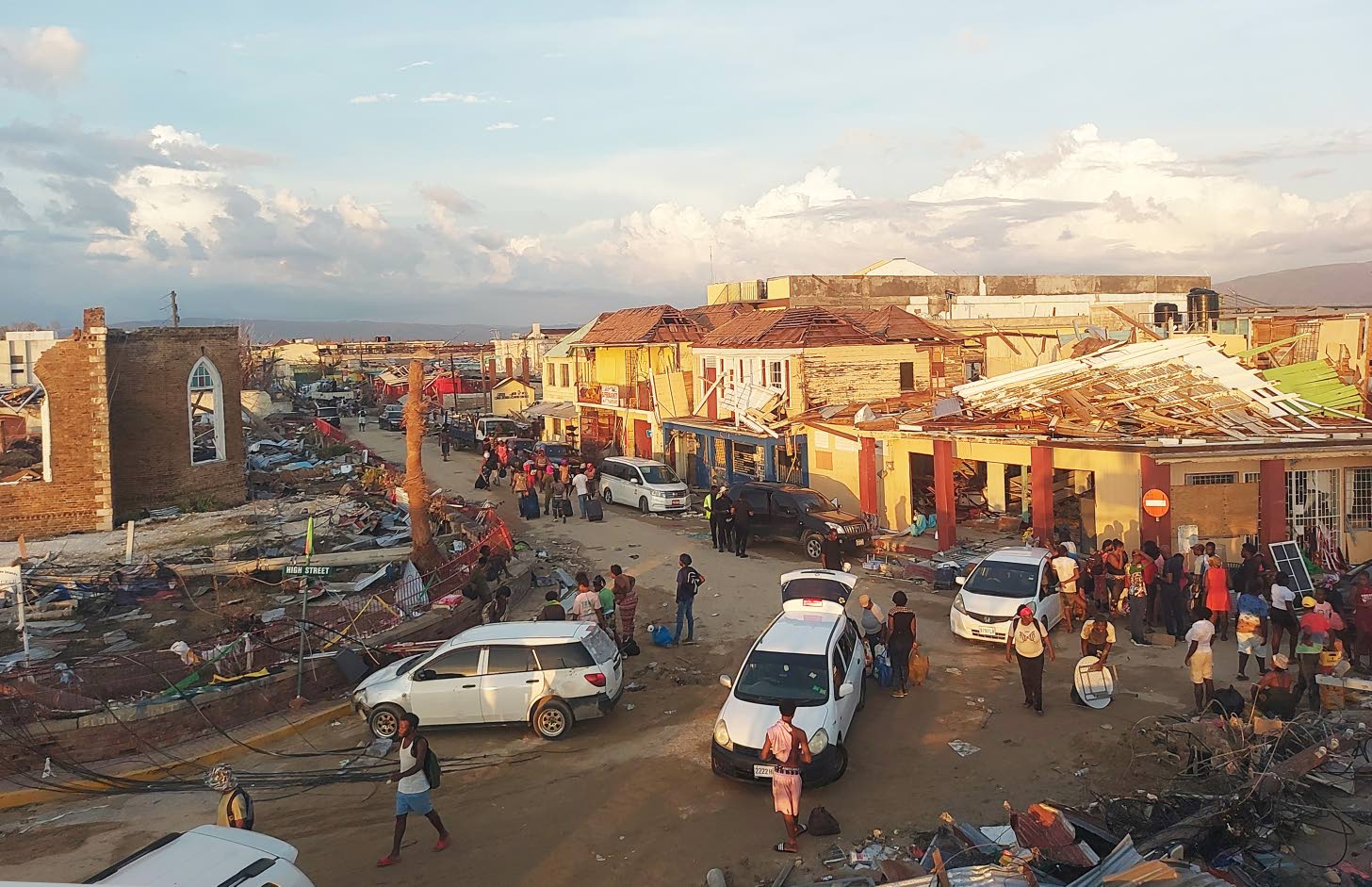
Widespread destruction from Hurricane Melissa left thousands of homes and businesses in need of major repairs across western Jamaica. More than six months after the Category 5 storm, unresolved insurance claims remain a source of frustration for many policyholders still trying to rebuild.


