



High awareness, low understanding
SALISES study exposes Jamaica’s AI knowledge gap
A national artificial intelligence (AI) readiness study has revealed that only six per cent of Jamaicans have been formally trained in the operation of the technology, prompting researchers to urge Jamaicans to get more involved or risk being left behind.
The study, conducted by researchers at the Sir Arthur Lewis Institute of Social and Economic Studies (SALISES) at The University of the West Indies, Mona, surveyed 1,072 Jamaicans across all 14 parishes between October and December 2025.
The researchers found that while awareness of AI was high, actual technical understanding was minimal.
“Only six per cent have had some sort of training and… of course, those who have been trained are those who are in the high-income bracket, postgraduate studies, and suburban areas.
“But let it not be lost on us that overall, only six per cent of the population have engaged in some sort of AI training. So we’re lagging where that is concerned,” said research fellow at SALISES, Dr Stephen Johnson who was the main presenter at the launch of the study at The UWI Regional Headquarters in St Andrew, on Tuesday.
According to the findings, Jamaica scored a 76 out of 100 on a public awareness scale, with most Jamaicans recognising AI’s role in customer service, communication, and education.
However, Johnson pointed out that this awareness was often filtered through the lens of “science fiction style machines” rather than a conceptual understanding of how algorithms function.
“Many respondents lack understanding of how AI actually works; struggle to distinguish AI from general technology; have low awareness of algorithmic decision making, weak risk literacy; limited understanding of deep fakes misinformation systems. AI knowledge remains shallow rather than deep, experience based rather than conceptual,” added Johnson.
The study also found that 62 per cent of respondents expressed interest in AI training and the SALISES researchers have warned that failure to expand access could deepen existing inequalities between higher-income and lower-income Jamaicans.
According to the report, public trust lagged at just 5.45 out 10, while 81 per cent of respondents strongly supported moderate or strict oversight of AI technologies.
Johnson underscored that should public trust increase, more people will be willing to become more immersive with their use of the technology.
Among the recommendations outlined in the report to help with Jamaicans’ advancement were the launch of a national AI literacy campaign, expanded subsidised AI training through institutions such as HEART/NSTA Trust, support for small businesses adopting AI tools, and the integration of AI education into school curricula.
As for whether Jamaica showed readiness to harness the full capabilities of AI, Johnson noted that the research indicated great potential, but more people needed to be able to use the generative technology beyond its basic functions.
“So we’re ready for regulation. As you can see persons are aware of it, they are willing to use it but trust is a major factor. One of the factors that will drive trust is having necessary regulations in place to build that confidence. So when we say readiness that’s what we mean. Older persons, persons in the lower-income bracket, they are ready for training,” Johnson told the Jamaica Observer following the launch.
In the meantime, during a panel discussion featuring lead researchers behind the report and other stakeholders, chairman of Jamaica’s National AI Task-Force Christopher Reckford, urged Jamaicans to seize the opportunity that the generative technology provides as this has the ability to narrow inequalities that exist in digital economies.
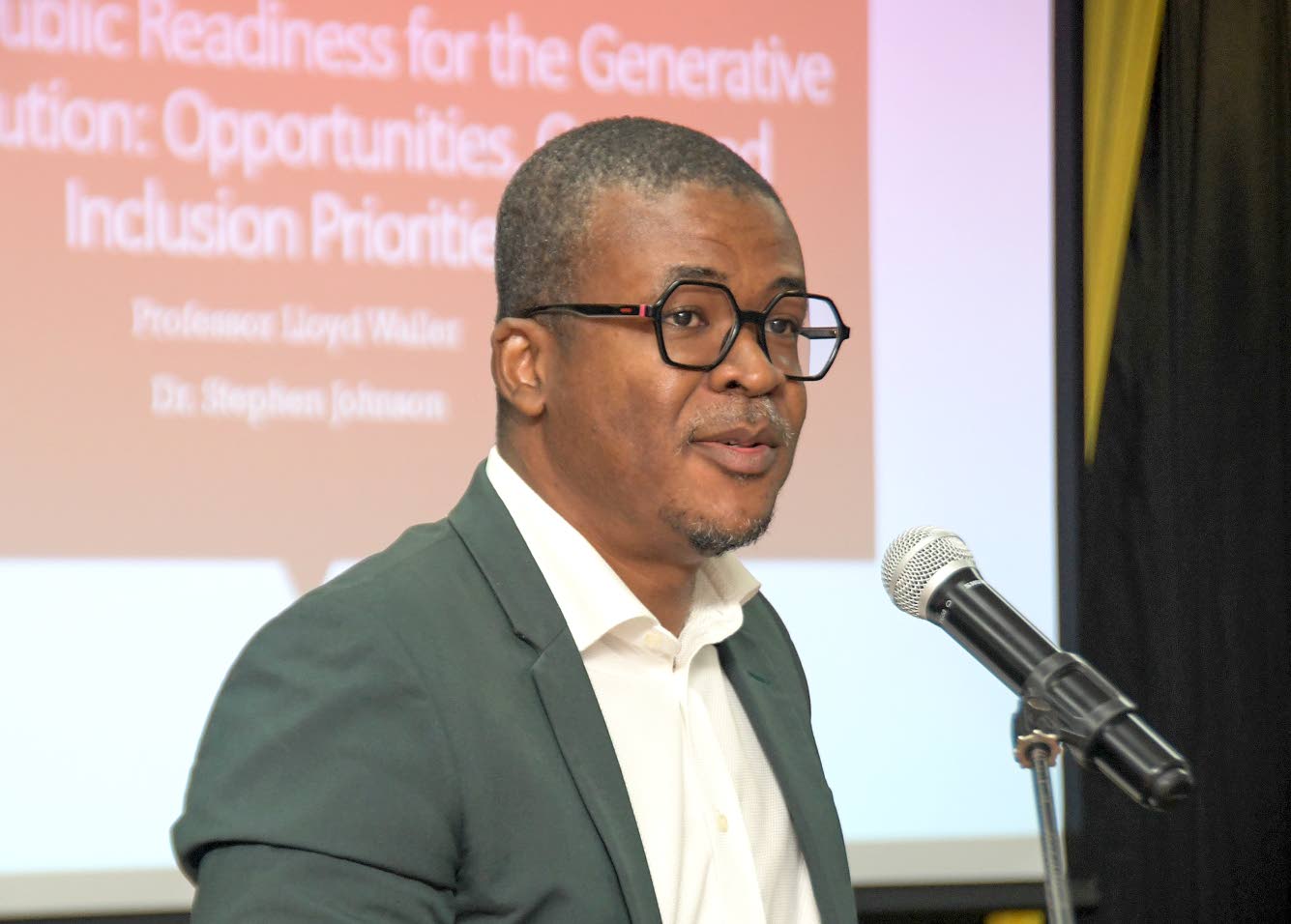
Research fellow at the Sir Arthur Lewis Institute of Social and Economic Studies (SALISES), The University of the West Indies, Mona Dr Stephen Johnson, presenting the findings of a national AI study at The UWI Regional Headquarters in St Andrew on Tuesday. (Photo: Naphtali Junior)


