



Big spending, modest returns
Jamaica invests like a rich country on education but results fall short
JAMAICA is devoting a rich-country share of its national income to education but the returns are falling far short of expectations, raising fresh questions about whether billions of dollars in public spending are being converted into the skilled and productive workforce the economy needs.
That is the central conclusion of a new report from the Caribbean Policy Research Institute (CaPRI) and UNICEF, which argues that while the country spends heavily on children, weak accountability, fragmented systems, and underinvestment in the first 1,000 days of life are limiting the impact of those outlays.
“We spend like a rich country but we’re not getting the outcomes of one,” said Dr Diana Thorburn, CaPRI’s director of research, at the launch of the report, Room for Improvement: The Gap Between Public Spending and Child Outcomes in Jamaica, on Thursday.
For a country facing chronically low productivity, an ageing population, and one of the world’s lowest fertility rates, the implications extend well beyond classrooms. The report suggests Jamaica may be failing to convert substantial public investment into the human capital needed to sustain economic growth and support future generations.
“Every single child matters more now than it did before, given the country’s fertility rate,” Dr Thorburn said.
“When a country like Jamaica’s child cohort shrinks, each child carries more of the weight of the country’s future. They’re a larger share of the workforce that is expected to drive growth, pay taxes, and sustain the generation above them,” she continued.
Over the last three decades Jamaica has spent an average of roughly five per cent of gross domestic product (GDP) on education. According to Dr Thorburn, that level of investment exceeds regional averages and is comparable to spending in many wealthy nations and high-performing education systems.
Yet the outcomes tell a different story.
A child entering school in Jamaica today can expect to complete about 11.5 years of schooling but will acquire the equivalent of only seven years of effective learning, based on the World Bank’s Human Capital Index. Jamaica’s score of 0.53 suggests that a child born today is on track to realise just over half of his or her productive potential by age 18.
“The gap between what Jamaica spends and what Jamaican children receive, and the outcomes we have to show for the money spent, is what this report is about,” Dr Thorburn said.
One of the report’s most striking conclusions is that Jamaica spends heavily once children enter the formal education system but allocates comparatively fewer resources to the earliest and most critical stage of development.
Thorburn pointed to the first 1,000 days of life — from birth to age three — as the period when brain development is fastest and when nutrition, housing stability, parental support and protection have the greatest influence on future outcomes.
“The rate of return on investing in this window is higher than at any later stage,” she said.
Negative experiences during this period, she said, including toxic stress, poor nutrition and inadequate stimulation, can reduce adult earnings by as much as 25 per cent.
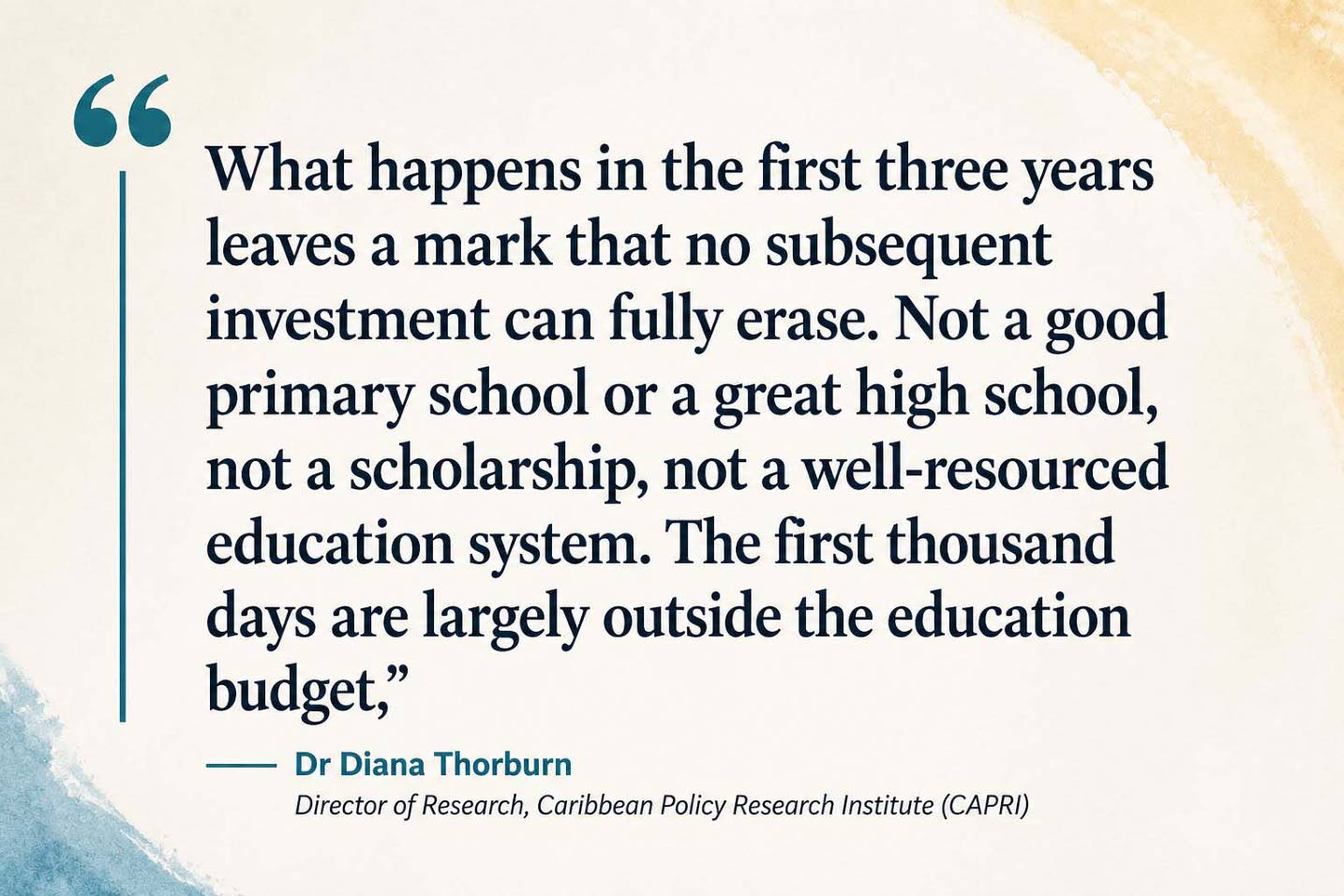
“What happens in the first three years leaves a mark that no subsequent investment can fully erase. Not a good primary school or a great high school, not a scholarship, not a well-resourced education system. The first 1,000 days are largely outside the education budget,” Dr Thorburn said.
“Education spending cannot deliver its potential returns where the foundations were not built. Jamaica is investing heavily at the wrong end of the developmental timeline,” she concluded.
The report also highlights that an increasing share of public spending being absorbed by employee compensation — rather than by the goods, services and programme inputs needed to deliver results — is another structural issue affecting several sectors serving children.
In education, compensation of employees accounted for roughly 83 per cent of the budget in 2017/18. By 2024/25 that figure had risen to 86 per cent.
The same pattern appears in child protection, nutrition, recreation, culture and sport.
Dr Thorburn acknowledged that the Government’s public sector compensation reform was a necessary response to years of wage compression and that teachers, social workers and other public servants deserved better pay. But she argued that higher wages were not matched by comparable increases in operational budgets.
“Money is being spent [but] it’s not reaching the children,” she said.
Further, a recurring theme throughout the report is that Jamaica lacks a comprehensive mechanism to track how much is spent on children and whether that spending translates into better outcomes.
Budget documents show what Government intends to allocate, but they do not consistently reveal what was delivered, to whom, or with what result, the report highlighted.
“The absence of data is not just a data gap; it is an accountability gap,” Dr Thorburn said.
In response to the report’s findings Dr Steven Kerr, director of policy analysis at the Ministry of Education, Skills, Youth and Information, said the ministry welcomes the study as a valuable contribution to the national discussion on how public resources are being used to support children.
But he cautioned against interpreting the findings as evidence that public spending has failed to produce meaningful gains.
“The report should not be seen as evidence that Jamaica has not made progress,” he said, pointing to expanded access to textbooks, digital learning resources and teacher laptops, as well as efforts to reduce the number of schools operating on the shift system.
Dr Kerr also pushed back against the suggestion that the growing share of education spending devoted to salaries necessarily comes at the expense of students.
“In education, people are the service. Teachers are educational delivery,” he said.
He argued that educators, guidance counsellors, special educators, principals and other support staff are central to the learning process, and that the real challenge is to balance fair compensation with adequate funding for classroom materials, student support services and other operational needs.
At the same time, Dr Kerr said the ministry agrees that greater visibility into child-focused spending would improve transparency and accountability. He said officials are prepared to work with the Planning Institute of Jamaica, the Ministry of Finance and the Public Service, UNICEF and CaPRI to strengthen reporting on expenditures and outcomes in areas such as early childhood development, special education, school nutrition and learning recovery.
The CaPRI report proposes several measures to strengthen the connection between public spending and child outcomes.
Among them are introducing child-disaggregated reporting into Jamaica’s public financial management framework, shifting more resources toward early childhood programmes, and strengthening accountability in the child protection system.
Dr Thorburn also called for urgent implementation of the Hope for Children Trust Fund announced by Prime Minister Andrew Holness in 2024, including the required legislation and appointment of a fund manager.
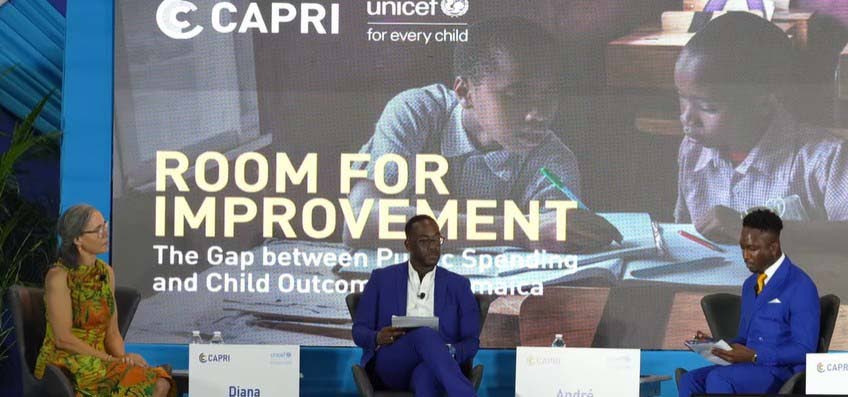
Dr Diana Thorburn (left), director of research at the Caribbean Policy Research Institute (CaPRI); Andre Miller (centre), social policy specialist at UNICEF Jamaica, and host Javaughn Keyes participate in the launch of the report, Room for Improvement: The Gap Between Public Spending and Child Outcomes in Jamaica, at the The University of the West Indies, Mona, on Thursday. The study examines whether Jamaica’s spending on children is translating into stronger educational and developmental outcomes.


