



Missing out on ‘the coins’
JAMMS says uneven enforcement allowing royalties to slip through the cracks
Music is played everywhere, from parties and stage shows to bars and hotels, but the Jamaica Music Society (JAMMS) says weak enforcement of intellectual property regulations across parishes is leaving too many producers and performers without income they should be earning as royalties continue to slip through the cracks.
That warning came on Wednesday during a meeting of a joint select committee reviewing the Green Paper on the National Culture and Creative Economy Policy.
General manager at JAMMS Evon Mullings told the committee that, while Jamaica is celebrated globally for its cultural influence, the country is still failing to fully convert that success into stable earnings for many of the people behind the music.
He argued that the problem is especially visible in the live entertainment trade, where a large number of events create major earning potential, but weak integration between copyright rules and the permit system leaves too much room for non-compliance.
According to Mullings, the issue is not marginal, but deeply tied to how the music economy functions.
“In terms of leakage, I would venture to say that what we call public performance is where we have the most significant area of leakage. And public performance really broadly encompasses the non-media side of things. So we are talking about the hotels, the shops, the bars, the restaurants, bands, and so forth,” Mullings said.
He said the biggest weakness lies in the events sector, where thousands are staged each year. Mullings told the committee that the island records an estimated 16,000-plus events annually based on Planning Institute of Jamaica data from parish councils, with Jamaica Constabulary Force data often showing even higher figures. Yet, despite that level of activity, the organisation said only a fraction is being properly licensed.
“We are currently only monetising or licensing around a little above a third of that, and that has to do significantly with what is mentioned several times in my presentation — the inconsistent sort of requirement at the various parishes by different authorities… required to support the process,” Mullings said.
He argued that music is helping to generate commercial value across the country every day, but the systems meant to ensure creators are paid are still too patchy.
Under Jamaica’s copyright framework, public performance licensing applies whenever recorded music is used outside the domestic circle, including in places such as hotels, supermarkets, nightclubs, broadcast media, and events.
However, Mullings said that unless copyright licensing is properly embedded into administrative systems, the result is cumulative losses affecting thousands of rights holders.
He said one major difficulty is that the police, who give final approval for events, do not currently have the legal backing to require JAMMS and Jamaica Association of Composers, Authors and Publishers (JACAP) permits in advance as a standard condition.
“However, the gap really stems from the fact that the police… their hands are tied. The police currently are unable to direct event organisers to have the JAMMS and the JACAP permits. They cannot bond them, they cannot compel them, they cannot force event promoters to have these permits as a condition precedent,” Mullings said.
He explained that while municipal corporations operate with timelines for applications, the Copyright Act does not clearly set out a matching deadline for copyright permits before an event is staged. That, Mullings said, leaves enforcement kicking in when an event is already under way.
“So, you know, on the one hand, they can act at a particular point in time, but that point in time at which they can act is sort of inconvenient, and we would not want to be putting the police in harm’s way, you know, to go shutting down events because there are no permits. But we would rather — from a governance standpoint, from an efficiency standpoint — that it takes place at an earlier stage in the process,” he added.
Mullings is therefore pushing for copyright licensing requirements to be built into permit systems and backed by clearer cross-ministry coordination.
He argued that embedding copyright licensing into permit requirements would “materially enhance revenue capture efficiency and reduce inequitable enforcement disparities”, while stronger coordination among the ministries responsible for culture, industry, national security, and local government would help create more consistent national compliance.
The hearing also touched on another gap affecting earnings — performers’ rights. Mullings said Jamaican vocalists and musicians are still disadvantaged because the law does not give them equivalent rights to earn in the same way as some counterparts overseas, a weakness he said has also blocked access to royalties being held abroad.
He told lawmakers that millions of US dollars for Jamaican performers are effectively stuck because reciprocal arrangements cannot be secured while similar rights are missing locally.
For her part, chair of the committee, minister with responsibility for entertainment and culture Olivia Grange signalled that changes may be coming.
She told the committee that the ministry is looking at a one-stop permit structure and the development of a protocol that would bring greater order to the process while involving municipalities, the police, and collective management organisations.
She also said more public education would be needed, since many small promoters still do not understand why royalties and permits are required.
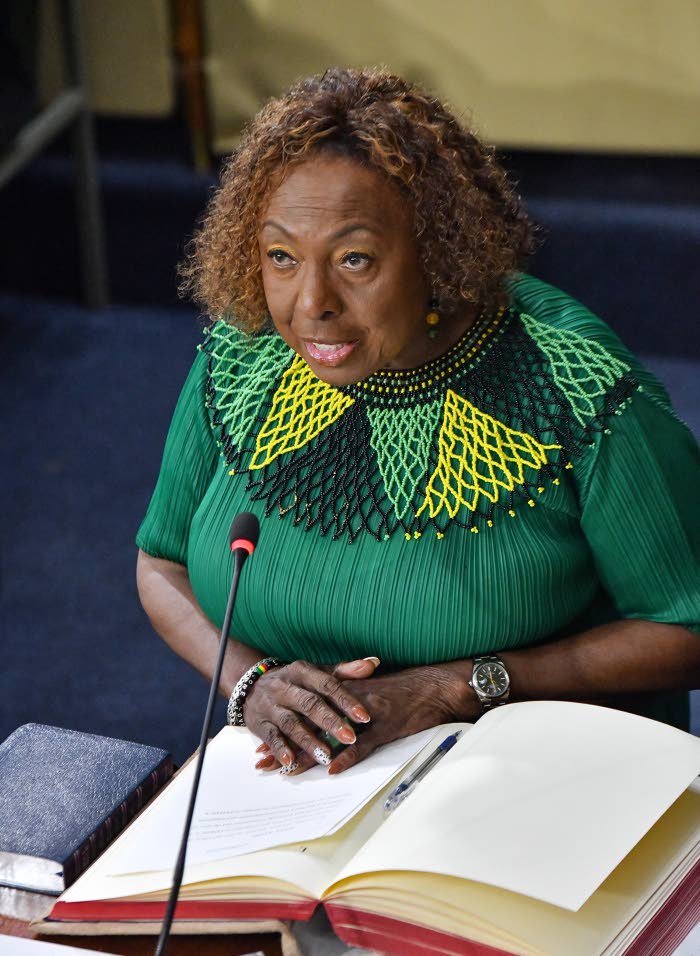
Minister of Entertainment and Culture Olivia Grange (Photo: Naphtali Junior)


