EXPRESS CATERING’S US$5-M GAMBLE
Buying brands over buildings
IF you’ve gone through Montego Bay’s Sangster International Airport (SIA) recently, you’ve likely passed a Margaritaville bar or a Bob Marley’s One Love shop. What you wouldn’t have seen is the financial engineering that has transformed the company behind these establishments, Express Catering Limited (ECL), from a simple airport concessionaire into a savvy brand consolidator poised for a national roll-out.
The company’s unaudited first-quarter results for the period ending August 31, 2025 showed higher revenue and profit than the previous year. Net profit surged to US$1.51 million, a 50 per cent increase compared to the US$1.01 million earned in the same period last year. Earnings per share followed suit, jumping to 0.092 US cents.
Revenues, meanwhile, reached US$6.8 million, up 5 per cent from a year earlier.
This quarterly profit nearly eclipses the entire US$1.41-million net profit the company reported for the whole of the previous financial year (FY2024), signalling a dramatic and successful turnaround in profitability.
The secret to this explosive growth wasn’t a massive influx of new passengers — although traffic was up a healthy 5.52 per cent — but a relentless focus on the bottom line. The most significant factor was a sharp improvement in the gross profit margin, which widened to 74.35 per cent from 70.05 per cent a year prior. Management credits this to securing medium-term, fixed-price contracts for ingredients and implementing stricter controls, ensuring more of every dollar spent by passengers falls straight to the bottom line.
From this fortified position within the airport, ECL serves travellers through a portfolio of major brands including Margaritaville, Bob Marley’s One Love, Wendy’s, Domino’s, Quiznos, Island Deli, Guitar Bar, and Du Chile Chili.
However, the most telling story is found not on the profit statement, but on the balance sheet. It reveals a fundamental strategic pivot. In the last financial year, ECL’s spending on property, plant, and equipment — the ovens, counters, and furniture of its physical restaurants — fell by 93 per cent to just US$85,501. Concurrently, its investment in intangible assets, primarily licenses and franchises, skyrocketed by 73 per cent to US$5.46 million.
The company has, in essence, stopped building, for now, and started buying.
“The truth is that once you put in infrastructure for the overall areas, I mean until the airport expands further, we have the infrastructure, so after that it’s just maintenance,” explained ECL Chief Executive Officer Ian Dear in an interview with the Jamaica Observer. “Then after that you’re trying to secure brands that will keep your momentum going forward and with the potential of further opportunities outside of the existing space.”
When pressed on where these “outside” opportunities lie, Dear was clear: “Well, right now we’ve been operating at the airport only, so we’re trying to secure some additional opportunities outside of the physical space that we currently operate in.”
This is not a newfound ambition. The company has hinted at regional and domestic expansion for years. But now, for the first time, its capital expenditure reflects a concrete plan being activated.
The US$5.4-million bet
So, what exactly did US$5.46 million buy? The rights to a future beyond the departure lounge.
Dear confirmed that the massive investment was to “take ownership of a number of different brands with the intention of rolling them out outside of the airport”. While he declined to name the specific brands in the current pipeline, this ambition has been years in the making. Back in December 2022, the company signalled its intent, announcing a master franchise agreement that would see it develop multiple locations across Jamaica for popular American brands, including the pretzel shop Auntie Anne’s® and the bakery Cinnabon®. It is not clear if these are the same brands now being secured, but it confirms the strategy to leverage well-known franchises for domestic growth has been long-held.
“Ultimately, we want to try at this point, certainly two, but probably three,” he told BusinessWeek, outlining the scale of the initial roll-out.
“The idea is to expand the revenue base for Express outside of its traditional business model which has been the airport only,” Dear stated. “We feel that Jamaican consumers will enjoy some of the offerings… and so by doing that it will allow Express to have a little bit more of an economic base, that is not only relying on the airport space. So we’re diversifying, that is the objective.”
This expansion beyond the terminal walls comes as ECL’s home base is itself poised for significant growth. The company’s core business is built on a captive audience at SIA, which saw a record 2.66 million passengers traverse its post-security departure lounge in the last fiscal year. Furthermore, the recent announcement of a US$750-million expansion plan for SIA, which includes a new terminal, signals that ECL’s primary market is far from saturated, offering growth for years to come.
Yet, Dear emphasised the need to diversify: “The idea is to expand the revenue base for Express outside of its traditional business model which has been the airport only.”
Its commercial success so far has been matched by critical acclaim. Its Bob Marley’s One Love brand was shortlisted for six categories at the prestigious global Airport FAB + Hospitality 2024 Awards, walking away with six regional and two global awards. The company has also invested heavily in its people, with management highlighting continuous training to ensure service excellence remains consistent.
It hasn’t, however, all been smooth sailing. The company’s audited financials for FY2024
were delayed multiple times, finally being released in late September, missing the original end July deadline. Furthermore, a 40 per cent nationwide increase in the minimum wage at the start of its FY2024 put significant pressure on administrative costs, contributing to a squeeze on profits that makes the recent Q1 rebound all the more impressive.
Return of capital to listed company
Still, a nuanced look at ECL’s financial position reveals a key area of focus for investors: a large, interest-free loan to its parent company. The ‘Due from Related Companies’ balance has grown to US$17.81 million and carries no fixed repayment terms, even as ECL itself carries significant debt obligations, including a US$12-million bond and substantial lease liabilities.
Asked how he justifies this to shareholders, Dear acknowledged it is a priority. “That is something that we’re working through now to get down. The idea is that we’ve had to do some advances in the group and we also are intending to really, at the end of the day, also pay that down through dividend opportunities in the future. But we’re working that through as to get that back down as quickly as possible,” he told BusinessWeek.
This points to a mechanism where future dividends paid to the parent company, Margaritaville St Lucia, would effectively reduce the outstanding loan balance.
ECL resumed dividend payments in 2024, declaring a dividend after the FY2024 year-end, a move that could serve as a mechanism for the parent company to recoup the loan. ECL paid around US$1 million in dividends during FY 2025. This was the first dividend payment since March 2020.
The company’s shareholder base has seen subtle shifts. The total number of stockholders has decreased slightly to 2,071, down from 2,104 a year prior, suggesting a minor consolidation. The controlling stake, however, remains firmly in the hands of Margaritaville St Lucia, which holds 62.32 per cent of the company. Directors and their connected parties collectively control over 70 per cent of ECL, firmly aligning management’s interests with those of the dominant shareholders.
Express Catering’s stock price closed at $2.69, leaving it down 11 per cent below its 2025 starting price of $3.02. That gave the company a market capitalisation or value of $4.41 billion. While ECL’s stock continues to trade above its 2017 initial public offering price of $1.50, it is far from its peak price of $8.90 set in August 2018 when market values were more buoyant.
The future: Efficiency and “Further Afield”
Looking ahead, Dear is bullish. The focus, he says, is on continuous improvement. “What is more important is that we have managed our costs to the point where we have had a significant improvement in our bottom line,” he said, referring to the stellar Q1 results. “We see that only improving.” Still, even within its airport fortress, ECL sees room for improvement. While passenger numbers were up 5.52 per cent in the recent quarter, the average “spend per passenger” saw a slight dip to US$9.64 from US$9.70. This marginal decline highlights the very efficiency challenge Dear is now targeting. He revealed plans to deploy new technology, including kiosks, to cut queues and improve service speed, directly aiming to boost this key metric.
“We’re bringing in some things that are going to cut lines to make it more efficient,” he said, framing the slight dip not as a loss, but as an untapped opportunity. We feel very confident that with additional streamlining and even stronger management and the use of technology that we can realise even better than we have been. So we’re trying to increase that yield, he pointed out.
This push for efficiency, however, involves calculated trade-offs. The company’s recent shift to a credit-card-only system in several outlets — a move designed to bolster controls and speed — has come with a direct cost, driving up associated commission expenses by 64 per cent.
And while the immediate future is about branding and efficiency, the long-term vision for ECL, stretches past Jamaica’s shores. Dear confirmed that the company has not given up on its ambition to operate in other regional airports.
“We feel that Sangster certainly has more room for growth,” he said, “but we also are continuing our objective of trying to get into other similar facilities whether regionally or otherwise”.
A section of the food court rotunda at Sangster International Airport in Montego Bay, Jamaica. This space, exclusively operated by Express Catering Limited, is the profitable core from which the company is now launching its US$5.4-million bid to expand its brands nationwide.
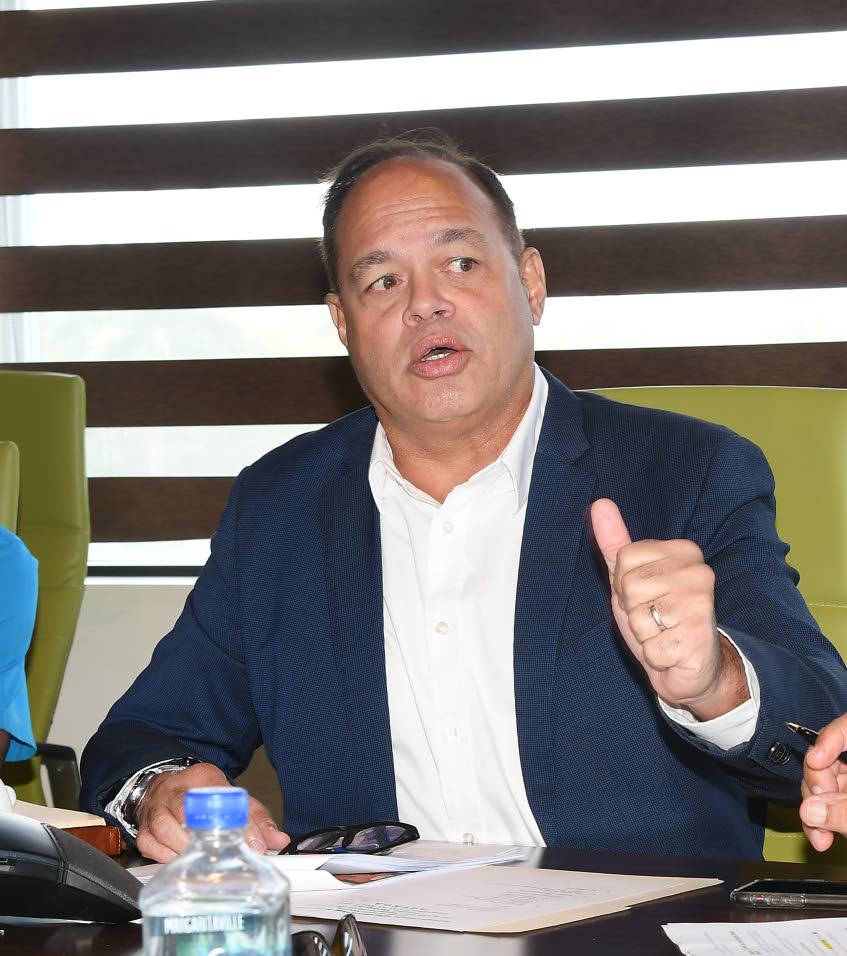
DEAR…we’re diversifying, that is the objective. (Photo: Karl Mclarty)
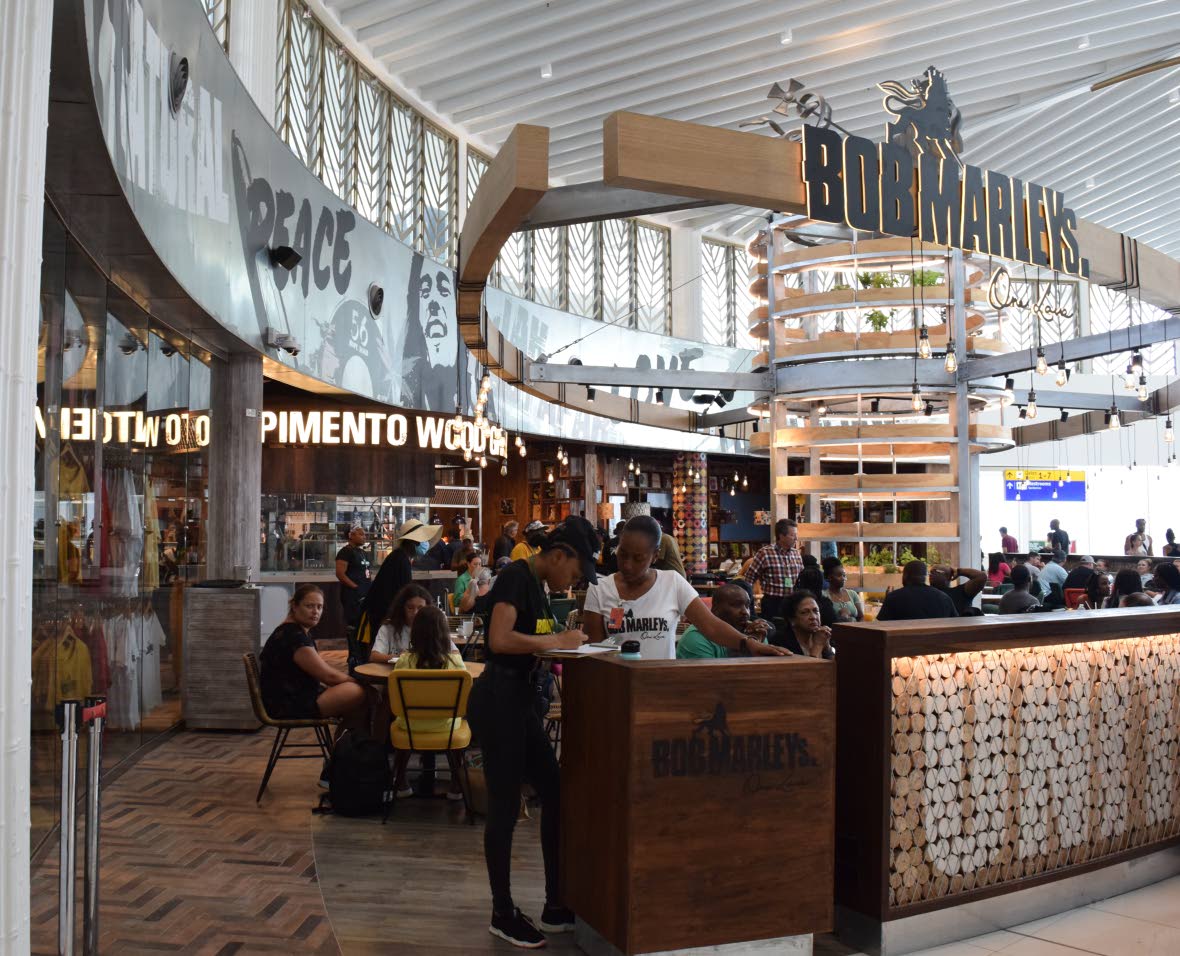
Express Catering Limited’s portfolio, including Margaritaville and Bob Marley’s One Love, dominates the post-security departure lounge at Sangster International Airport—the launchpad for its US$5.4 million bet on a national brand rollout.