



‘It’s a tough one’
JA technical leader not fully on board with women’s 100m schedule for LA 2028
World Athletics (WA) has called the move to complete the entire women’s 100m programme in one day at the 2028 Olympics in Los Angeles (LA) ‘historic and innovative’. However, long-serving technical leader of Jamaica’s senior track and field team Maurice Wilson says he’s concerned that the athletes and their performances may suffer.
On Wednesday, the world governing body confirmed that the athletics programme at the summer Games in LA will move to the first week rather than starting in the second week like in previous editions.
One of the main changes will see the women’s 100m headlining the start of track and field on Saturday, July 15, 2028. Instead of being completed over two days, the preliminaries and heats will take place in the morning session while the semi-finals and final will be run in the evening session.
It means Jamaica’s women, who have consistently qualified for the final since 1984, could be running a maximum of three rounds in less than 12 hours.
WA President Seb Coe, in a statement on Wednesday, said, “It is in the spirit of collaboration between World Athletics, LA28, Olympic Broadcasting Services, IOC and NBC as host broadcaster that we have landed on an athletics programme that will start with a bang as our women sprinters take centre stage on day one and then the men’s sprinters on day two to maximise and sustain global interest after the opening ceremony.”
The move has already received approval from America’s Olympic champion Sha’Carri Richardson and Great Britain’s three-time Olympic medallist Dina Asher-Smith.
However, Wilson, who oversaw Jamaica’s team at the 2012 London Olympics, 2016 Rio Olympics, 2021 Tokyo Olympics and 2024 Paris Olympics, told the Jamaica Observer that it could be strenuous on the athletes’ bodies.
“I think it is not necessarily in the best interest of the athlete from a performance standpoint,” he said. “I know that there are certain coaches, certain camps that have the necessary provision to get athletes recovered based on the machinery and the technology and so on but on a general basis, it is very difficult to run three rounds in one day, two high-level rounds in the afternoon, semi-finals and finals, so I think it’s a tough one.”
While not in support of the change, noted local coach and Jamaica Track and Field Coaches Association President David Riley doesn’t believe it will be a major issue for the medal contenders.
“They only run hard in the semi-finals and finals. I mean, it might be an issue mentally for people but this is two years down the line. Recovery is something you can work on, you can build your capacity to recover,” he told the Jamaica Observer.
“People wouldn’t want to do but if it’s what it is, it’s what it is. I wouldn’t oppose people making representation to have it changed but it’s two times they run hard anyway and those two times will remain, the semi-finals and final. I’m not in support of it but it can be explained.”
Wilson, who is the founder and head coach of the Sprintec Track Club, says the decision will likely result in coaches and athletes having to be strategic in order to achieve maximum success.
“Athletes will have to adapt their programme. Yes, I can understand that if you are 10.7 seconds or a 10.6 seconds runner and you’re running the preliminaries with persons who are running 11.3 then the effort may not be the same,” he said. “However, you still will have to prepare, you still will have to spend about an hour with warm-up, you still will have to go through your paces, you still will have to go through the mental fatigue of possibility knowing that you have to perfect the start so you don’t false start, so it is a mental toll just the same.”
“Then, you have to rest up to come back in the afternoon knowing that you still have another round, so it’s a difficult call but as the athlete representative said on the commission, it was a decision that persons would have respected based on the consensus that they got. We can only give our opinion based on what is happening now, so basically for 2028, it will be down to just about managing the athletes, coaches, programmes, etc,” Wilson added.
He does, however, admit that the athletes could gain more recognition than in previous global championships.
“I think what is happening now is that there is a need or an urgency to bring some amount of highlight to women’s sport and with that, the ladies who have worked so hard, they also want to be a part of the publicity and I don’t know the intention in terms of why the first day, but I guess just to make sure that the ladies get the publicity, what they have done is to move the 100m on one day,” said Wilson.
Tina Clayton was Jamaica’s lone finalist at the 2024 Paris Olympics, where she finished seventh.
Jamaica has been one of the most successful countries in the event, having at least a finalist since the 1984 Olympics. Nine women have had podium finishes with Shelly-Ann Fraser-Pryce and Elaine Thompson Herah winning gold twice.
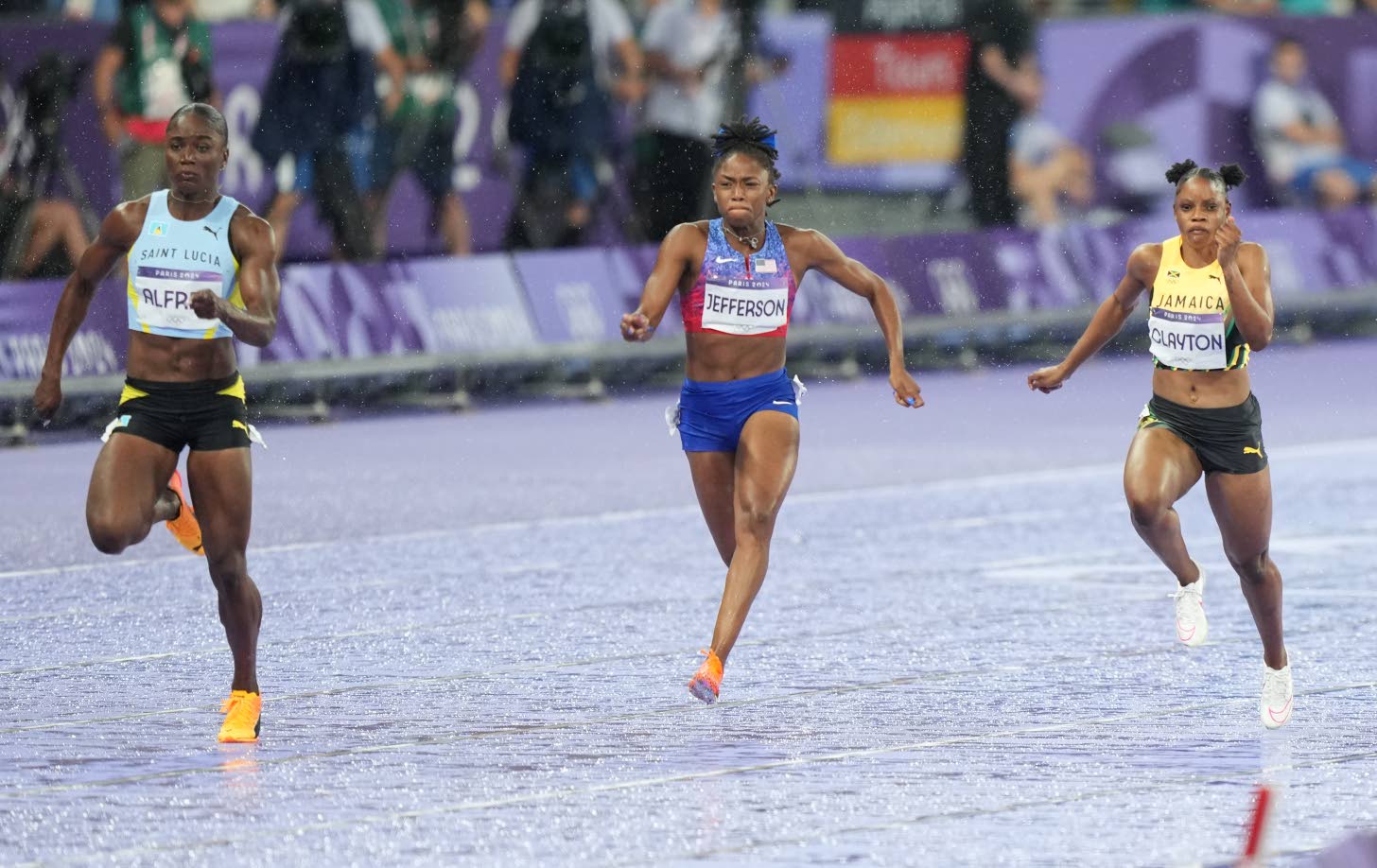
St Lucia’s Julien Alfred (left) powers ahead of the USA’s Melissa Jefferson (centre) and Jamaica’s Tia Clayton in the women’s 100m final. (Photo: Naphtali Junior)
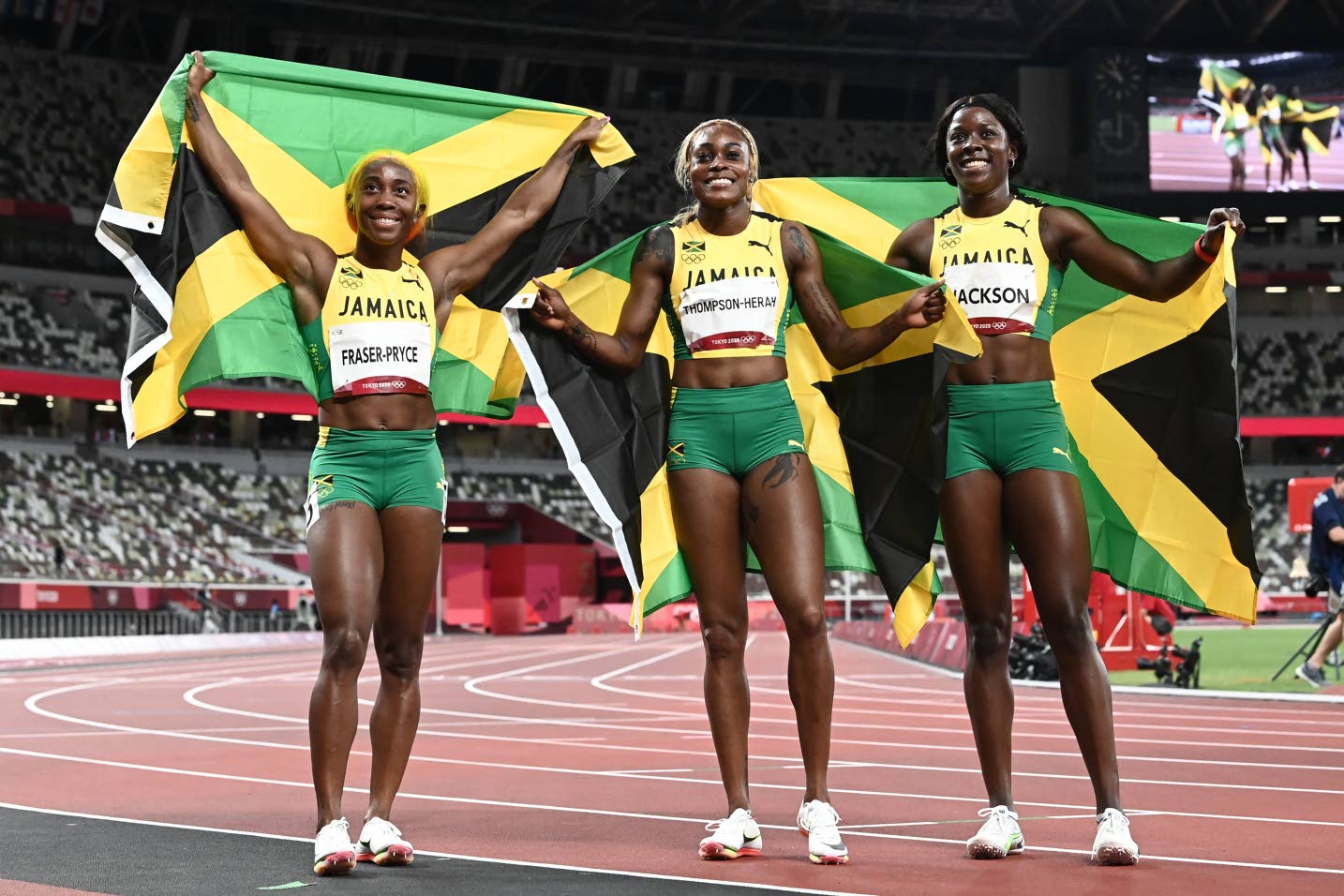
Winner Elaine Thompson-Herah (centre) poses with second-placed Shelly-Ann Fraser-Pryce (left) and third-placed Shericka Jackson after the women’s 100m final at the Tokyo 2020 Olympic Games at the Olympic Stadium in Tokyo. (Photo: AFP)


