



Nope! We’re not coming back!
A highly qualified Jamaican nurse who left for greener pastures in the United States nearly two decades ago has some frank words for Health Minister Dr Christopher Tufton, specifically regarding his call for nurses to come home to help deal with a crisis in the health sector.
“No, we’re not coming back,” said Dr Cheryl Morgan, who migrated in 2009 after graduating as a registered nurse from The University of the West Indies (UWI) in St Andrew.
She went on to excel in her chosen profession, pursuing doctoral studies, writing a book titled
Jamaican Born, about her humble beginnings, and becoming a businesswoman.
Dr Morgan said the call near year-end by the health minister, in the face of an acute shortage of nurses, had raised eyebrows among Jamaican nurses in the US, noting that she and her migrant colleagues had left to seek better salaries, benefits and work environments in America, Canada, England, and even other Caribbean islands.
“The reality is that nurses are treated poorly in Jamaica by various governments. I was tired of seeing nurses demonstrating with placards every time they should get a salary increase. When I was a nurse in Jamaica, nurses were just poor,” she told the Jamaica Observer.
“You could see them walking on the streets to the bus stop after work. They couldn’t afford a car. They couldn’t afford a mortgage. For the few nurses who were in a better position financially, it was not because of their salaries, it was because of help from their spouses or family members, or a lot of overtime work to make ends meet.
“The public always ostracised nurses when they lobbied for a raise of pay. They said nursing is a calling and it should not be about the money. Yet, we struggled to pay our bills and send our children to good schools. Nurses were not getting a livable wage to compensate them for their education and expertise.
“Then we were approached by international recruiters who paid a salary that we never dreamed of,” said Dr Morgan, who hails from the little-known enclave of Top Mountain in rural St Catherine.
“When I arrived in America I was placed in a beautiful apartment with excellent amenities, including a swimming pool, in a gated community. There were incremental salary increases yearly.”
Morgan’s narrative suggests that Dr Tufton would find the going tough as he tries to entice the nurses to respond positively to his invitation in a situation where, for example, 27 per cent, or 1,730 of all positions in the Western Regional Health Authority (WRHA), are now vacant. And that is only in one of four regions.
Tufton said he had thrown the invites out to Jamaicans during recent visits to Washington, DC New York; and Miami, and that he would be formalising it through actual advertising and promotion.
Making the case for their return, he pointed to improvements in the country’s infrastructure, ongoing hospital upgrades, efforts to reduce crime, and the opportunity for individuals to have more disposable income, saying it had made Jamaica increasingly attractive as a place to live and work.
“What this means, I believe — and I’m saying so with a lot of faith and conviction and hope — is that some of the very Jamaicans who have left our shores for ‘greener pastures’ will reconsider and return to our shores,” he said.
“… And we are saying to Jamaicans who live in the Diaspora — whether it is in Canada, the UK, the USA or elsewhere — ‘Come back home. We have a place for you in the health system within the areas, obviously, where we are short of specialists.
“‘We will find a way to incentivise you to relocate. We will work with you because we would like all those posts to be filled by Jamaicans who have left us — which is their right so to do,’” the minister appealed.
He would also be focusing on nurses who have not yet been lured away from Jamaica, stating that there would be a housing programme for staff across the country and more training opportunities.
But he insisted that some positions were difficult to fill because of the location and the specialised skills required, for example, specialised nurses and doctors. He also acknowledged that the shortage had resulted in staff being overworked.
Morgan, saying that the health minister was looking for “a quick solution to a long-standing problem”, suggested he would have an uphill climb.
“While we endured some adjustment issues [when we first arrived in the US], we eventually learned the culture — about building credit and was able to start helping families back home in Jamaica.
“We were able to advance our career without prejudice. There was no sister from nursing administration to block our applications to get specialised training or to study advanced nursing. We no longer had to suck up to anyone to be transferred to another unit.
“Now that we walked away from a broken system in Jamaica that suffocated us for many years, experienced success, acquired assets, built houses back in Jamaica, helped our parents and siblings, they are calling us to return to a broken system that has minimal improvement from what we left,” she said.
On a long list of inadequacies she had a lack of new hospitals since 2008; no significant hospital upgrades; hospital patients still being admitted in a room that is separated by drapes; lack of IV pumps to administer IV fluids; patient’s relatives still being asked to buy their medications and surgery supplies or drinking water for the patients, outside of the hospital.
She also named the shortage of ambulances to transfer people from their homes to the hospital; and passers-by still throwing accident victims “in the back of pickup trucks to take them to the hospital”, and the like.
However, Dr Morgan suggested ways in which expatriate nurses could help Jamaica with their expertise, even while not coming back to live.
“We can offer our expertise to the Government to show them how to set up proper infrastructure and services in the hospitals; advise how to set up telemedicine services in Jamaica; show the Government how to set up satellite clinics, standalone emergency rooms, and urgent care centres to serve more patients.
“We can show the Government a lot, but we will not return to the bedside! We cannot return to the same broken system, the same way the politicians practised the same old-time politics. We got a taste of a more efficient health-care system and the ease of delivery of care. There are available resources that improve patient care and nursing support systems. There are vast opportunities to advance our careers, Morgan said”.
She believes it is time for Jamaica to revamp its health-care system and improve it, one public hospital at a time; and offer jobs to the new nurses who have graduated from nursing schools in Jamaica who have not been employed.
“Instead of asking nurses to come home, improve the system to attract young people to join the profession and [do] not ask them [expatriate nurses] to return to sacrifice more,” she added.
Dr Morgan trained as a registered nurse in Jamaica and since then achieved the Doctor of Nursing Practice (DNP); Master of Science in Nursing (MSN); Family Nurse Practitioner (FNP), and bachelor’s degree in nursing (BSN).
She is a family nurse practitioner with approximately 20 years’ experience in the health-care industry and operates a clinic with emphasis on type 2 diabetes, offering care to patients who lack health insurance. She is licensed to practise in the states of Arizona, Florida, Iowa, New Hampshire, New Mexico, Texas, and Utah.
As a philanthropist, she runs the Stop A Gap Foundation, serving needy individuals in her Top Mountain district with the support of her husband, a US army veteran.
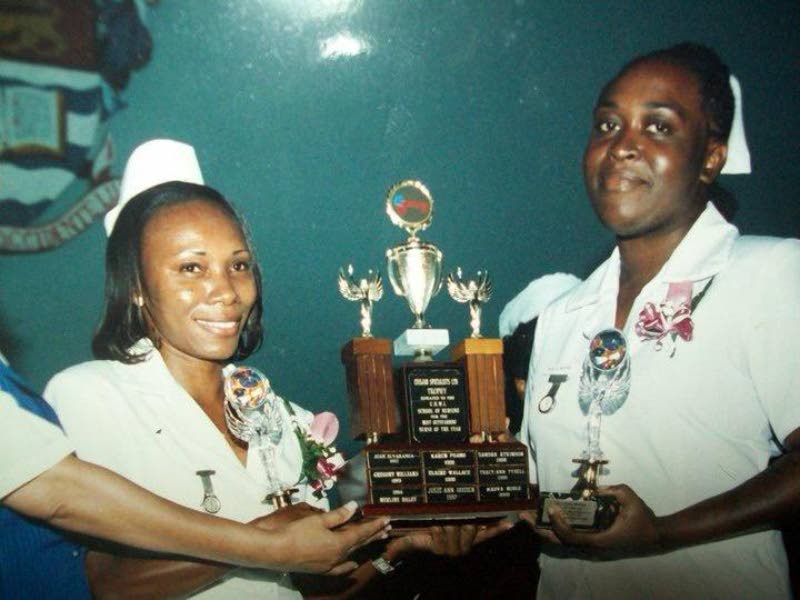
Nurse Cheryl Morgan (left) sharing the trophy for Class Prize with colleague Claudine Witter on the occasion of their graduation from the University Hospital School of Nursing. Both were recruited to work in the United States and have maintained a close friendship. She is also a family nurse practitioner in the USA as well.
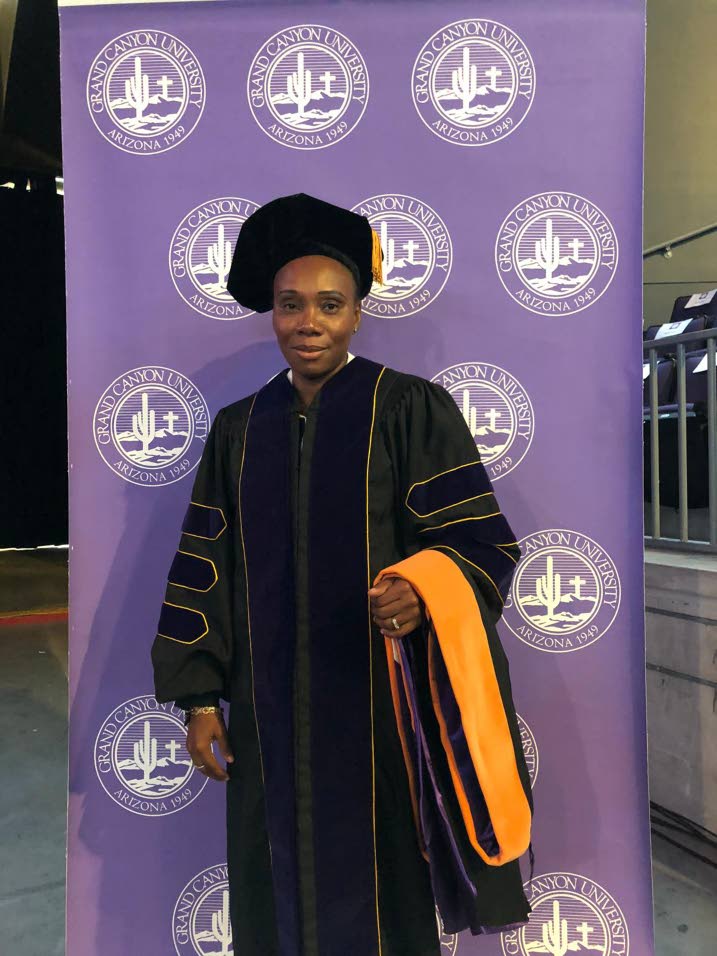
Dr Cheryl Morgan in graduation regalia at Grand Canyon University, Arizona, United States.
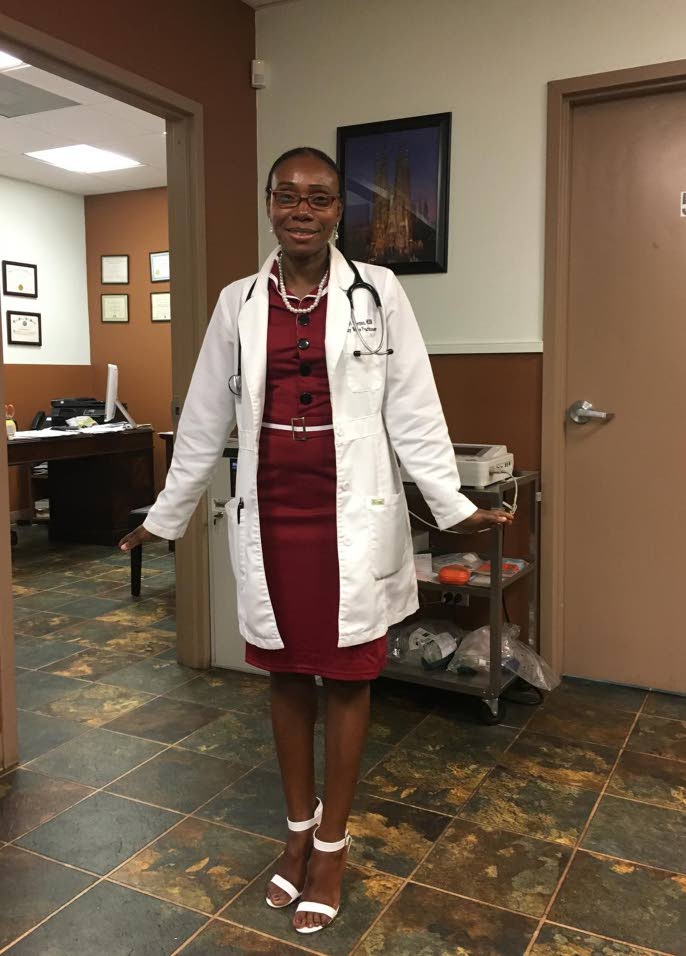
Dr Cheryl Morgan at her place of work.


