Cash-strapped FSC wants fee hike
Insurance industry targeted as regulator seeks to close multimillion-dollar deficit
Executive director of the Financial Services Commission (FSC) Lieutenant Colonel Keron Burrell has warned that a widening $262.5-million shortfall is hampering the entity’s ability to keep pace with Jamaica’s rapidly expanding insurance industry.
The FSC is seeking Parliament’s approval to implement long-delayed fee increases and Burrell pointed out that the proposed hike comes after 18 years without any adjustment to the fee structure, leaving the commission financially constrained and struggling to effectively supervise the sector.
Addressing Parliament’s Regulations Committee on Thursday as members assessed The Insurance (Amendment of Twentieth Schedule) Regulations, 2026, Burrell laid out the scale of the imbalance between the sector’s expansion and the FSC’s limited capacity to regulate it effectively.
“At the inception of the FSC [in 2008], we had a complement of about 131 persons. At that time, the size of the industry was approximately $170 billion in terms of assets. Over the next 18 years, we’ve had an increase in size to upward of $728 billion. In contrast, we have only been able to have a marginal increase in staff, based primarily on resources at our disposal, being that of fees,” Burrell told the committee.
He warned that the growing complexity of the industry now demands stronger oversight, supported by modern technology and specialised expertise.
“As the industry evolves and grows by quantums and complexity, the insurance division in particular requires the requisite sub-tech and resources to effectively monitor and assess the risk for both malconduct and prudential reasons. However, this can only be done by increasing resources, and recall, Chair, that we do not get a subvention, we operate a full cost recovery model,” added Burrell.
The FSC’s financial challenges were further underscored by divisional director in the Ministry of Finance and the Public Service Aisha Wright, who detailed the growing gap between regulatory costs and revenue.
“When they did their analysis in 2024-25, the estimated costs for supervising the insurance industry total $749 million. However, they only collected $487.2 million, so there was a shortfall of $262.5 million. So from this you can see that it is critical that the fees are revised to ensure that FSC can carry out its mandate of supervising the insurance companies and also protecting the consumers as well,” Wright said.
She added that the proposed changes are intended not only to raise revenue but also to simplify the system of charges applied to companies.
“In terms of the changes to the fees, it should be noted, though, that for the annual fees, what currently exists is a tiered approach, and what it will be revised to is a standard rate. So it will be revised for both the life insurance companies and also the general insurance companies, which will make it simpler to understand and also simpler to operate,” Wright explained.
In the meantime, Burrell also revealed that the FSC has already been forced to rely on its reserves to remain operational and warned that this approach is not sustainable.
“We have used more reserves, so we are making a loss currently. The loss is not only due to one sector, of course, but we’re making a loss of over $500 million, [and] $200 million comes from the insurance sector.
So we have been using the reserves, and even from a personal standpoint, tell me what happens when you continue to use your reserves and you don’t have enough income. I think you can see the trajectory,” he told committee members.
Member of Parliament for Kingston Central Donovan Williams acknowledged the financial strain facing the FSC, but raised concerns about the timing of the proposed increases, as he noted that the country is still recovering from the impact of Hurricane Melissa which ravaged sections of the island last October.
“My only concern is that we are coming off the most devastating weather event to have hit Jamaica. And, you know, in these circumstances, persons are resistant to increases so the timing is a concern,” Williams said, while weighing the broader economic context against the regulator’s needs.
Despite this concern Williams signalled that the case for an adjustment was compelling, given the FSC’s financial position and operational demands.
“After 18 years operating on tight operating budget or expenses and now having dipped into reserves. It is my view that the increases are warranted at this juncture…[and] having listened to the presentation, and if you’re operating at a loss of $250 million to cover your operating expenses, then an increase of some type is justified,” he added.
Burrell, in response to questions about industry reaction, indicated that while resistance to fee hikes is inevitable, there has been sustained engagement with stakeholders over time.
“There is never a good time to increase fees, it has not increased for 18 years and I think a big part of it is that we have listened, when we have had hurricanes like Beryl and so on, we listened and we pushed back. We wanted to increase it, albeit I was not at the FSC at the time, so I’m picking up data before my time. We wanted to increase it during the COVID period, and we listened and said, ‘okay’. We didn’t increase it during a time where we were making losses. So we have listened, but we have to increase fees,” Burrell noted.

Divisional director in the Ministry of Finance and the Public Service Aisha Wright outlines the growing financial gap facing the Financial Services Commission (FSC), noting that the cost of supervising the insurance sector far exceeds the fees currently collected.
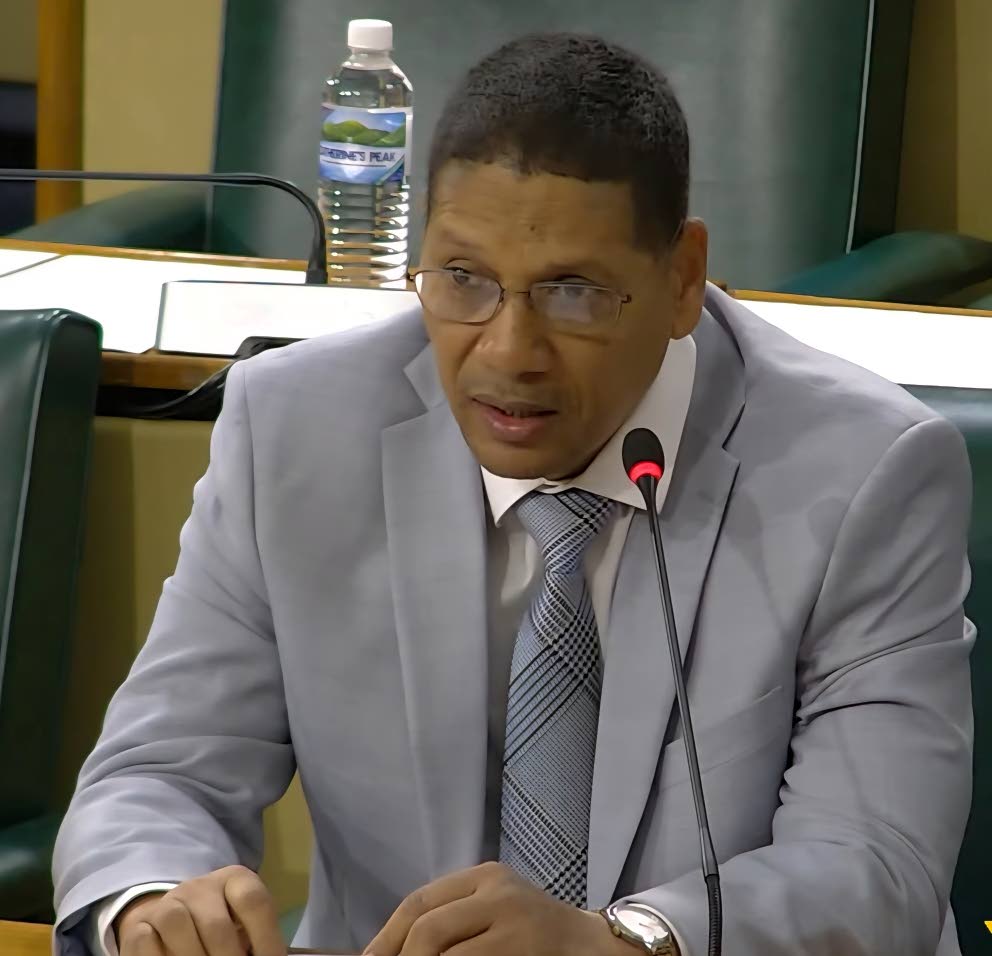
Member of Parliament for Kingston Central Donovan Williams makes his contribution during a meeting of Parliament’s Regulations Committee on Thursday.