



NSWMA boss urges Jamaicans to take responsibility for bulky waste disposal
JAMAICANS are being urged to fundamentally rethink how they dispose of bulky waste, as Executive Director of the National Solid Waste Management Authority (NSWMA) Audley Gordon warned Wednesday that current practices are both financially draining and environmentally unsustainable.
Speaking at Parliament’s Infrastructure and Physical Development Committee, Gordon signalled that a shift in public behaviour is now critical, as the country’s waste management system struggles to keep pace with growing demand and improper disposal habits.
Gordon argued that at the heart of the issue is a long-standing expectation that the State should bear the full burden of bulky waste removal.
“With our arrangement, we have gone in a direction [from other jusrisdictions] which is unsustainable to do all the collection from the property taxes. So there are some harsh realities that we will have to contend with and one of them is that we will have to communicate to people their own obligation that they have,” he said.
He indicated that part of the solution will involve reshaping public understanding of responsibility, particularly when it comes to large household items such as old appliances, construction debris, and furniture.
“A part of what the public education programme will have to be doing is to educate people that you are responsible for the solid waste that you generate, and to communicate with them through that same medium the best practises that’s obtained elsewhere. So if in another jurisdiction somebody has some old stove, they have done some reconstruction and their house is being refurbished, it is their duty to ensure that it is disposed of in a responsible environmental and sound manner and so they would [tally] its weight and they pay to have it done,” he explained.
The comments come amid mounting concerns about widespread improper disposal practices across communities, with bulky waste often left on sidewalks, in gullies, or along roadways. Member of Parliament for St Andrew North Western, Duane Smith, pointed to what he described as a troubling pattern of behaviour among residents.
Smith also highlighted the broader cultural challenge facing the country, recounting a personal observation that underscored the scale of the problem.
“On my way down here this morning, I just saw a driver in a car, and the person wind down the window, threw a patty bag and a box drink, right on West Kings House Road…and that in itself is a national disgrace,” Smith recounted.
Furthermore, committee chair Heroy Clarke argued that the issue is not only about public behaviour but also enforcement, stressing that existing laws must be actively applied if the situation is to improve.
“Enforcement is part and parcel of your mandate,” he told Gordon.
“And if you’re not enforcing the situation then you’re going to find everybody thinking that is the norm. For example, in the west, people building, they will do debris removal, it is placed on the sidewalk [and they think] it is for solid waste now to use heavy equipment and dumper trucks to remove a truckload of debris when a man lick down his house, and it can’t be, and so we ask of you to pay more attention because the law is already there, so use it,” he added.
In response, Gordon outlined steps already being taken to strengthen the authority’s enforcement arm, including expanding staffing and improving capacity.
“That’s the reason why we impress on the Ministry of Finance for some enforcement posts because the committee should know that up to recently we only had an enforcement director position on our establishment. All of them were unattached workers, they weren’t a part of the government establishment,” he said.
“We have now 150 established posts for enforcement, and as we speak, we are recalibrating the enforcement effort inside to recruit higher calibre,” Gordon added.
However, he acknowledged that enforcement alone will not solve the problem, particularly if penalties remain too weak to deter offenders.
“You can have the enforcement but you need the kind of fines that will hurt people. We have been writing tickets, over 500 per month. So we are out there and we are doing work, but our fines are not creating the deterrent effect that we would like,” he noted.
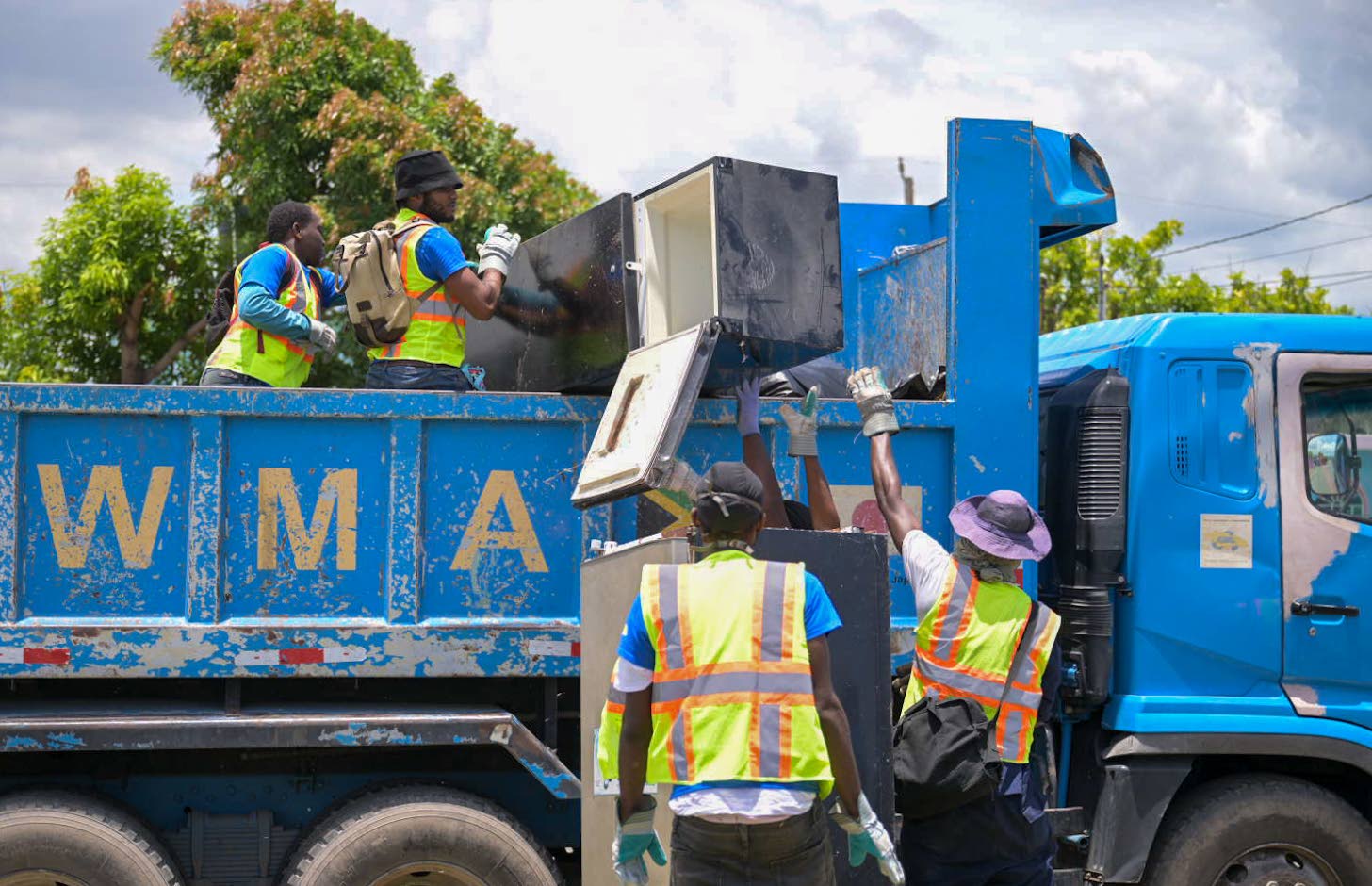
Workers from the NSWMA remove an old, abandoned refrigerator during their derelict vehicles and bulky waste removal programme in Portmore, St Catherine.


