



Daughter’s pain fuels life-saving mission
Woman who helplessly watched as her mother suffered cardiac arrest joins Rotary’s initiative to expand CPR training
FROM the minute someone becomes unresponsive due to cardiac arrest, every second without cardiopulmonary resuscitation (CPR) brings them closer to death, and Marie Shaw knows that all too well.
Shaw, who was participating in a CPR and Automated External Defibrillator (AED) training session at the Heart Foundation of Jamaica (HFJ) on Tuesday, shared with others taking the course how she stood helpless after her mother collapsed, unsure of what was happening or how to respond.
She told the room that her mother’s only symptom was stomach pain, which eventually led to her falling and becoming unresponsive.
Shaw, who did not understand what was happening, said she could only call for help; but in a matter of minutes her mom was gone.
“I came today because I had no idea what to do when I had that experience. I had no idea what to do because I was in panic mode, and I had no knowledge of CPR. If I did have this knowledge I would have been able to save her,” said Shaw in an interview with the Jamaica Observer after the training session.
She explained that the memory of her mother’s passing motivated her to become formally trained, as CPR could mean the difference between surviving cardiac arrest and death.
“Getting the information today, I was able to see what was happening [that day], and it brings back the memory. Actually, I’m so excited because I have background knowledge of what to do, so I will be able to identify the signs.
“As a matter of fact, I sat there and I could remember a number of cases where I heard people say their chest was hurting, or I heard them talk about the [numbness in their] arm. Now that I’m getting this information I’m better able to tell the person, ‘Well, possibly you are having a heart problem and need to get help,’ ” added Shaw.
The CPR and AED training initiative — funded through District 7020 of the Rotary Community Corporation, in partnership with the HFJ — is a targeted approach at training individuals across key beneficiary groups, including schools, coaches, community organisations, and first responders on how to respond in the event of a life-threatening heart attack or cardiac arrest.
According to chairwoman of the District 7020 Rotary Community Marie Powell, focusing on these groups ensures that life-saving skills are embedded where they are most likely to be needed — whether in classrooms, on the playing field, public spaces, or other situations where emergencies are likely to arise.
Powell told the Observer that this strategy strengthens the entire chain of survival, from immediate bystander response to professional intervention.
“Cardiovascular disease is a very prevalent thing in the Caribbean, Jamaica, and the world. So this year, our district governor outlined a programme where clubs are encouraged to deal with CPR training [in order] to increase awareness, and also to provide AED devices, in public spaces to help people —because you can feel it, based on what we have learnt today, the importance of that.
”We are in the process of training as many people as funds allow,” said Powell.
Her claims are not unfounded as an HFJ report details that in Jamaica and other Caribbean countries, cardiovascular diseases account for four of the five leading causes of death, with 30 per cent of all noncommunicable, disease-related deaths linked to this challenge.
Powell said the tools to combat this include training and educating individuals on the topic, plus measures to dissuade lifestyle habits that lead to cardiovascular diseases, along with training people on what to do if a person becomes unresponsive because of cardiac arrest or shows symptoms of a heart attack.
According to Powell, her group has already trained 377 people in CPR, with an additional 326 scheduled to be trained by the end of the Rotary Year, June 30.
The initiative is also on track with 20 AEDs already donated and another 18 slated for delivery by June 30.
“Rotary District has embraced the fight against cardiovascular disease, and these numbers that I mentioned will tell a powerful story because behind each statistic is the possibility that you could save a life. We are very pleased to be associated with the project and to have been able to train as many people as we can,” said Powell.
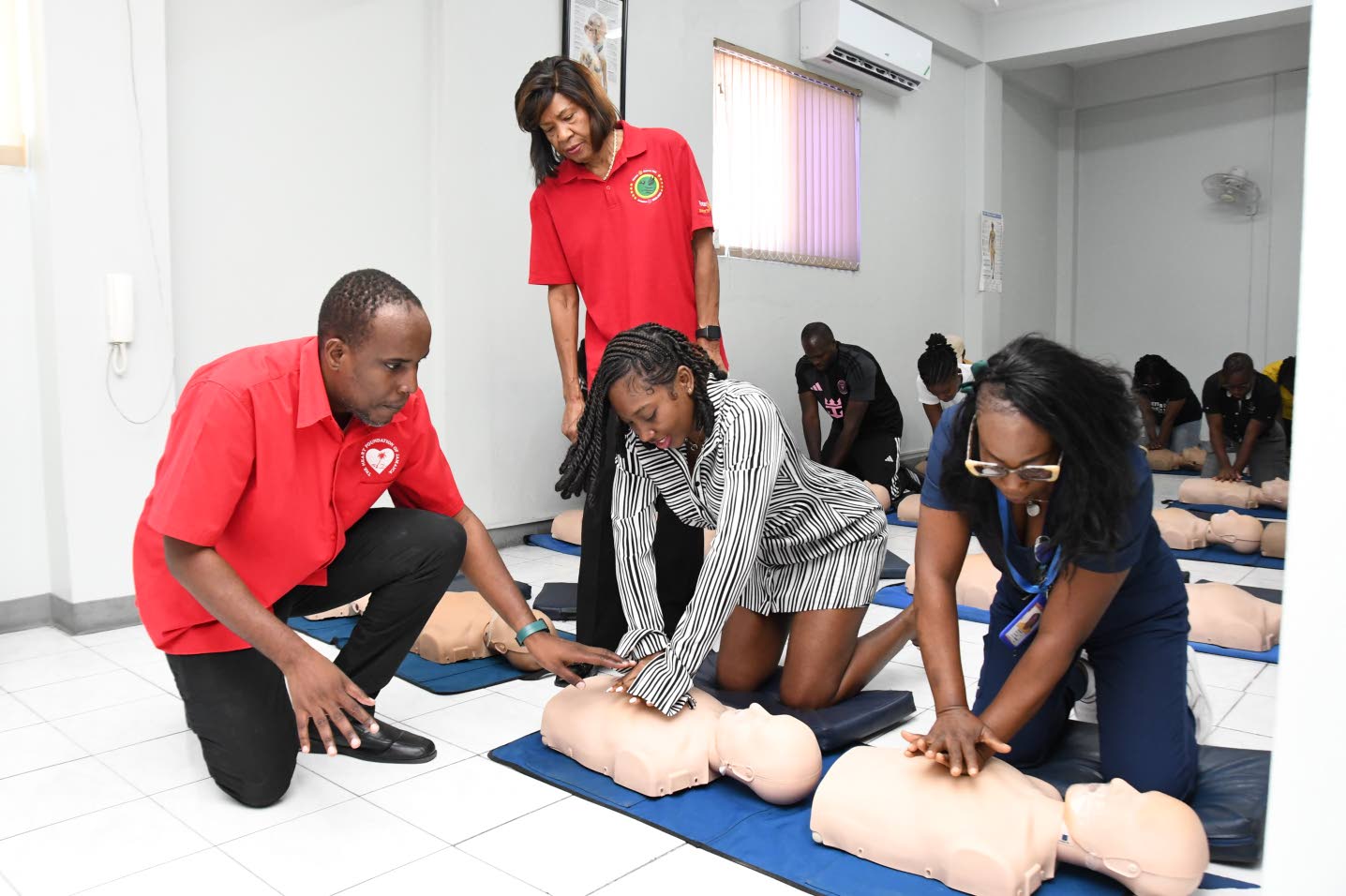
Instructor Alonzo Mothersill (left) takes Chantina Downer (third left) of the Young Women’s Christian Association and Janette Walker (right) of Salvation Army School for the Blind through a CPR drill while Marie Powell, assistant governor and chair of the Rotary District 7020 Community Corp, looks on. (Photo: Naphtali Junior)
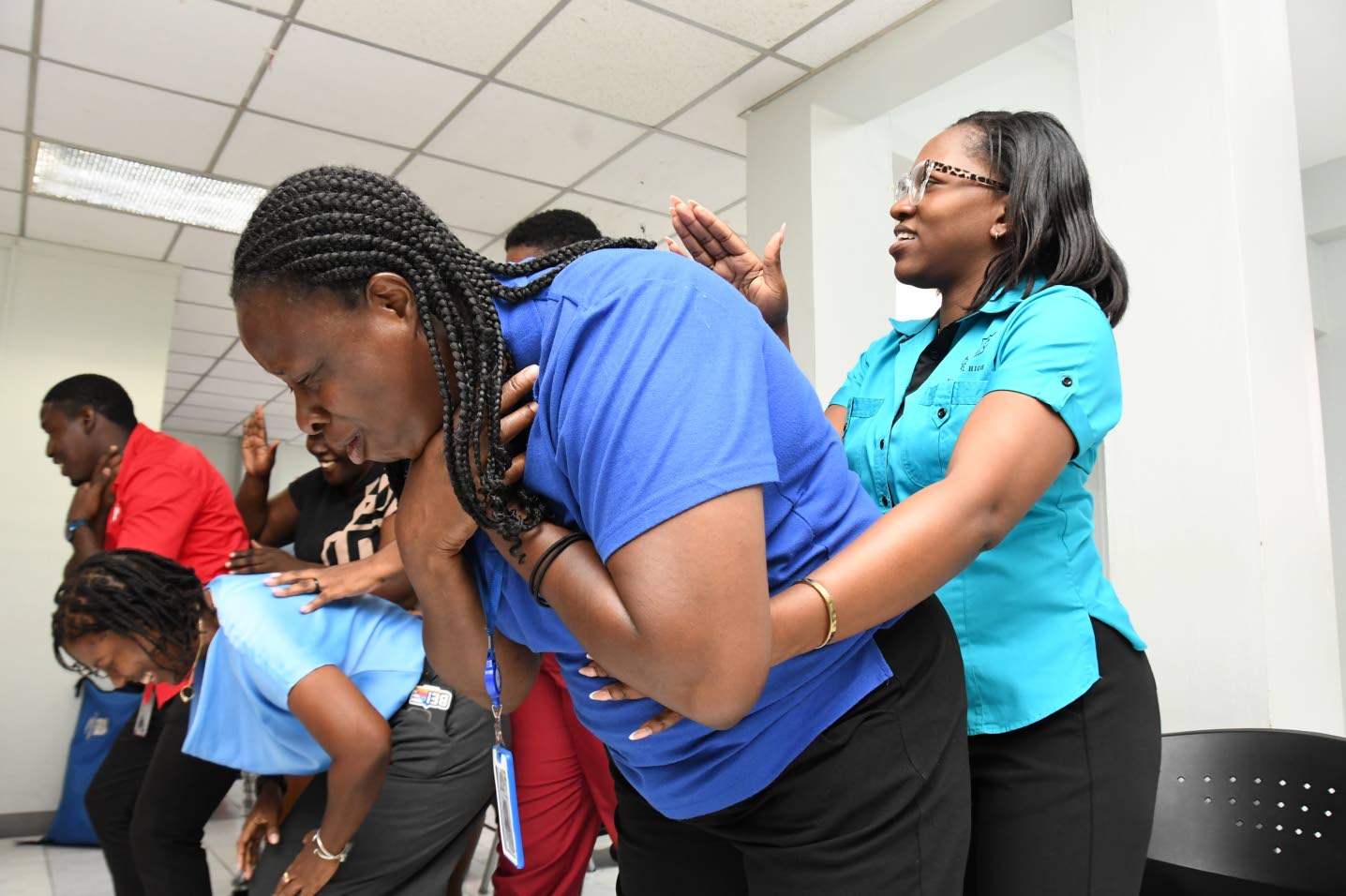
Marie Shaw (foreground) gets help from Erica Frater during a a CPR and Automated External Defibrillator (AED) training session at the Heart Foundation of Jamaica on Tuesday (Photo: Naphtali Junior)


