



18 to consent
Crawford offers solutions to teen pregnancy problem
With more than 6,000 schoolgirls getting pregnant each year, often ending their studies since many do not continue their formal education after giving birth, Opposition spokesman on education Damion Crawford is calling for the age of consent to be moved from 16 to 18 years.
He made the call on Tuesday during his contribution to the 2026/27 Sectoral Debate in the House of Representatives.
In a wide-ranging critique of the education system, which he said was failing the nation’s children, Crawford highlighted that among girls who dropped out of school, 49 per cent did so because they became pregnant.
“This is a major problem that we have to consider. Teen pregnancy has become a problem in this country. Indeed, the average as recorded by Jamaican institutions is 6,000 per year,” Crawford stated.
“If one looks at the reality that there is approximately 13 years of education between age six and 17, we would recognise that in school at this time, 78,000 children are children of children in school… looking at the rate of 6,000 per year,” he added.
“We therefore are asking for a reconsideration once again of the age of consent, and I once again believe that this Parliament should consider the movement from 16 to 18 as we move from a five-year secondary institution to a seven-year secondary experience going forward,” Crawford continued.
The last time the age of consent was adjusted in Jamaica was in 1988 when it was moved from 14 to 16 years via an amendment to the Offences Against the Person Act.
The argument put forward at the time was that the change was necessary to address the high levels of teenage pregnancy and to address the vulnerability of girls between the ages of 14 and 16.
Crawford’s call for a further upward movement comes at a time when a joint select committee of Parliament reviewing the Child Diversion Act appears to be leaning towards accepting a recommendation for what is referred to as a close-in-age exemption which would allow for “consensual” sex between a girl who is 15 years old and a 19-year-old male.
Crawford also highlighted that there was chronic absenteeism among students — those who miss at least 10 per cent of the school year or 19 days. “We’re going as high as 35 per cent in some of our regions and the lowest region is 18 per cent — that is Kingston,” he said.
Crawford told the House that in some deep rural areas absenteeism is as high as 55 per cent. He said absenteeism in Region One was at 17 per cent, it was 18 per cent in Region Two, 20 per cent in Region Three, 28-34 per cent in Region Four, and 35 per cent in Region Six.
“Every single region is in the phase of chronic absenteeism,” he said.
Noting that absenteeism leads to dropouts, Crawford pointed to a World Bank report which he said indicated that the dropout rate at the lower secondary level was 25 per cent and 15 per cent at the upper secondary level. He shared that among boys, 41 per cent of them left school because they were no longer interested.
“If we should look at the total number between 2010 and 2017 you would realise that there’s an increase in the number that just don’t want to attend school, there’s a decrease in the value of education over that time,” said the Opposition spokesman. He told the House that in 2010 19 per cent indicated that they were no longer interested in attending school, and this jumped to 32 per cent in 2017.
Crawford was also critical of the Government’s announcement that all schools have been reopened since the passage of Hurricane Melissa last October. He said that announcement does not take into account what he called “hidden absenteeism” in schools. He pointed out that some schools are offering two days on and three days off for students to ensure that all students are in school for several days each week. This, Crawford said, has resulted in a learning loss among some students of between 40 and 60 per cent.
Declaring that “we have to protect our children”, Crawford lamented that the Government’s response has, instead, been a failed bus system and the removal of the 20 per cent duty concession on motor vehicles bought by educators. Regarding the duty concession, he argued that principals and guidance counsellors often have to travel to find students who are absent from school to get them back on track.
Crawford also highlighted that there has been no increase in the Programme of Advancement Through Health and Education and that there continues to be an exodus of teachers.
“Ten years ago [there were] 350 [teacher] resignations in that year. In 2026, 1,800 resignations in that particular year,” he pointed out.
He also said 145 maths teachers resigned in 2022, representing 10 per cent of the maths teachers who are available to the system.
“The Government has failed, with no retention plan; they’ve also insulted our teachers with a two per cent [salary] increase proposal,” Crawford insisted.
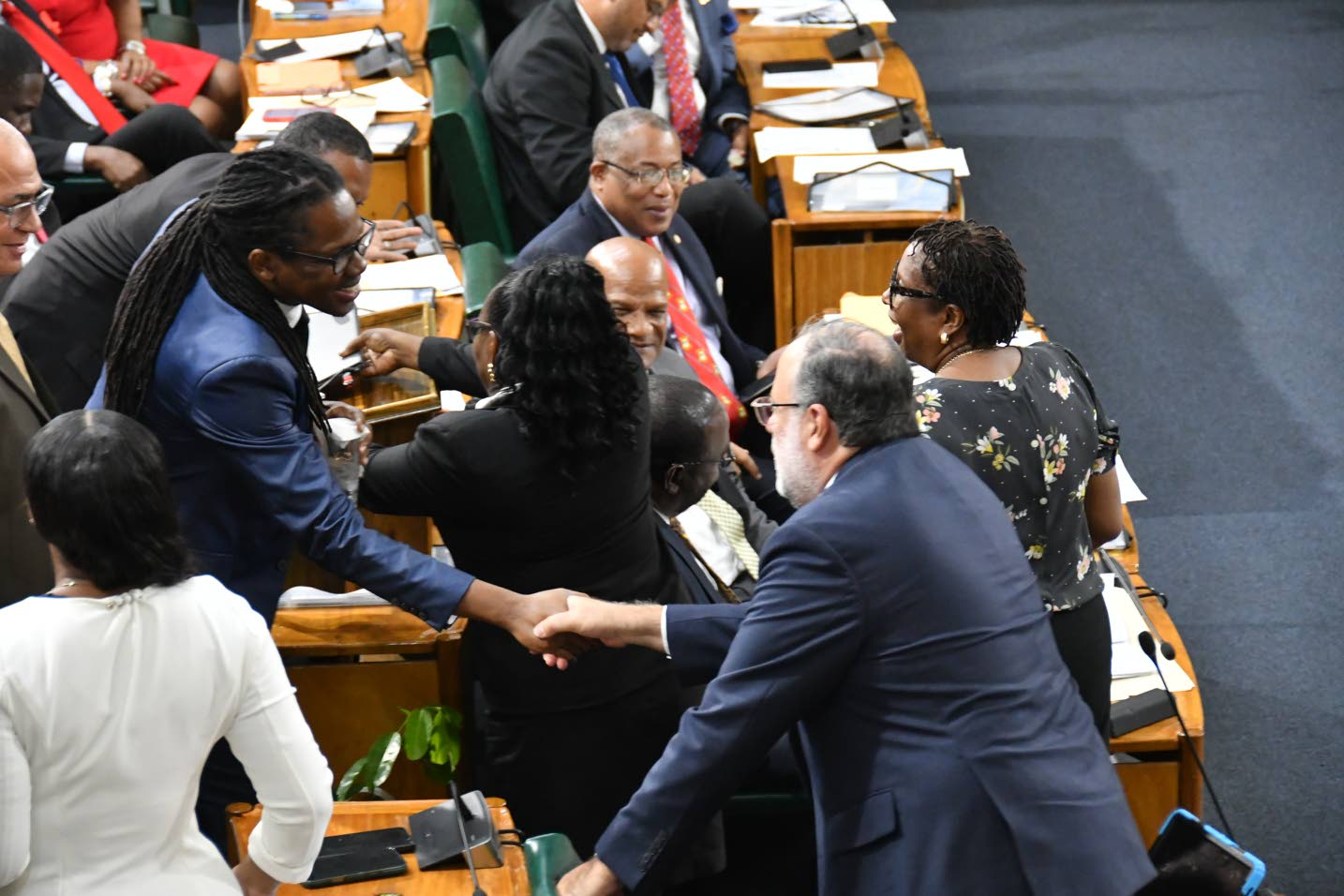
Opposition spokesman on education Damion Crawford greets Opposition Leader Mark Golding in the House on Tuesday. (Photo: Garfield Robinson)


