GROCERIES, GAS TO COST MORE
Major manufacturers move to raise prices from May 1 as Government lifts cap on weekly fuel price movements
Key points:
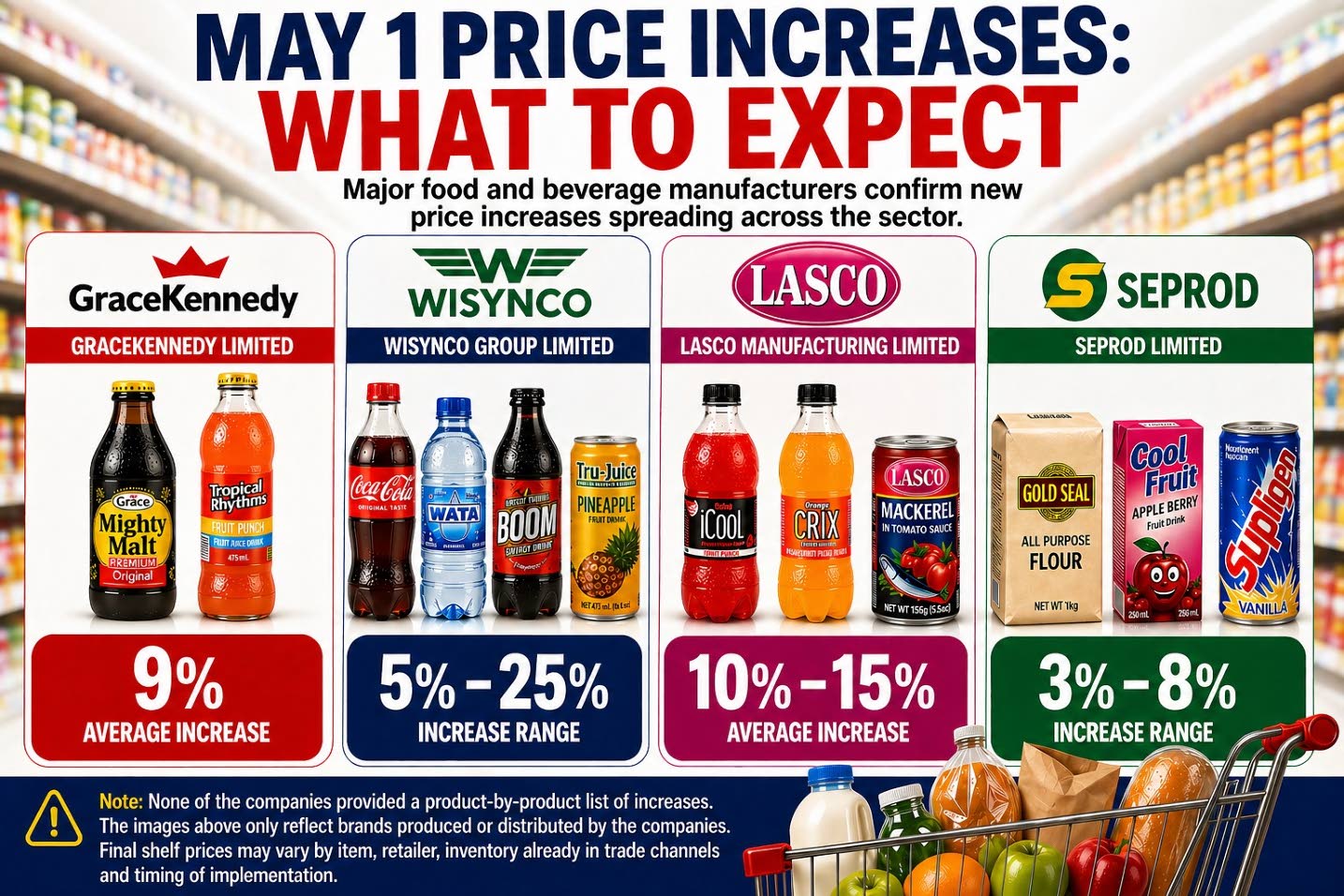
Wisynco Group Limited, Lasco Manufacturing Limited and Seprod Limited are preparing price increases from May 1, adding to hikes already announced by GraceKennedy Limited.
Companies say the increases are being driven by the sugar tax, higher environmental levy, rising fuel costs and imported inflation linked to geopolitical tensions.
Households could face a double squeeze as grocery prices rise while the Government removes the current $4.50 cap on weekly fuel price movements, increasing exposure to higher pump prices.
Jamaican households will face another hit to their wallets from May 1, after three of the country’s largest food and beverage manufacturers confirmed on Tuesday that they will join the latest round of price increases spreading across the sector.
Wisynco Group Limited, Lasco Manufacturing Limited and Seprod Limited told the Jamaica Observer that adjustments are now being finalised, adding to increases already announced by GraceKennedy Limited and reinforcing concerns that consumers are entering another period of rising living costs.
The developments come as motorists face the prospect of higher pump prices after the Government said it will remove the current $4.50 cap on weekly fuel price movements, exposing consumers more directly to swings in international oil markets.
With transportation and supermarket prices both under pressure, the May 1 increases are shaping up to be a fresh inflation test for families already stretching pay packets across rent, school expenses and groceries.
What makes the latest round especially significant is the reach of the companies involved. Among them, the four manufacturers produce or distribute brands found in kitchens, lunchboxes, corner shops and vending fridges across Jamaica every day. Their portfolios include powdered drinks, bottled water, juices, soft drinks, oats, flour, canned fish, canned meats, biscuits, snacks, condiments and ready-to-drink beverages.
At Wisynco, executive chairman William Mahfood said the company’s increases will span multiple categories, driven by fuel-related inflation, the sugar tax and the higher environmental levy.
“There’s a broad price increase coming,” Mahfood said, adding that some products would rise modestly while others, particularly high-sugar, lower-priced beverages, could move sharply. He said certain items could see increases as high as 20 to 25 per cent, while products such as bottled water would be closer to the lower end of the range.
Wisynco’s portfolio includes Coca-Cola, Boom energy drink, Wata, Tru-Juice and CranWata.
Using current advertised prices on the Loshusan Supermarket website as an illustration, a 20 oz Coca-Cola priced at $129.84 would move to about $149.32 if increased by 15 per cent, or roughly $162.30 at the top end of a 25 per cent adjustment. A 600 ml Boom energy drink now selling for $139.67 would rise to approximately $160.62 at 15 per cent, or $174.59 at 25 per cent.
At Lasco, Managing Director James Rawle said some of the company’s products will also be adjusted from May 1, particularly products affected by the special consumption tax on sweetened beverages.
He said the company had absorbed increases in raw materials and other costs since late last year, but had now reached the point where some of those expenses would have to be passed on.
“There’s increase coming from the environmental levy, there’s increase coming from petroleum prices, then there is also on the sugary drink [tax], the deposit refund scheme and the special consumption tax. So it all adds up,” Rawle said.
He placed the average increase across impacted lines in the region of 10 to 15 per cent.
Lasco’s brands go well beyond beverages. The company produces Lasco Food Drink, oats, cereals, soups, mixes, pharmaceuticals and household staples. Its canned mackerel, for example, is a common quick breakfast or dinner option in many homes, while Lasco food drink remains a regular beverage choice for both children and adults.
Seprod is also preparing adjustments. Chief Executive Officer Richard Pandohie said the company has to account for higher Government taxation, including the sugar tax and environmental levy, alongside costs linked to geopolitical tensions and imported inputs.
“These include sugar tax and environmental levy. Compounding this is the impact of cost driven by geopolitical issues. Difficult days ahead as I have been warning the nation about,” Pandohie said.
Depending on sugar content, packaging costs and inventory already on hand, Seprod’s increases are expected to range between three and eight per cent.
That matters because Seprod’s footprint extends into some of the most basic items in the Jamaican pantry. Through brands such as Gold Seal, the group is linked to flour, edible oils, snack products, biscuits and other grocery lines, while also distributing a wide range of imported and local consumer goods.
The environmental levy, unlike the sugar tax, is not tied to sugar content. It is a broader charge applied on certain imported goods and materials, intended to support waste management and environmental programmes. Businesses say the levy affects packaging and imported inputs, spreading costs across multiple categories.
None of the companies gave a product-by-product list of increases, meaning the final effect will vary by item, retailer and timing.
The Government has said the revised sugar tax and higher environmental levy form part of the revenue package to help finance reconstruction and recovery efforts following Hurricane Melissa. Under the approved measures, the new special consumption tax on sweetened beverages will take effect on May 1 at 22 cents per gram of added sugar, replacing the earlier volume-based proposal, while the environmental protection levy will also increase from the same date.
Mahfood says Wisynco’s broad-based price increases, driven by higher taxes, fuel costs and input pressures, could see some products rise by as much as 20 to 25 per cent from May 1.
![RAWLE...There’s increase coming from the environmental levy, there’s increase coming from petroleum prices, then there is also on the sugary drink [tax].](/jamaicaobserver/news/wp-content/uploads/sites/4/2026/04/image_1-538.jpg)
RAWLE…There’s increase coming from the environmental levy, there’s increase coming from petroleum prices, then there is also on the sugary drink [tax].