Rising fees squeeze Carib Cement profit
...record sales fail to lift earnings as royalty payments and import costs climb
CARIBBEAN Cement booked record sales in 2025 but a higher royalty rate paid to parent company Cemex pushed royalty and service fees up more than 50 per cent, even as production volumes slipped.
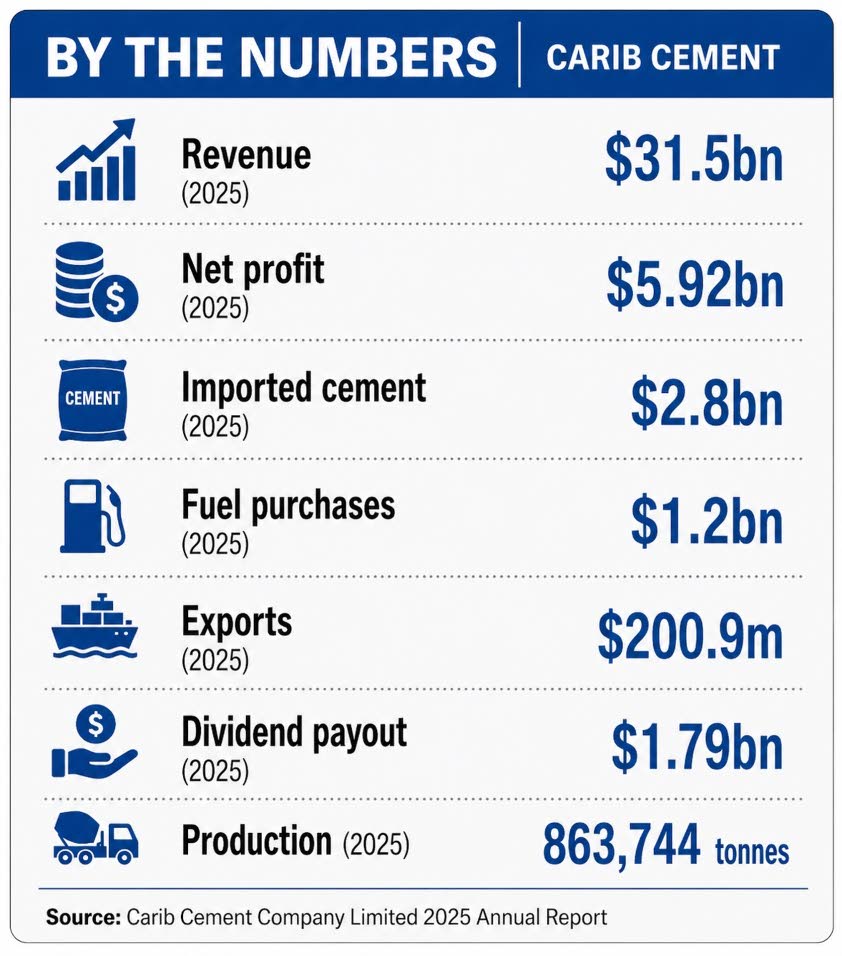
The Rockfort-based manufacturer generated $31.5 billion in revenue last year, up 13 per cent from 2024, yet net income remained little changed at $5.92 billion.
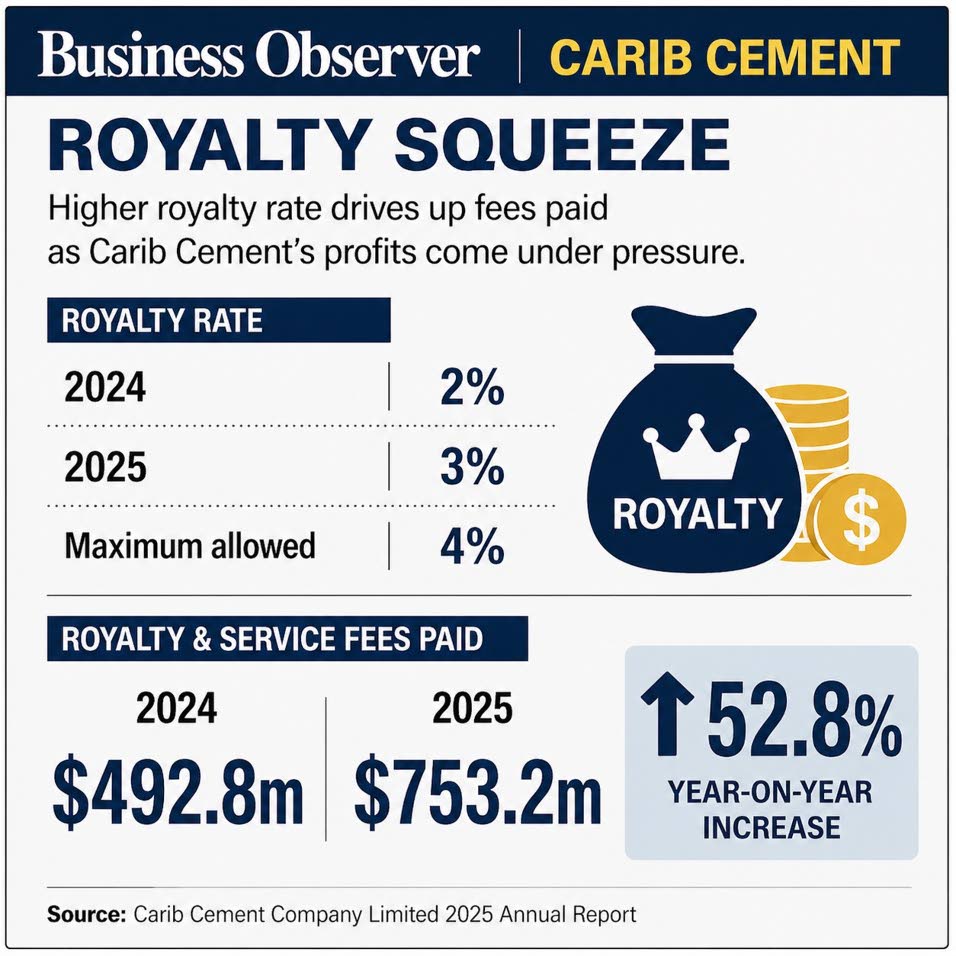
Royalty and service fees to Cemex and its affiliates climbed to $753.2 million from $492.8 million a year earlier, after the contractual royalty rate increased to three per cent from two per cent of consolidated net sales.
The higher rate took effect on January 1, 2025, under a framework approved by shareholders in December 2021. The agreement allows the royalty to rise as high as four per cent.
The nearly $260-million increase in royalty payments was one of the fastest-growing expense lines for the company, adding pressure to costs already inflated by fuel, maintenance and logistics.
Cemex, the Mexican building materials giant, controls Caribbean Cement through its indirect majority stake in Trinidad Cement Limited, which together with affiliates owns more than 74 per cent of the Jamaican company. Unlike dividends, the royalty payments are made regardless of profit, effectively reducing earnings available to minority shareholders.
Behind the higher revenue, production continued to fall. Cement output declined to 863,744 tonnes in 2025 from 870,649 tonnes a year earlier and 962,550 tonnes in 2023. Caribbean Cement said a planned kiln shutdown in the first half of the year to facilitate its $6.7-billion de-bottlenecking and modernisation project affected production. The project installed a new main baghouse and upgraded process ducts and stack sections, increasing clinker production capacity to 2,850 tonnes per day from 2,650 tonnes.
Despite the lower output, the company leaned on pricing to drive revenue higher. Caribbean Cement said it implemented a measured pricing strategy aligned with market conditions, helping offset inflation and higher operating costs. Total cement volumes sold rose 6.9 per cent year on year, suggesting the company drew down inventory to meet demand.
The upgraded plant is also expected to support exports. In September, Caribbean Cement shipped 3,000 tonnes of cement to Curaçao, one of its first significant export shipments in years, and signalled that regional exports would become more regular.
Chairman Parris Lyew-Ayee said the investment had “significantly expanded production capability”, allowing the company to meet local demand and “seriously embark on exporting cement in the region”.
It also remained reliant on imports. Caribbean Cement purchased cement from related parties for $2.8 billion in 2025, along with $1.2 billion in fuel and $430 million in additives, much of it sourced through Cemex’s global trading network. Freight charges and technical service fees added further foreign currency outflows.
Looking ahead, management said domestic demand should remain resilient in 2026, supported by hurricane recovery work, infrastructure investment, and housing construction. But the company warned that higher energy prices linked to the US-Iran conflict, and ongoing supply chain pressures from the Russo-Ukrainian war, could increase input and transportation costs.
The royalty rate, meanwhile, still has room to rise. Under the 2021 shareholder-approved agreement, Cemex can charge up to four per cent of consolidated net sales.