



It’s a pattern…
The resistance women face in positions of authority rarely arrives as something so honest as open opposition. It comes, instead, through a sustained pattern — questioning capacity, manufacturing controversy, demanding standards of conduct that male predecessors were never held to, and treating the authority of an office as somehow provisional when a woman occupies it. It is a pattern that repeats with enough consistency that calling it coincidence requires a deliberate act of looking away.
I am not looking away. And I think it is time more of us stopped.
The People’s National Party’s (PNP) argument against House Speaker Juliet Holness, as stated by Leader of Opposition Business Phillip Paulwell and repeated across walkouts and press releases since September, is one of constitutional principles. The Speaker lacks impartiality, they say. Her presence on parliamentary committees compromises the independence of the chair. It is a serious-sounding argument, and it has received serious-sounding treatment. But arguments do not exist in a vacuum. They exist inside histories. And the PNP’s history with accomplished women in authority is a history that does not survive scrutiny.
Begin with Portia Simpson Miller. Jamaica’s first and only female prime minister. A woman who gave nearly five decades to public life; led the PNP to a historic 42-seat majority in 2011; and campaigned on the simple, radical proposition that it was “woman time now”. Throughout her leadership, she faced a persistent line of attack from within her own political world; that she lacked the intellectual capacity to represent Jamaica on the global stage. It wasn’t that her policies were misguided. Not that her record was poor. That she, specifically, was not enough. The party that now lectures us about the dignity of the chair allowed that narrative to take root around their own prime minister and never once moved to stop it.
Then there is Lisa Hanna — four-term Member of Parliament, former Cabinet minister, a woman who came within 296 votes of leading the PNP in 2020. To this day many Jamaicans believe she would have been the stronger leader, and the evidence is not hard to find. Her charisma, her connection to ordinary people, her profile on the national and international stage were undeniable. But, after losing that leadership race, she was not integrated as the political force she clearly represented. By 2022 she announced she would not contest another election. Jamaica will simply never know what a Lisa Hanna leadership would have looked like, because she has all but disappeared from political life, a casualty of the very infighting and internal hostility the PNP has never been willing to name.
Kamina Johnson Smith’s case is the most instructive, because the PNP’s conduct there was not passive. When Johnson Smith ran for Commonwealth secretary general in 2022, the official Opposition of her own country refused to support her. The bid was called ill-advised. Financial disclosures were demanded in a manner calibrated to embarrass rather than inform. A three-vote loss in a secret ballot among 54 Commonwealth nations was framed as governmental incompetence. The PNP invoked Caricom unity as the reason Jamaica should not have challenged the incumbent. That principle materialised precisely when a JLP woman was on the line and dissolved when it was no longer convenient.
And if there is any doubt that gender is operating here as much as politics, consider who sits at the front of the campaign against Speaker Holness. Damion Crawford told Ann-Marie Vaz publicly that the furthest she would go was being Mrs Vaz. He was recorded in a leaked voice note spending considerable time belittling Lisa Hanna. He dismissed Angela Brown Burke in terms that her own colleague described as chauvinistic. These are not isolated moments. They are a documented disposition towards women in authority, and Crawford’s party has never once asked him to account for it.
Then there is Isat Buchanan who, while serving as chairman of the PNP’s own Human Rights Commission, made explicit comments about Jamaica’s first female director of public prosecutions, Paula Llewellyn, on a public
YouTube programme. He was suspended by the General Legal Council. Buchanan resigned quietly from the commission but now sits as a PNP Member of Parliament. That is not a party that takes the dignity of women in authority seriously. That is a party that weighs it against convenience and moves on.
Now look at the Speaker’s actual record in the chair. She has enforced time limits. She has ruled on points of order. When she cut off the leader of the Opposition during the recent debate on the National Reconstruction and Resilience Authority (NaRRA) Act she reversed the decision within minutes and granted him additional time. That reversal went unremarked. What was amplified was the original ruling, described by Paulwell as disgraceful and consistent with a growing practice of suppression.
For decades male Speakers chaired the same committees and ruled on the same points of order without their independence being framed as a constitutional crisis. Not one of them faced a removal campaign before the Parliament had sat for a single day. The standard being applied to Speaker Holness is not the parliamentary standard. It is a different standard, built specifically for her.
What makes this especially hard to take seriously is the Opposition’s own conduct inside the same House. Its representatives walked out in October over a ruling that was procedurally correct. They disrupted proceedings in April over time limits applied consistently to both sides. A member of its caucus grabbed the ceremonial mace, refused a direct order to leave, and her colleagues surrounded her in gospel solidarity.
The PNP has produced no evidence of a specific breach of standing orders by the Speaker. What they have produced is an atmosphere of suspicion, sustained and amplified until it acquires the weight of fact. That is not accountability. That is a campaign.
Every walkout, every disruption, every manufactured controversy costs this country time, money, and attention that could be spent on the business of governing. Jamaicans are paying for a Parliament. They deserve one that is actually working. The next time the PNP takes to a microphone to question the integrity of the Speaker, ask yourself what Bill was not debated that day, what committee did not sit, what policy affecting real people was delayed while the Opposition performed outrage for the cameras. Then ask yourself who that actually serves. It is not the Jamaican people. It never was.
Gabrielle Hylton
Gabrielle Hylton is a Jamaican political commentator. Send comments to the Jamaica Observer or gjhylton@gmail.com.
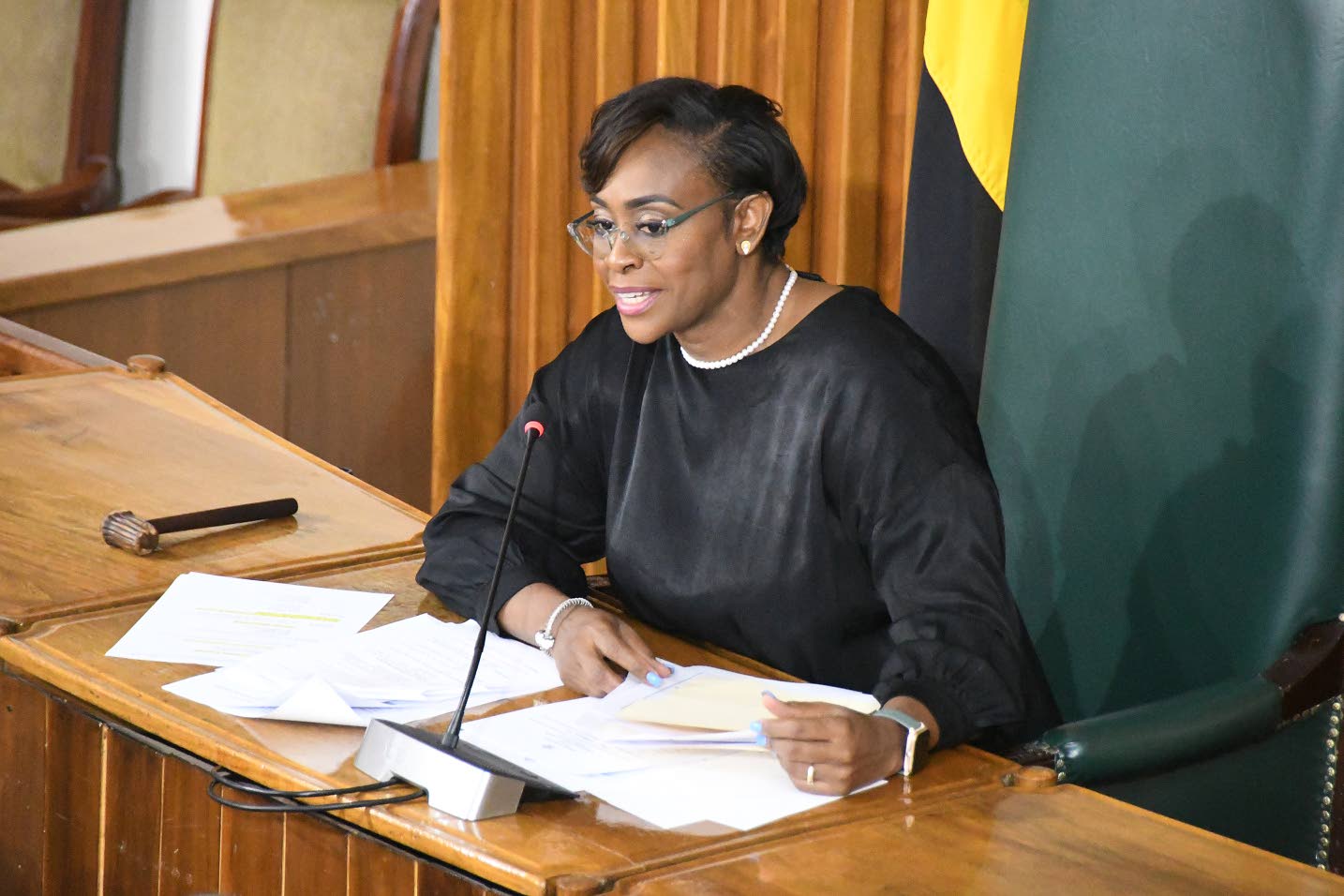
Juliet Holnessa


